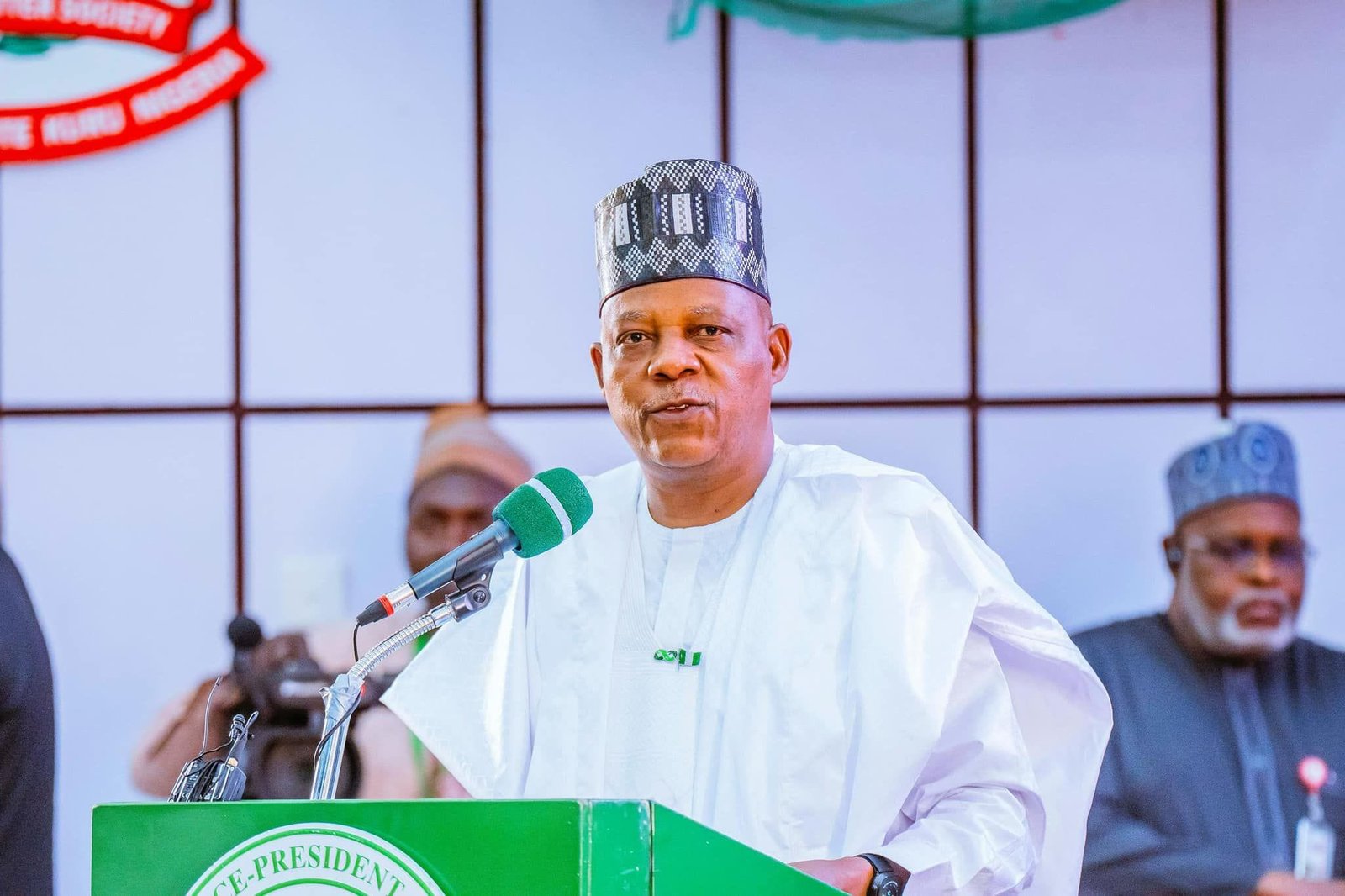

Vice President Kashim Shettima has drawn national attention to the alarming effects of malnutrition on children in Nigeria, revealing that nearly 40% of children under the age of five are deprived of their physical and cognitive potential due to poor nutrition.
Speaking through Senator Ibrahim Hadejia, Deputy Chief of Staff to the President (Office of the Vice President), at the National Summit on Nutrition and Food Security in Abuja, Shettima described the crisis as a silent emergency with long-term implications for Nigeria’s future.
The summit, organized by the House of Representatives Committee on Nutrition and Food Security, was part of the House’s Open Week activities.
The Vice President emphasized that the administration of President Bola Ahmed Tinubu is tackling the crisis with renewed urgency through initiatives like the Nutrition 774 Program a grassroots-focused approach designed to confront nutrition challenges in all 774 local government areas, especially underserved communities.
He explained that under the Renewed Hope Agenda, nutrition has been elevated from a humanitarian concern to a national development priority.
Shettima called for robust legislative action, stronger budgetary allocations, and policy frameworks that recognize nutrition as an issue of social justice and equity.
“Nutrition should no longer be treated as charity. It must be seen as a matter of national justice a right every Nigerian child must enjoy,” he said.
In his remarks, Speaker of the House of Representatives, Hon. Abbas Tajudeen, represented by Hon. Julius Ihonvbere, warned that the cost of inaction is staggering.
He disclosed that malnutrition is costing Nigeria an estimated $56 billion annually, equivalent to about 12.2% of the country’s Gross National Income (GNI). He added that post-harvest losses further drain the economy by an additional $2 billion.
Ihonvbere also pointed to systemic challenges in the food value chain, particularly multiple levies on food transportation that inflate prices and deepen food insecurity.
He emphasized the need for legislative reforms that protect the movement of food commodities and reduce waste.
Chairman of the House Committee on Nutrition and Food Security, Hon. Chike Okafor, highlighted insecurity as a major barrier to food production, especially in the Northeast, Northwest, and North Central regions.
According to him, ongoing violence and displacement prevent farmers from accessing their land, which contributes directly to food scarcity.
“The government must prioritize the security of our food-producing regions if we are serious about ending hunger and building a resilient food system,” he stated.
Uju Anwukah, Senior Special Assistant to the President on Public Health, called for a unified national strategy to tackle malnutrition, stressing the importance of harmonizing policies, resources, and stakeholder efforts for maximum impact.
Speaking on behalf of development partners, Micheal Ojo, Country Director of the Global Alliance for Improved Nutrition (GAIN), noted that while federal policies are critical, real progress must be driven by state and local governments, where food production and processing take place.
He emphasized the need for collaborative implementation, urging all tiers of government, civil society, and international development organizations to come together to deliver sustainable, community-led solutions.
The summit concluded with a call to action for all stakeholders to make nutrition a national development goal, not just a health target, ensuring that every Nigerian, especially children has the chance to grow, learn, and thrive.