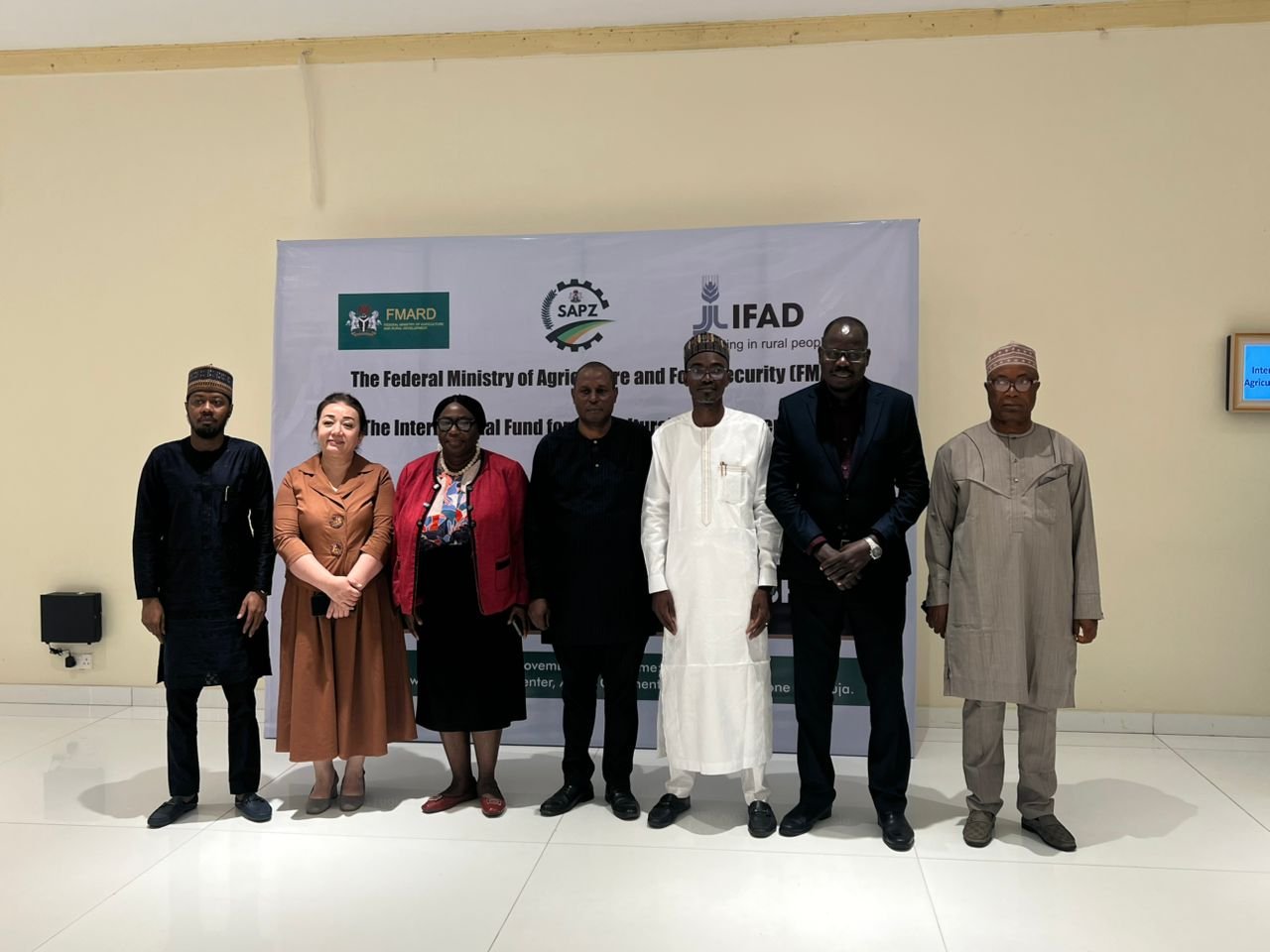

The Federal Government of Nigeria, in partnership with the International Fund for Agricultural Development (IFAD), has launched the Second Joint Supervision Mission of the Special Agro-Industrial Processing Zones (SAPZ) Project to enhance programme performance, identify implementation challenges, and strengthen accountability for accelerated results across participating states.
Speaking during the inception workshop in Abuja, Director, Department of Development Partners Projects (DDPP), Federal Ministry of Agriculture and Food Security, Mrs. Iluromi Adebola, described the SAPZ as a flagship agricultural industrialization programme designed to reposition Nigeria from a raw commodity producer to a competitive processor for both domestic and export markets.
She explained that Nigeria’s agricultural system has historically been limited by inadequate processing capacities and weak market linkages—challenges the SAPZ model is strategically designed to tackle.
“The SAPZ model connects producers to processors, logistics, storage, and market systems. This is why it is a cornerstone of the agricultural industrialization agenda of the Federal Government,” she said.
Represented by Dr. Ahmed Abubakar, Adebola said the supervision mission offers a critical opportunity to honestly assess achievements, review emerging bottlenecks, and define a coordinated path to accelerate performance across participating states.
She emphasized that farming communities are eagerly awaiting fully functional agro-industrial zones that will add value to their produce while significantly reducing post-harvest losses across commodity value chains.
“The Department of Development Partners Projects remains fully committed to providing the oversight, technical backstopping, and inter-governmental coordination required to deliver this project successfully,” she assured, urging stakeholders to approach the mission with renewed urgency and responsibility.
In her High-Level Opening Speech, IFAD Country Director for Nigeria, Mrs. Dede Ekoue, reaffirmed IFAD’s commitment to supporting Nigeria’s agricultural transformation agenda, noting that the SAPZ programme represents a strategic convergence between national priorities and international development partnerships.
She described SAPZ as a flagship initiative designed to structurally transform food systems through agro-industrialization, enterprise development, youth employment, and inclusive rural prosperity.
Presenting progress updates, Ekoue revealed that the programme has recorded significant milestones, transitioning from planning to concrete delivery, with the profiling of 41,204 smallholder farmers and value chain actors — including 7,398 from the 2024 Kano pilot and 33,806 from the 2025 profiling in Ogun and Kano States.
She emphasized that profiling is crucial for accurate targeting, resource planning, and transparency in beneficiary support.
“In Ogun State, women account for 50% of profiled actors, while youth represent nearly a quarter in Kano—an encouraging indication of SAPZ’s growing relevance to young agripreneurs,” she noted.
According to her, 14,655 of the 33,806 actors profiled in 2025 have already benefited from training, input support, and access to digital services including Climate Information Services (CIS). Cumulatively, 15,664 individuals—representing 15.8% of the 100,000 Life-of-Project target—have been reached since inception.
Ekoue also highlighted the success of IFAD’s 4P (Public–Private–Producer Partnership) model under SAPZ, noting that the programme has established the Multistakeholder Agribusiness Forum (MAF) and signed 24 Memoranda of Understanding linking smallholders in cassava, rice, tomato, and groundnut value chains to guaranteed offtakers and processors.
“The SAPZ programme is not merely supporting farmers, but building rural economies, unlocking agribusiness opportunities for youth, advancing food security, and strengthening resilience in the face of global challenges,” she said.
She noted that approximately 16,000 smallholders and agripreneurs have benefited from digital climate information services, while digital extension tools are being finalized for deployment.
Ekoue commended the Federal Government and the Federal Ministry of Agriculture and Food Security for their leadership in driving agricultural industrialization under the SAPZ programme, reaffirming IFAD’s alignment with the Renewed Hope Agenda.
In his remarks, National Programme Coordinator, SAPZ, Dr. Kabir Yusuf, expressed appreciation for the growing collaboration between stakeholders and reaffirmed the government’s strong commitment to achieving impactful results.
He emphasized that the SAPZ programme aligns with President Bola Ahmed Tinubu’s Renewed Hope Agenda, describing it as a top priority for national food security and economic transformation.
“The objective is not just to boost production, but to domesticate the processing of whatever is produced locally in Nigeria. What we have been seeking and yearning for is to diversify Nigeria’s economy,” he stated.
Dr. Yusuf explained that Nigeria loses valuable foreign exchange by exporting raw commodities for processing abroad, stressing that strengthening domestic processing will reduce capital flight, attract investment, and improve livelihoods.
He cited the 2024 pilot involving 1,000 farmers as evidence of the programme’s potential impact when implementation is properly coordinated.
Yusuf disclosed that SAPZ has conducted three supervision missions, multiple financial management workshops, and major assessments such as the ISP and ALTB, with three consolidated financial reports produced across eight participating states.
He appealed for increased support from IFAD, noting that despite successful progress in Kano and other states, IFAD currently supports only two states.
“Nigeria can achieve greater results if we deploy our processing zones fully, drawing from successful models in Ethiopia, Georgia, and Russia,” he added.
He stressed the need for innovation, stronger technical partnerships, modern thinking, and a fast-tracked implementation approach that can deliver meaningful transformation at scale.
“Meaningful progress will depend on stronger support, deeper collaboration with partners, and a full-scale implementation strategy—not partial or artificial approaches,” he cautioned.