

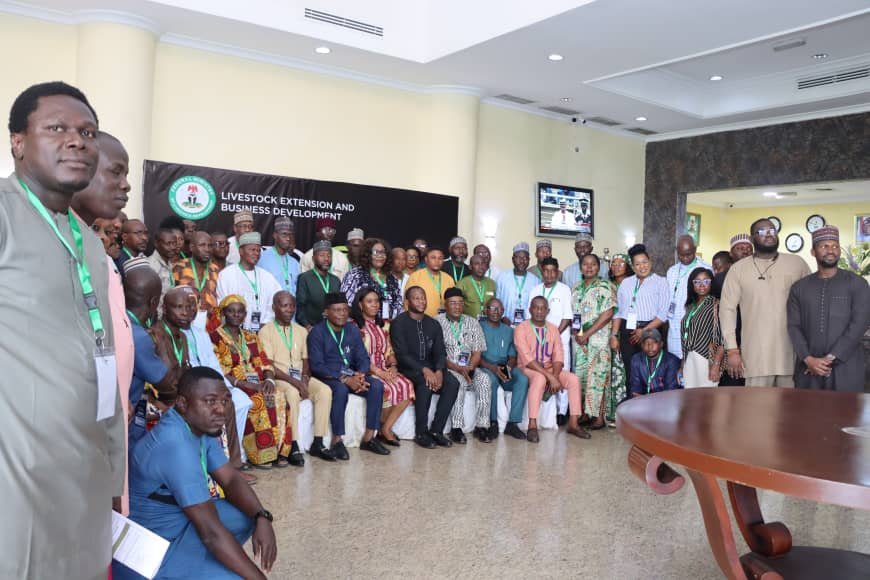
The Federal Government has taken a major step toward ending decades of fragmented livestock statistics by launching a two-day intensive training for the first cohort of Livestock Data Collection Officers drawn from the 36 states and the FCT.
The programme is designed to strengthen Nigeria’s data architecture and standardise livestock reporting across all value chains.
The workshop, which began on Thursday, marks a key milestone in the Federal Ministry of Livestock Development’s rollout of its Monitoring and Evaluation (M&E) Framework, an initiative intended to shift the livestock sector from broad policy concepts to full-scale operational implementation.
Speaking on behalf of the Permanent Secretary, Dr. Chinyere Ijeoma Akujobi, the Director of Livestock Extension Services, Mr. Joseph Ako, told participants that their role signals a renewed national commitment to making accurate, verifiable data the foundation of policy development and sector-wide transformation.
He explained that the sector has, for years, relied on outdated projections, assumptions, and inconsistent figures, which hinder government and investors from properly addressing production gaps, disease surveillance, market trends, and resource planning.
“In an era of evidence-based decision-making, data is our most essential resource,” Mr. Ako said. “The success of the National Livestock Growth Acceleration Strategy (NL-GAS) and our transition to efficient, commercially viable livestock systems will be determined by the quality of data we generate.”
The Permanent Secretary further noted that the officers form the pioneer batch under a training-of-trainers model and will be responsible for cascading modern data skills to state and local government levels, ensuring uniform capacity across the national livestock system.
Earlier in his welcome address, Mr. Ako highlighted the severity of past data challenges, referencing the absence of updated national livestock population figures since the 1992 National Livestock Census. He said this long-standing information gap underscores the urgency of adopting harmonised, technology-enabled data collection methods and building a credible national database.
The training will equip participants with standardised tools and templates, align them under a unified Data Governance Framework, enhance data quality, and prepare the sector for the introduction of digital dashboards and real-time decision-making systems. Participants will also contribute to the co-design of national data collection protocols to strengthen reporting efficiency across all livestock value chains.

1 comment
I’m very interested