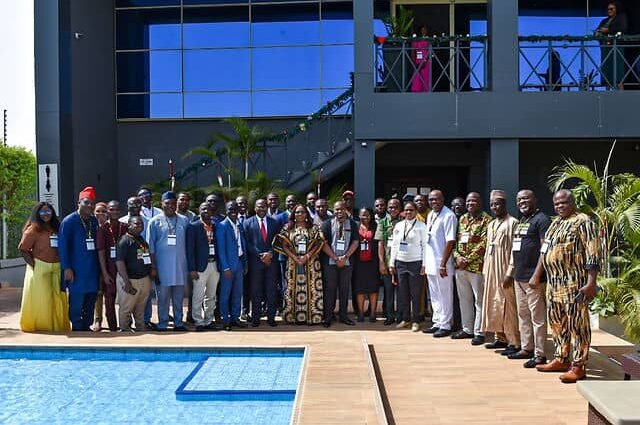

The University of Nigeria, Nsukka (UNN) has urged government and relevant stakeholders to support its Smart Alternate Irrigation and Drying (SAID) Project, aimed at enhancing digital rice production.
The vice chancellor of UNN, Simon Ortuanya, made the call on Monday, at a two-day workshop of the AgriDI-UNN Digital Innovation project, in Abuja.
The event was organised by AGROTECH Research Group of the UNN, in collaboration with Accelerating Inclusive Green Growth through Agri-based Digital Innovation in West Africa (AGriDI) of the Tropical Insect Institute (icipe).
It is with the theme “From Pilot to Policy: `Scaling Smart Alternate Irrigation for Climate-Resilient Food Systems.”
Mr Ortuanya said that the closing of the project marked a transition from pilot implementation to wider expansion of smart agriculture initiatives.
According to him, though it is a closing-out ceremony, we want it to be a closing-up process, with Agri-DI returning stronger and expanding beyond Nigeria, to other African universities.
“Though this marks the closeout of the pilot phase, we are optimistic that the technology developed will be further expanded not only across Nigeria, but throughout Africa, where it holds potential to significantly improve agricultural productivity and climate resilience,” he said.
He said that farmers involved in the pilot across Enugu and Ebonyi States had acquired dry-season irrigation and smart farming skills capable of improving rice yields in spite of the challenges of climate change.
“These innovations will enable farmers to sustain rice production even during the dry season and expand their activities using proceeds from improved yields,” he said.
The vice chancellor commended the federal government and the European Union for supporting the project and called for increased participation for its sustenance.
“Without scaling up, you cannot sustain, so we urge our partners and supporters to invest further in expanding this project,” he said.
On his part, the team leader of the project, Anthonia Achike, said that the university had developed a digital application to support dry-season rice farming after 15 months of research and field testing.
Ms Achike, from UNN Department of Agriculture Economics, said that the application had been tested and proven efficient for dry-season rice farming.
“The app has been tested and proven effective; what we need now is buy-in from government and international organisations to upscale the pilot results,” she said.
Also speaking, Chinedum Nwajiuba, chairman of the governing board of the West African Science Service Centre on Climate Change and Adapted Land Use (WASCAL), commended UNN for integrating digital technology into agriculture to address food insecurity.
“Those who farm only the way their forefathers farmed cannot feed today’s population; technology must transform agriculture.
“Insecurity remains a major constraint to agricultural productivity, so I am calling on everyone to join hands to fight insecurity.
“I am also calling on the government and other relevant stakeholders to address the challenges alongside technological innovation,’’ he said.
The SAID project is one of the third-party projects which piloted the technology in Ebonyi and Enugu states, with over 300 rice farmers.