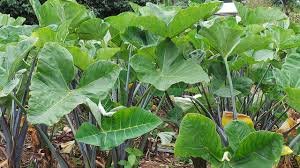

Cocoyam is a vital starchy root and vegetable crop sustaining about 400 million people worldwide, especially in Africa, Asia, and the Pacific Islands. Grown for its edible corm (underground stem) and nutrient-packed leaves, it ranks third among African root crops after cassava and yam.
The crop includes two main genera in the Araceae family:
- Colocasia esculenta (Taro or “old cocoyam”): Originated in Southeast Asia; thrives in wet, swampy soils with a large central corm.
- Xanthosoma sagittifolium (Tannia or “new cocoyam”): From tropical America, introduced to West Africa in the 19th century; prefers drier soils and dominates as an edible aroid there.
A key “hunger-season” staple when yams are scarce, cocoyam sees Africa producing over 70% of the global supply—Nigeria leads the world. Nutritionally superior to yam and cassava, it boasts up to 11% protein (dry weight) in tubers with high digestibility.
Versatile in the kitchen, corms are boiled, roasted, fried into chips, or pounded. They star in dishes like bitterleaf soup, oha soup, and ebiripo. Leaves, with up to 23% protein, feature in delicacies such as ekpang nkukwo. Health perks include small, digestible starch granules (1.5–6.6 micrometers) ideal for weaning foods and gut issues, plus fiber and micronutrients like potassium, magnesium, and vitamin B6 for blood pressure, heart health, and blood sugar control. Traditionally, it’s used for digestion, wounds, and inflammation—but raw cocoyam itches due to calcium oxalate crystals, so always cook it thoroughly.
Economically, it bolsters food security and income for smallholder farmers.
Requirements for Cocoyam Production
Climate
Cocoyam loves tropical humidity, needing 1,500–3,000 mm of well-distributed annual rainfall (minimum 1,000 mm). Drought stress yields small, poor-quality corms; it tolerates waterlogging like rice paddies. Optimal temperatures: 20–30°C (above 21°C ideal; frost kills it). It suits low- to medium altitudes (up to 1,500 m) and 75–80% humidity, often under partial shade from bananas or coconuts.
Soil
Deep, fertile sandy loams rich in organic matter work best—loose for root growth. Adaptable to various types but shuns heavy clays or pure sands. pH: 5.5–6.5 (tolerates 4.2–7.5). Needs drainage to avoid rot; use raised beds (1 m × 1 m) in wet areas. Prep by clearing, tilling, ploughing, and harrowing into ridges for aeration and weed control.
Planting/Propagation
Use healthy corms, cormels, or suckers (2–4 oz pieces, dusted with lime/ash, dried). Plant 6–7 cm deep on ridge crests at onset of rains, spacing rows 0.9–1.3 m and plants 40–60 cm apart.
Nutrient Management
Blend organic manure (2.5–5 t/ha poultry or farmyard) with NPK (200–400 kg/ha, e.g., 15-15-15). Band 5–10 cm from setts; split applications for best uptake.
Weed Control
Weed manually at 3, 8, and 12 weeks post-planting. Pre-emergence herbicides like Diuron (3.2 kg ai/ha) or Sulfentrazone (600 g ai/ha) help early on.
Water Management
Needs >2,000 mm rain; irrigate if short, especially for establishment and tubers. Mulch with grass or residues to retain moisture, cool soil, and curb weeds.
Pest and Disease Management
Watch for root-knot nematodes, corm borers, Pythium rot, Phytophthora blight, and mosaic virus. Use clean planting material, rotate with cereals/legumes, sanitize fields, and apply bio-pesticides or fungicides as needed.
Harvesting
Ready in 9–12 months (yellowing/dying leaves signal maturity). Lift gently with hoes/forks for 25–37 t/ha yields under good management.
Post-Harvest Handling
Clean, sort, and store in cool, ventilated barns (curing cuts rot to 10–25%). Process into flour or fufu for longer shelf life and value.
Challenges and Prospects
Cocoyam faces hurdles like drought sensitivity, pests/diseases, poor storage, and limited processing—but its nutrition, adaptability, and market potential shine. Boosting research, varieties, and tech can enhance food security, diets, and farmer incomes in the tropics.