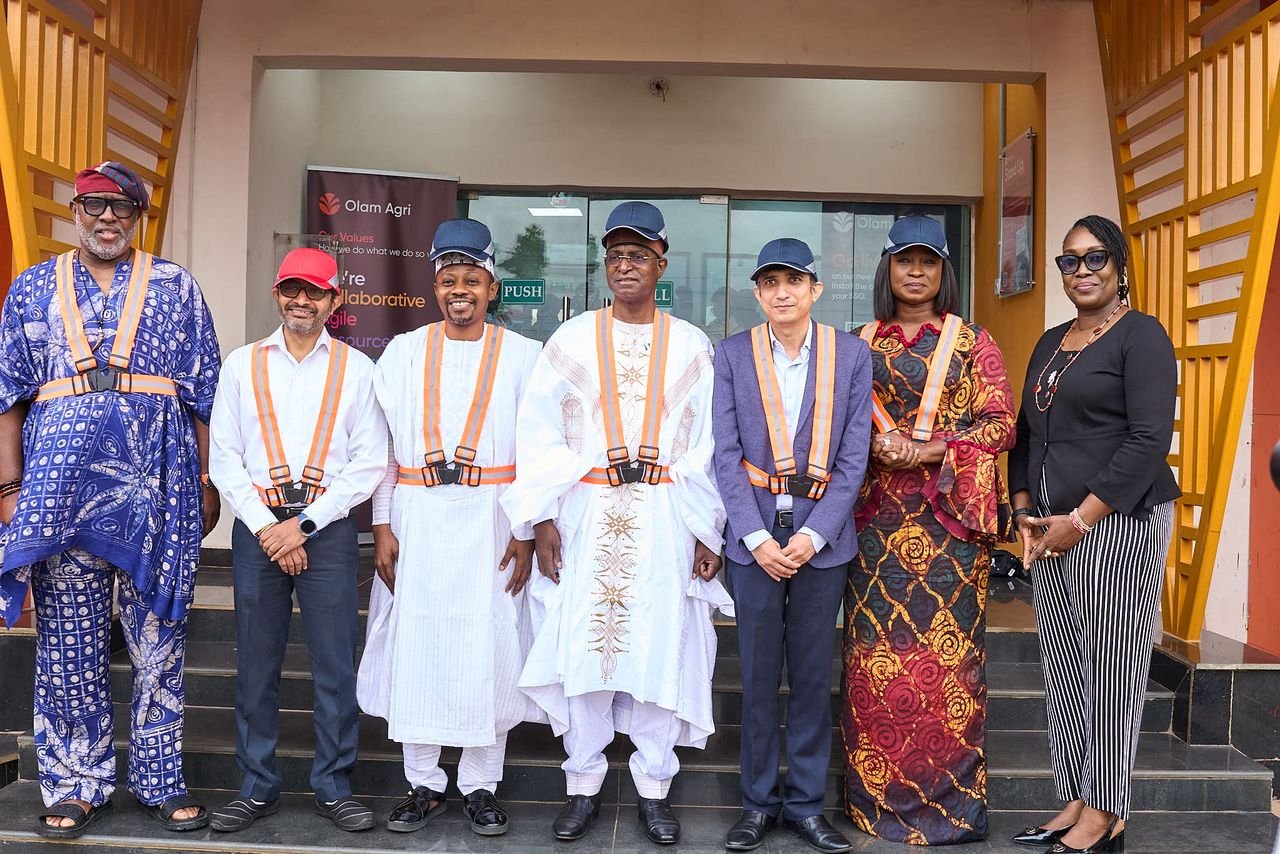

The Federal Government has reaffirmed its focus on feed security as a foundation for livestock sector stability following a working visit by the Honourable Minister of Livestock Development, Alhaji Idi Muktar Maiha, to Olam Agri’s Integrated Soy Crush and Feedmill Complex in Ilorin, Kwara State.
The Ilorin facility, developed by Olam Agri at an estimated cost of 50 million dollars, is structured to significantly expand Nigeria’s soybean processing capacity while supplying high quality feed to poultry and other livestock producers. Industry stakeholders view the visit as a practical signal of government interest in strengthening domestic inputs for animal agriculture.
The Minister was received by Amit Agarwal, Managing Director of Olam Agri’s Integrated Feeds and Protein business, who led him and members of his delegation on a tour of the crushing plant and feed production lines.
Also present were the Kwara State Commissioner for Livestock Development, Hon Oloruntoyosi Thomas, the Commissioner for Agriculture and Rural Development, Dr Hafeez Abolore Alabi, as well as senior directors and advisers from the Federal Ministry of Livestock Development.
Speaking during the visit, Minister Maiha underscored the strategic importance of feed to the overall performance of the livestock economy.
He described poultry as a critical component of the sector and noted that feed accounts for the largest share of production expenses across livestock systems.
According to him, any serious attempt to stabilise output and improve access to animal protein for Nigerians must prioritise feed availability.
He observed that expanding local soybean crushing capacity would reduce vulnerability to external supply disruptions while contributing to price moderation and more reliable access to soybean meal, which remains a key protein ingredient in feed formulation.
Agarwal explained that the Ilorin complex reflects the company’s long term investment outlook in Nigeria’s agricultural and livestock value chains.
He stated that integrating soybean procurement, crushing and feed manufacturing within a single location allows for greater operational efficiency and improved supply consistency for livestock farmers, including those in the poultry segment.
He added that the company continues to deepen collaboration with local farmers and commodity aggregators in order to expand domestic sourcing of raw materials and ensure that processing capacity is supported by local production.
In his remarks, Dr Ade Adefeko, Director of Corporate and Regulatory Affairs at Olam Agri, expanded on the implications of the Ilorin investment for poultry producers and the national food system.
Describing the project as a decisive response to price instability in feed markets, Adefeko said, “The Ilorin investment is a direct strike against feed cost volatility.” He pointed out that many poultry farmers currently face uncertainty tied to imported soybean meal and fluctuations in foreign exchange.
By processing soybeans locally in Kwara State, he explained, the company is helping to eliminate what he called the logistics and FX tax that inflates feed prices.
“We are converting local soybeans into high quality meal right here in Kwara State.
“This removes the logistics and FX tax that currently inflates feed prices. For the farmer, this means a predictable price floor and a consistent supply of protein rich feed, which is roughly 70 percent of their total production cost,” he said.
Adefeko also spoke about the sustainability framework underpinning the expanded crushing capacity.
He said the company is proactively building supply rather than relying solely on open market purchases. Through expanded outgrower programmes across the North Central and North West regions, farmers receive improved seed varieties that are high yielding and drought tolerant, alongside agronomic training to raise productivity.
He further disclosed that the company uses its AtSource platform to achieve full traceability across its soybean supply chain.
By offering farmers a guaranteed buy back price, he said, the programme provides planting incentives year after year, thereby creating what he described as a closed loop system.
According to him, this approach helps shield processing operations from raw material shortages while supporting Nigeria’s ambition of achieving food sovereignty.
Earlier, Hon Oloruntoyosi Thomas described the Ilorin complex as a strategic addition to Kwara State’s economic and agricultural landscape.
She noted that the presence of a major processing facility strengthens the state’s standing as a livestock production hub, opens new market channels for farmers and supports the wider ecosystem required for sustainable sectoral growth.
Dr Hafeez Abolore Alabi emphasised that increased processing capacity must be matched by deliberate efforts to raise soybean output.
He explained that the state’s agricultural strategy includes improving farmer organisation, boosting productivity and enhancing market linkages so processors can secure more of their raw materials within Nigeria.
Throughout the engagement, participants stressed the need for coordinated action along the entire value chain, from crop cultivation through feed manufacturing to livestock production.
Minister Maiha referenced the National Livestock Growth Acceleration Strategy as a framework that recognises the interdependence of these components.
He maintained that livestock development cannot be pursued in isolation and that feed production, crop farming, financing structures and infrastructure must function in alignment to deliver a competitive and stable livestock industry.