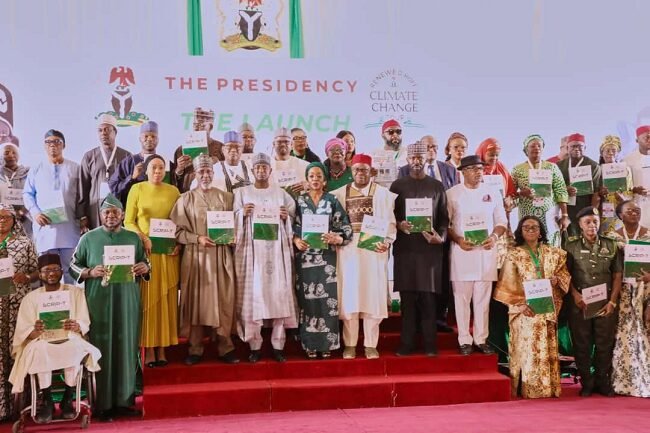

President Bola Tinubu has launched the Renewed Hope Climate Change Awareness Tour (REHCCAT), setting in motion a nationwide campaign designed to reposition Nigeria as a front-runner in climate resilience, green growth, and sustainable development.
Unveiled at the State House in Abuja, the initiative signals a strategic shift from climate dialogue to climate delivery, taking awareness beyond policy rooms into communities, markets, farms, and classrooms across the country.
Represented by the Minister of Environment, Balarabe Abbas Lawal, the President described the tour as more than a sequence of events, but a national movement anchored on innovation, investment, and opportunity.
He declared that climate change is no longer a distant threat but a lived reality, impacting farmers battling desert encroachment in the North, coastal communities confronting erosion in the South, businesses grappling with energy costs and supply chain disruptions, and young Nigerians whose future depends on decisions made today.
Positioning climate action as both an economic and security imperative, the President stressed that Nigeria must seize the global transition to low-carbon development as a moment of advantage. With capital shifting, markets evolving, and technology redefining industries, he noted that nations that act decisively today will dominate tomorrow’s economy.
Through REHCCAT, the Federal Government intends to deepen subnational engagement, identify bankable climate projects, unlock local solutions, and scale up Nigeria’s access to climate finance. The tour will engage governors, traditional institutions, entrepreneurs, financial institutions, students, and innovators—bridging the gap between commitments and implementation.
The President emphasised that Nigeria’s Nationally Determined Contributions are not ceremonial documents but binding commitments to cut emissions, strengthen resilience, and protect communities. However, he maintained that commitments must be matched with investment-driven action, particularly at the state and grassroots levels.
Earlier, Lawal underscored the urgency of consolidating climate governance at the subnational tier, noting that desertification, flooding, coastal erosion, and erratic rainfall patterns are already disrupting livelihoods nationwide. He referenced the Climate Change Act 2021 as a historic legal framework that institutionalised carbon budgeting and charted Nigeria’s path to net-zero emissions by 2060, while stressing that true impact requires state-level domestication and institutional reforms.
He disclosed that the Ministry has partnered with state governments to establish climate governance structures, appoint Subnational Directors of Climate Change, and create Climate Change Desks within Ministries, Departments, and Agencies to coordinate implementation.
Placing young Nigerians at the heart of the green transition, the Minister highlighted initiatives such as the Eco-School Programme, the Youth Climate Innovation Hub, and the Uni-Go-Green Initiative—platforms designed to equip youths with skills in renewable energy, sustainable agriculture, climate technology, circular economy solutions, and green entrepreneurship.
Delivering the keynote address, Professor Babajide Alo called for a decisive shift from top-down technocratic models to locally driven adaptation strategies. He urged governments to strengthen state-level capacity, expand climate education, empower local governments, and enhance community access to climate resources.
He further advocated responsible consumption, reduced carbon footprints across sectors, and the enforcement of sustainable production systems as essential pillars for building a resilient and economically competitive Nigeria.
With REHCCAT now underway, the Federal Government has signalled its intent to move climate governance from policy aspiration to measurable results—positioning resilience, green investment, and youth-driven innovation at the centre of Nigeria’s development trajectory.