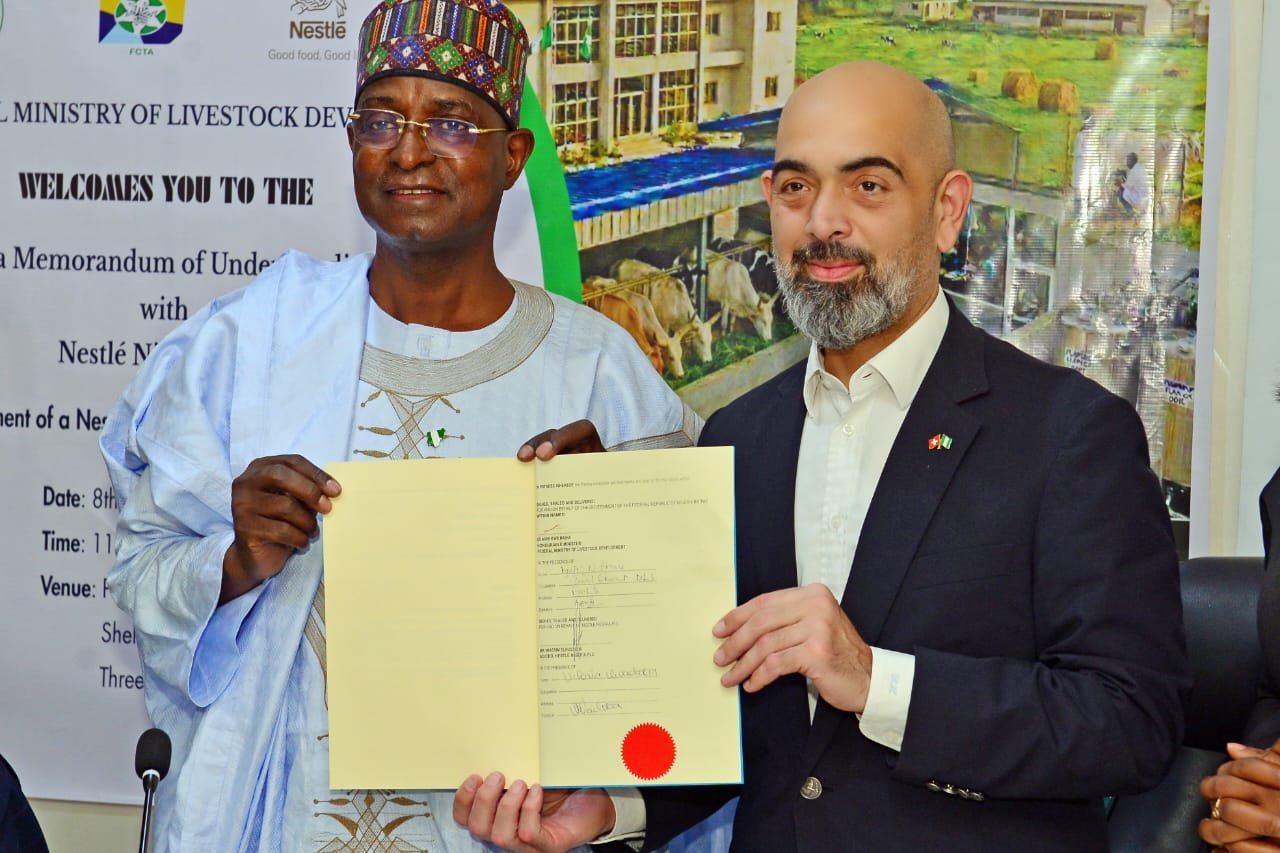

The Federal Government has signed a Memorandum of Understanding (MoU) with Nestlé Nigeria Plc for the establishment of the Nestlé Dairy Technical Skills Development Centre in the Federal Capital Territory (FCT), as part of efforts to boost dairy production and strengthen the country’s livestock value chain.
This development was disclosed by the Honourable Minister of Livestock Development, Idi Mukhtar Maiha, in Abuja on Wednesday, April 8, 2026.
Meanwhile, the announcement was made known to Agronigeria in a statement released by Henrietta Okokon, Deputy Director, Press and Public Relations, Federal Ministry of Livestock Development.
Maiha explained that the partnership goes beyond a ceremonial agreement, describing it as a strategic intervention aimed at addressing one of the most critical challenges in Nigeria’s dairy industry—limited technical capacity and poor practical farm management skills.
He noted that Nigeria’s dairy sector continues to face a paradox of vast potential and underperformance despite the country’s large livestock population.
“The reality is that our traditional pastoral systems currently yield an average of merely one to two litres of milk per cow daily.”
He attributed the low productivity to systemic gaps in modern husbandry practices, poor feed formulation, limited access to clean portable water, climate change impacts, and inadequate expertise in key areas such as artificial insemination, herd health management, and milk hygiene.
“This low productivity is directly linked to a systematic deficit in modern husbandry practices, inadequate feed formulation and lack of clean portable water, as well as impact of climate change and a lack of proficiency in essential areas such as artificial insemination, herd health management and milk hygiene leading to huge post-harvest losses,” he added.
According to the Minister, these challenges have significantly contributed to Nigeria’s annual dairy import bill of about $1.5 billion.
Maiha further stated that the proposed Dairy Technical Skills Development Centre would serve as a practical knowledge hub, facilitating the transition from traditional dairy practices to a modern, globally competitive system.
“We are actively aware that theoretical knowledge, while important, cannot substitute for hands-on experience in farm management,” he said.
He further stressed the importance of global standards in designing the programme.
“Therefore I have directed that the curriculum for this centre must be rigorously benchmarked against the best standards in the global dairy industry.”
The Minister explained that the training structure would comprise 70 percent practical farm experience and 30 percent theoretical instruction to ensure participants gain hands-on expertise.
He added that trainees would acquire skills in breeding, assisted birth, calf management, farm operations, record keeping, milking techniques, hygiene compliance, feed management, and animal welfare for improved productivity.
Maiha commended Nestlé Nigeria Plc for its commitment to developing the local dairy value chain.
In her welcome address, the Permanent Secretary, Dr. Chinyere Ijeoma Akujobi, highlighted the expected impact of the initiative on livelihoods and nutrition.
“The success of this partnership will be measured in farms that thrive, in children who are well-nourished, and in households that earn more because their work in livestock is supported and profitable.”
She added that the agreement is designed to translate resources, knowledge, and investment into tangible benefits for farmers and producers across the country.
Speaking at the event, the Managing Director and Chief Executive Officer of Nestlé Nigeria Plc, Wassim Elhusseini, said the MoU formalises the establishment of the centre as a critical step towards improving productivity and quality in Nigeria’s dairy sector.
He noted that the initiative aligns with the National Dairy Policy under the National Development Plan, aimed at driving growth in the livestock industry.
“Through the project, Nestlé Nigeria has invested over 1.8 billion Naira to support dairy communities in and around Pai-Konkore and the Luger grazing reserves.”
He revealed that the investment has yielded measurable results, with participating milk producers increasing their monthly incomes from ₦70,000 to ₦250,000 between 2021 and 2024.
Elhusseini further disclosed that Nestlé has established over 83 dairy cooperatives, aggregating more than one million litres of raw milk locally.
“We have trained over 2,000 pastoralists, vaccinated over 36,000 cattle and invested in critical infrastructure, including boreholes, water troughs, milk collection and cooling systems to support productivity and quality.”
He added that the company launched the Nestlé Dairy Demonstration Farm in 2025 to showcase improved practices.
“In 2025, we launched the Nestlé Dairy Demonstration Farm, a practical model to show how improved breeding, feeding and herd management can increase productivity from an average of 1 litre per cow per day to 10 litres and has also demonstrated the importance of milk hygiene, animal health and more settled farming systems in achieving consistent quality and sustainable production.”
Also speaking, a representative of the Commercial Dairy Ranchers Association of Nigeria (CODARAN) identified capacity building as a major challenge in the livestock sector, noting that the MoU would help address the gap.
The event featured goodwill messages from former Speaker of the House of Representatives, Yakubu Dogara, as well as representatives from the Food and Agriculture Organisation (FAO), the Bank of Agriculture, and other key stakeholders in the dairy industry.