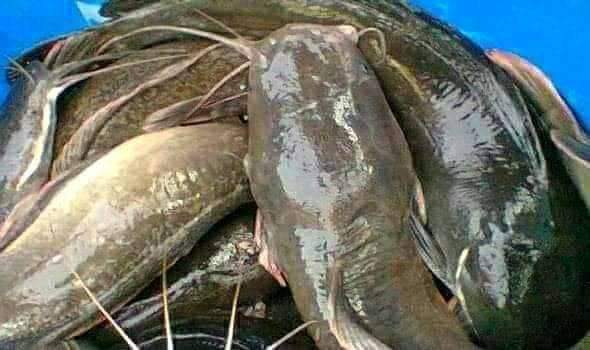

The Association of Fish Farmers in Kwara State (AFFAK) has raised concern over the increasing cost of fish feeds and other production materials, warning that many catfish farmers are struggling to remain in business.
The association said while the prices of essential inputs continue to climb daily, the market value of catfish has remained almost unchanged, leaving farmers with little or no profit.
AFFAK President, retired Gen Tayo Olasupo, spoke during a practical demonstration session organised for fish farmers on pond preparation, planning and record keeping under the FISH4ACP cluster upgrading programme.
According to him, several fish farmers have already abandoned the business because of mounting losses, while others are surviving only through persistence and hope for improvement.
He explained that the price of a kilogramme of catfish has recorded only slight changes over the years despite the sharp increase in operational expenses.
Olasupo noted that catfish sold between N1,800 and N2,300 per kilogramme about two years ago, adding that the current price remains below N2,600 despite rising inflation and production costs.
He appealed to both the federal and state governments to intervene through subsidies on fish feeds and support schemes that would ease the burden on farmers.
The AFFAK president also urged feed manufacturers to work closely with the association in making feeds more affordable and accessible to fish producers.
He called for the establishment of commodity boards and improved access to grants through institutions such as the Bank of Agriculture and Bank of Industry to prevent farmers from being exploited.
Also speaking, Director of Fisheries at the Kwara State Ministry of Agriculture and Rural Development, Nasir Akogun, identified inadequate financing for inputs as one of the major threats facing aquaculture sustainability.
Akogun described aquaculture as an important sector for employment generation, food security and improved access to affordable protein in the state.
The training programme was organised by the Justice, Development and Peace Commission of the Catholic Archdiocese of Ibadan in collaboration with the Food and Agriculture Organisation of the United Nations, ACP, the European Union and German Cooperation.
Representative of JDPC, Anthony Adedeji, said the training started in October last year and had reached its 24th week, with the demonstration organised to allow participants display the practical knowledge gained during the sessions.