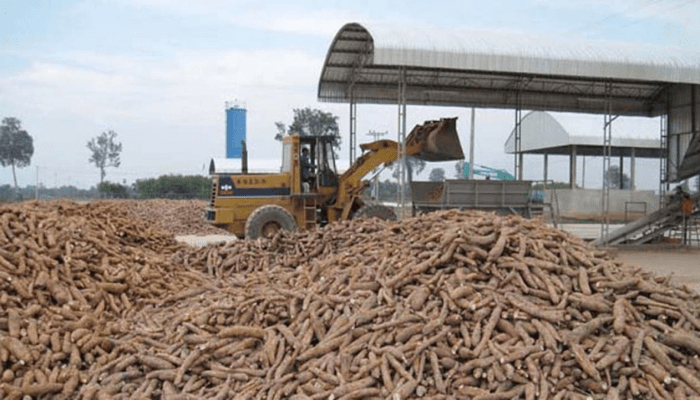

An agricultural expert, Tony Bello, has called for accelerated industrialisation of Nigeria’s cassava industry, saying greater investment in value addition is essential to unlock the crop’s full economic potential, generate employment and strengthen the country’s export capacity.
Mr Bello, the Chief Innovation and Commercialisation Officer of Matna Foods Ltd., made the appeal on Tuesday in Lagos.
He observed that although Nigeria remains the world’s largest cassava producer, with an annual output exceeding 60 million metric tonnes, the country has not fully capitalised on the economic opportunities available through large-scale processing and value addition.
According to him, the priority should now shift from increasing production volumes to converting cassava into high-value industrial products capable of delivering long-term economic returns.
“Nigeria has already won the production race. The challenge is industrialisation. The challenge is transforming production into value, value into revenue, and revenue into sustainable profitability,”he said.
Mr Bello explained that several advanced economies have successfully transformed staple crops into engines of industrial development, employment generation and export growth instead of limiting their use to food consumption.
He pointed to wheat and potatoes in the United States, potatoes and corn across Europe, maize in Latin America and rice in Asia as examples of crops that have been effectively integrated into industrial value chains.
He noted that cassava plays a similarly strategic role in Nigeria, providing livelihoods for millions of households through products such as garri, fufu, lafun, flour, tapioca and starch.
Despite its importance, he said the country continues to lose significant economic value because of inadequate processing infrastructure and limited commercialisation.
Mr Bello maintained that meaningful prosperity in the cassava industry would only be achieved by creating stronger links between production, processing, market access and sustained consumer demand.
He observed that while considerable resources have been invested in cassava cultivation and processing facilities, insufficient attention has been paid to market expansion, innovation, commercialisation and integration across the entire value chain.
According to him, many cassava processing plants are currently operating below their installed capacities due to inadequate feedstock supply and other constraints affecting the value chain.
He emphasised the need for improved technology, greater mechanisation and supportive government policies to enhance productivity and guarantee a reliable supply of raw materials for processors.
Mr Bello added that deliberate efforts to strengthen feedstock security are essential for achieving sustainable industrial development within the cassava sector.
He urged Nigeria to reposition cassava beyond its traditional role as a food security crop and recognise it as a strategic industrial resource capable of driving manufacturing, export earnings and broader economic development.
The agricultural expert also stressed that the sector should be managed as a commercially viable industry that attracts investment, encourages innovation and responds to both local and international market opportunities.
“The challenge before Nigeria is not simply to produce more cassava. The challenge is to create more value from cassava,”Mr Bello said.