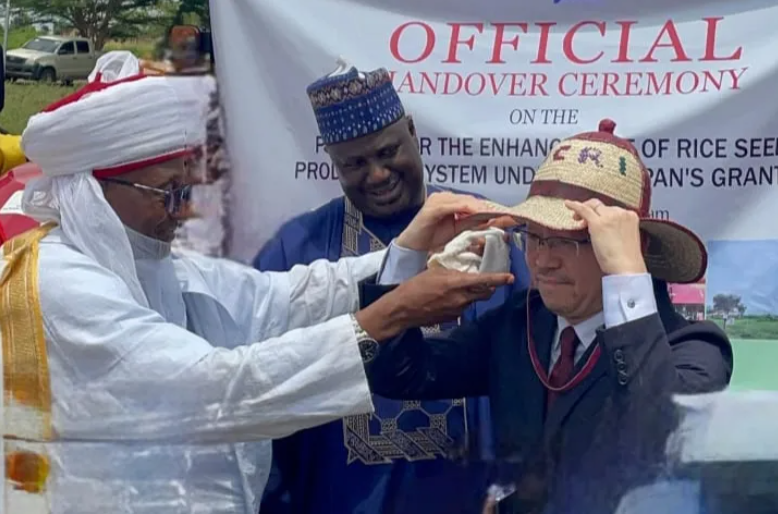

The Government of Japan has committed about ¥587 million, equivalent to $3.5 million, to strengthen rice seed production and support agricultural development and food security in Nigeria.
Japanese Ambassador to Nigeria, Hideo Suzuki, disclosed this on Monday at the handover ceremony of the Project for the Enhancement of Rice Seeds Production System at the National Cereals Research Institute (NCRI), Badeggi, Bida Local Government Area of Niger State.
Suzuki said the intervention would enhance NCRI’s capacity to produce high-quality breeder and foundation rice seeds, ultimately improving the supply of certified seeds to farmers and boosting productivity, yields and confidence in Nigeria’s seed system.
He described agriculture as a major pillar of Nigeria’s economy and food security, noting that demand for rice continued to outstrip domestic production.
According to him, the project supports the Federal Government’s Second National Rice Development Strategy (2020–2030), which seeks to double domestic rice production.
The ambassador stressed that access to quality planting materials was essential to achieving agricultural transformation, as improved farming technologies and agronomic practices could only deliver their full potential when farmers had reliable seeds.
Suzuki said the grant would provide modern agricultural equipment for NCRI headquarters and its outstations in Niger and Oyo states, including 20 medium-sized tractors, three rice transplanters, four small combine harvesters and two excavators for seed cultivation and production.
Other equipment supplied under the project included four constant-temperature germination testers, three automatic weather observation systems and seven small flat drying machines for post-harvest processing.
He said the intervention went beyond the provision of machinery, describing it as an investment in knowledge, innovation and the future of Nigerian agriculture.
According to him, the equipment would improve seed production efficiency and quality, reduce labour-intensive operations and strengthen NCRI’s capacity to provide better services to farmers nationwide.
Suzuki added that the project incorporated technical assistance, equipment operation and maintenance training, as well as institutional capacity development, stressing that sustainable agricultural development required both modern machinery and skilled personnel.
He urged NCRI to ensure proper maintenance and effective utilisation of the equipment to guarantee lasting benefits for Nigerian farmers.
The ambassador reaffirmed Japan’s commitment to improving agricultural productivity, food security and rural livelihoods in Nigeria.
Speaking at the event, Minister of State for Agriculture and Food Security, Aliyu Sabi-Abdullahi, commended the Government and people of Japan, as well as the Japan International Cooperation Agency (JICA), for their continued support for Nigeria’s agricultural development.
Abdullahi described the intervention as timely and strategic, saying it would strengthen rice seed production and mechanisation while addressing key gaps within the rice value chain.
He said agriculture remained critical to Nigeria’s economic transformation and national stability, adding that food security should be viewed not only as an agricultural concern but also as an issue of national security and economic sovereignty.
The minister said the project was consistent with President Bola Tinubu’s Renewed Hope Agenda, particularly its focus on food security, reducing import dependence, job creation, farmer empowerment and inclusive economic growth.
In his remarks, Chief Representative of JICA Nigeria Office, Keiji Ishigame, recalled that JICA launched the Coalition for African Rice Development (CARD) in 2008 in partnership with other organisations to help African countries increase rice production and reduce reliance on imports.
He said Nigeria remained a key participant in CARD and had developed the National Rice Development Strategy II (NRDS II), covering 2020 to 2030, as a framework for transforming the rice industry through improved productivity, stronger seed systems, mechanisation and value-chain development.
Ishigame said the equipment supplied under the project included tractors, seed production and processing machinery, laboratory equipment, an Automatic Weather Station and maintenance tools installed at NCRI headquarters in Badeggi and its outstations in Ibadan and Mokwa.
He noted that JICA’s support for Nigeria’s rice sector had expanded over the years to cover production, post-harvest management, marketing, agricultural extension, institutional strengthening and policy development.
He added that JICA was also implementing the Capacity Development for Enhancement of Rice Seed Production in Nigeria project to strengthen institutions and stakeholders involved in rice seed multiplication, quality control and seed management.
On his part, the Niger State Governor, Umaru Bago, reaffirmed the state government’s support for initiatives aimed at improving rice seed production and strengthening food security.
Bago, represented by the Managing Director of the Niger Agricultural and Mechanisation Development Authority (NAMDA), Muhammed Baba, said greater access to quality rice seeds would improve farmers’ productivity, strengthen food security and reduce dependence on imported food.
Earlier, NCRI Executive Director, Mohammed Ndagi-Ishaq, said the intervention had significantly improved the institute’s capacity to produce rice seeds.
He said the modern machinery and seed-processing equipment would enhance the efficiency, quality and scale of production.
Ndagi-Ishaq added that the institute had developed and released high-yielding and climate-resilient crop varieties, including zinc-biofortified rice varieties.
He appealed to the Japanese government, through its embassy and JICA, to provide NCRI with five Hilux vehicles to strengthen field inspection, monitoring and technical support in remote areas.
Also speaking, Chairman of the NCRI Governing Board, Prince Sunday Fagbemi, described the project as evidence of the value of international cooperation and a shared commitment to food security and economic prosperity.
Report gathered that the equipment supplied under the project included tractors and attachments, rice transplanters, combine harvesters, seed graders, paddy huskers and germination testers.
Other items included laboratory equipment, grain moisture meters, dryers, an Automatic Weather Station, maintenance tools, spare parts and other consumables.