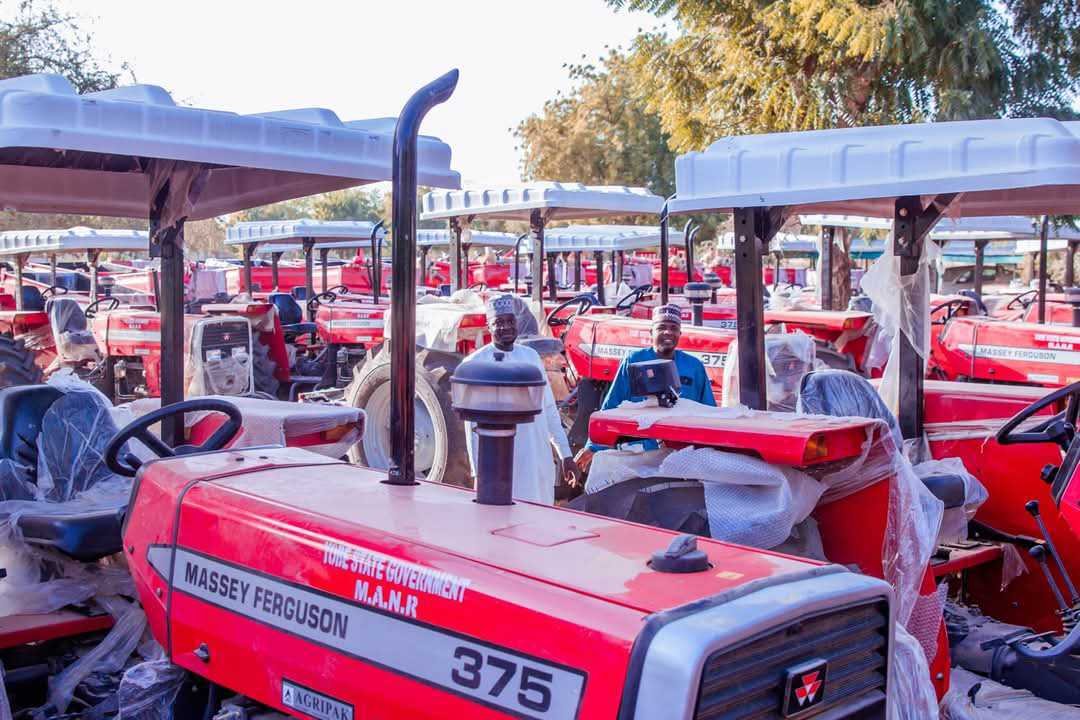

As part of efforts to modernise Nigeria’s agricultural sector, boost food production and reduce dependence on imported farm machinery, the Federal Government has unveiled a new policy and investment strategy designed to create a commercially viable agricultural mechanisation ecosystem.
The initiative, unveiled by the Minister of Agriculture and Food Security, Senator Abubakar Kyari, in Abuja, includes plans for a mega tractor assembly plant with an annual production capacity of between 2,000 and 4,000 tractors.
The National Agricultural Mechanisation Policy and National Agricultural Mechanisation Investment Strategy are expected to attract private capital, expand access to machinery and strengthen local capacity in the production, maintenance and servicing of agricultural equipment.
Speaking at a high level national policy dialogue on agricultural mechanisation, Kyari said the government was determined to move the country away from fragmented interventions focused largely on tractor procurement to a system driven by private investment and sustainable mechanisation services.
He said the new framework would bring together capital, technology, skills and entrepreneurship while ensuring that farmers could access appropriate machinery when and where it was required.
Kyari said the government had already commenced procurement and deployment of 2,000 tractors, alongside more than 9,000 implements and spare parts, under the Renewed Hope National Agricultural Mechanisation Programme.
He described the intervention as the largest single agricultural mechanisation programme undertaken in Africa, but stressed that the success of the initiative would not be determined by the number of tractors purchased.
According to him, the real measure would be whether the machines remain productive, properly maintained, financed and accessible to farmers.
The minister said the new approach would also expand mechanisation beyond tractors to cover land preparation, planting, irrigation, crop protection, harvesting, threshing, processing, storage, logistics and transportation.
He said the planned tractor assembly facility would help reduce Nigeria’s dependence on imported machinery, strengthen domestic industrial capacity and create employment opportunities.
Kyari urged investors to look beyond equipment supply and participate in developing a wider agricultural technology and services ecosystem.
He said Nigeria’s large agricultural market, growing agro processing sector, youthful population and unmet demand for mechanisation services offered significant opportunities for investors.
The minister also said young Nigerians, women and persons with disabilities would be incorporated into the sector as equipment operators, technicians, engineers, entrepreneurs, equipment managers and service providers.
He cited Borno State as an example of how state level commitment could complement federal agricultural initiatives, noting that the state government had distributed 200 truckloads of fertiliser and facilitated more than a dozen solar powered irrigation systems.
Kyari also commended TracTrac Mechanization Services Limited for training young Nigerians and deploying small scale tractors to support smallholder farmers.
He said successful implementation of the new framework would require coordinated action by the Federal Government, state governments, private investors, financial institutions, development partners, research institutions and farmers.
According to him, the Federal Government would provide policy, standards, coordination and investment architecture, while states would support land access, infrastructure and implementation.
Private investors, he said, would be expected to provide capital, innovation and mechanisation services, while financial institutions would develop appropriate financing, leasing and risk sharing mechanisms.
Development partners, he added, would provide catalytic funding, technical expertise and institutional support.
Earlier, the Permanent Secretary of the ministry, Dr Marcus Ogunbiyi, said Nigeria must urgently address its mechanisation deficit if the country was to increase agricultural productivity and achieve food security.
Ogunbiyi said farmers had continued to contend with inadequate machinery, high production drudgery, limited access to appropriate technologies and weak investment across the agricultural value chain.
He cautioned that tractors alone could not transform agriculture, stressing the importance of operators, maintenance and financing.
He said the National Agricultural Mechanisation Policy would establish the direction for the sector, while the investment strategy would provide a framework for mobilising the resources required to implement it.
The permanent secretary said the emerging mechanisation economy would extend into equipment assembly and leasing, maintenance, spare parts production, digital fleet management, operator training, irrigation, post harvest technology and agro processing.
Chief Executive of TracTrac MSL, Mr Godson Ohuruogu, said the company had reached more than 500,000 farmers since it began operations six years ago.
Ohuruogu said the company had catalysed more than N2 billion in investment and trained over 6,000 young people, women and persons with disabilities through its ISSAM Project with the Mastercard Foundation.
He said the initiative had created more than 3,000 jobs in one year, established 567 youth and women led cooperatives and facilitated the deployment of hundreds of tractors and nearly 2,000 labour saving devices.
Ohuruogu said the experience demonstrated the potential of public private collaboration when agricultural interventions were structured around the needs of smallholder farmers.
He urged stakeholders to measure the success of the new policy by its impact on farmers, particularly whether mechanisation services become affordable, reliable and available when required.
He said access to finance, technology and inclusive service delivery would be critical to ensuring that the new framework translates into practical improvements in the agricultural sector rather than becoming another policy document.