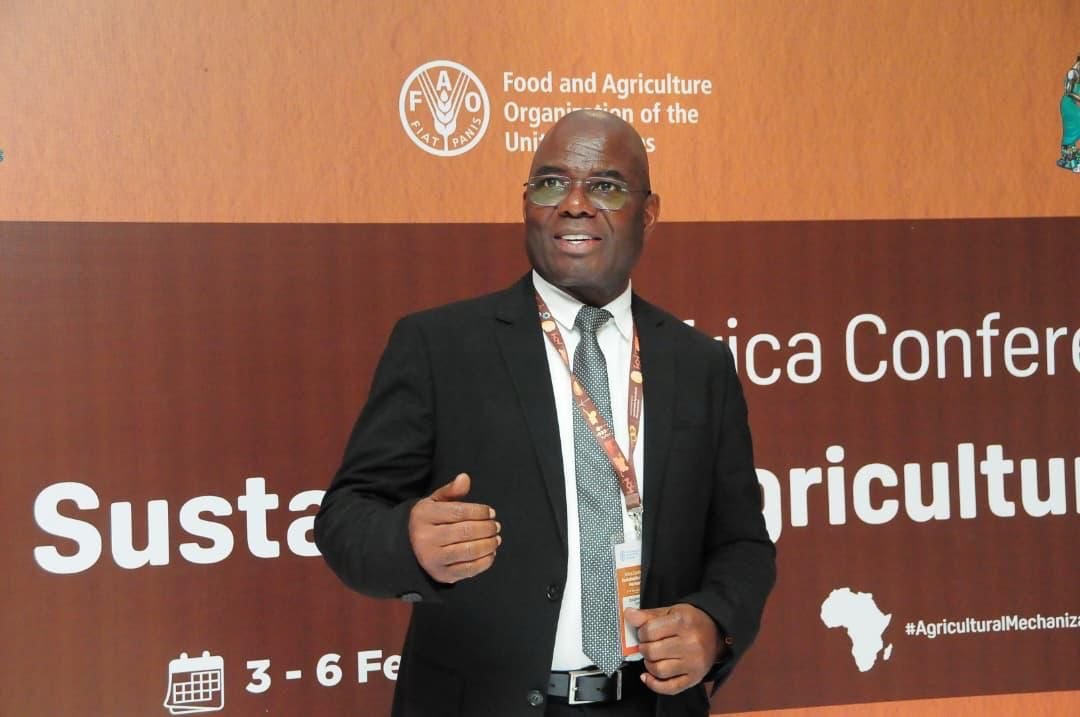

By Ify Mgbemena
The Chief Executive Officer of the Pan African Farmers’ Organization (PAFO), Dr Babafemi Oyewole, has called on African governments to adopt farmer-centred mechanisation policies that can move the continent’s agriculture from labour-intensive practices to a productive, resilient and competitive sector.
Dr Oyewole made the call while speaking at a high-level panel discussion during the Conference on Sustainable Agricultural Mechanisation in Dar es Salaam, Tanzania, on Tuesday.
He described sustainable agricultural mechanisation as a strategic public policy choice that will determine whether African agriculture continues to struggle with low productivity or evolves into a viable engine for food security and economic growth.
The PAFO CEO noted that African leaders have made strong commitments under the Comprehensive Africa Agriculture Development Programme (CAADP) and the Kampala Declaration to accelerate agricultural transformation, strengthen climate resilience, create jobs for young people and place farmers at the centre of food systems.
However, he said these commitments will remain unattainable without effective mechanisation strategies.
According to him, there is still a wide gap between policy ambition and implementation, as many mechanisation programmes focus on equipment procurement rather than farmer access, services, skills and financing.
This, he said, continues to exclude the majority of smallholder farmers, particularly women and youth.
Dr Oyewole emphasised that smallholders dominate African agriculture, warning that mechanisation policies not designed for small-scale production risk marginalising most farmers.
He called for a shift from machine-centred approaches to farmer-centred systems built on right-sized technologies, cooperative and service-provider models, and strong public investment.
He added that mechanisation should be treated as a food systems investment, extending beyond production to storage, processing and market access, in order to reduce post-harvest losses and improve farmer incomes.
On financing, Dr Oyewole stressed that deliberate public intervention through blended finance, leasing frameworks, guarantees and targeted subsidies is critical to ensuring smallholder inclusion, adding that farmers’ organisations should be recognised as key delivery partners.
He further noted that mechanisation policies must align with Africa’s climate and land restoration commitments by promoting climate-smart and regenerative practices.
Dr Oyewole reaffirmed PAFO’s readiness to work with governments, regional bodies and development partners to ensure sustainable mechanisation that delivers tangible results for farmers, food security and Africa’s agricultural transformation.