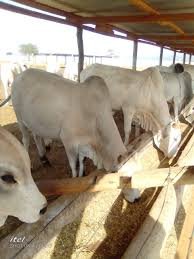

Following the successful completion of a landmark 24-month commercial research project, Ajogbe Agro-Allied Industries Limited has increased the capacity of its concentrated animal feeding operation, Feedlot Nigeria.
The research focused on developing highly nutritious ruminant feeds using agricultural byproducts and crop residues, an initiative that has enabled the company to expand its one-time herd capacity to 5,000 animals.
This move is expected to boost the annual supply of finished cattle to 250,000.
The pioneering research received grant funding from the United Kingdom Research and Innovation (UKRI) led African AgriFood Knowledge Transfer Partnerships (AAKTP).
It involved collaborative partnerships with the Federal University of Agriculture, Abeokuta and the University of West of Scotland in the United Kingdom.
The Executive Chairman of Ajogbe Agro Allied Industries Limited, Mr Bosoye Olalere, explained that the expansion demonstrates the company’s growing expertise in turning crop residues, forage, fodder crops and agro industrial by products into reliable ingredients for basal feeds and total mix rations for cattle.
He added that the organisation’s wider livestock and grains operations continue to grow, covering grain production and processing, feed milling, backgrounding, ranching, feedlot management, abattoir services and beef deboning.
According to Olalere, the company’s commitment to commercial feedlots is firmly rooted in data driven science and research, which serve as core tools for its feedlot modeling.
The operation is designed to prioritize customer satisfaction, superior animal nutrition, health and welfare, cost efficient production, and ecological stewardship.
Olalere further clarified the feedlot concept, defining it as an enclosed or designated area where cattle are kept without freedom to roam.
This controlled setting, coupled with the newly developed TMR feed, allows the company to accurately predict the time required to fatten a calf from 200 kilograms to a slaughter weight of approximately 350 kilograms.
Highlighting the substantial market opportunity, Olalere revealed that annual demand for cattle in Nigeria’s six southwestern states totals $2.5$ million.
Ajogbe has set a goal to capture at least 10 percent of this market within the next three years, translating to the projected 250,000 cattle per year.
Also speaking, Professor Christian Harrison, Project Lead from the University of West of Scotland, lauded the initiative as a massive undertaking that addresses both economic and social challenges.
Harrison who also serves as Professor of Leadership and Enterprise and Director of the Centre for Leadership and Empowerment at the University of Greater Manchester confirmed that substantial plans for commercialization are underway, with significant interest already shown by banks and investors.
“The intellectual property is jointly owned by the university, FUNAAB, and Ajogbe.
While the formulation will not be disclosed, we are committed to commercializing it and making it widely available at an affordable cost,” he added.
In his remarks, Professor Adebayo Shittu, co-lead of the African Agricultural and Land Transfer Partnership project and an FAO country project consultant, described the development as a historic breakthrough for Nigeria.
Shittu explained that the project’s goal is to provide a consistent, all year-round feed solution.
“During the dry season, herders lack access to fresh grasses, which forces them to move south. This project will help resolve that issue by converting materials typically considered waste, such as maize stover, into a total mixed ration for our cattle,” he said.
He added that this innovation will allow farmers to bring the feed to the cattle, rather than the cattle seeking the feed, making it possible for Southern farmers to sustainably raise cattle even on limited land.
He stated that it is possible for farmers to manage a hundred head of cattle on a small area, less than one hectare.
This approach, he said, will help reduce the requirement for migration and allow animals to be produced within the limited land area that is available.