

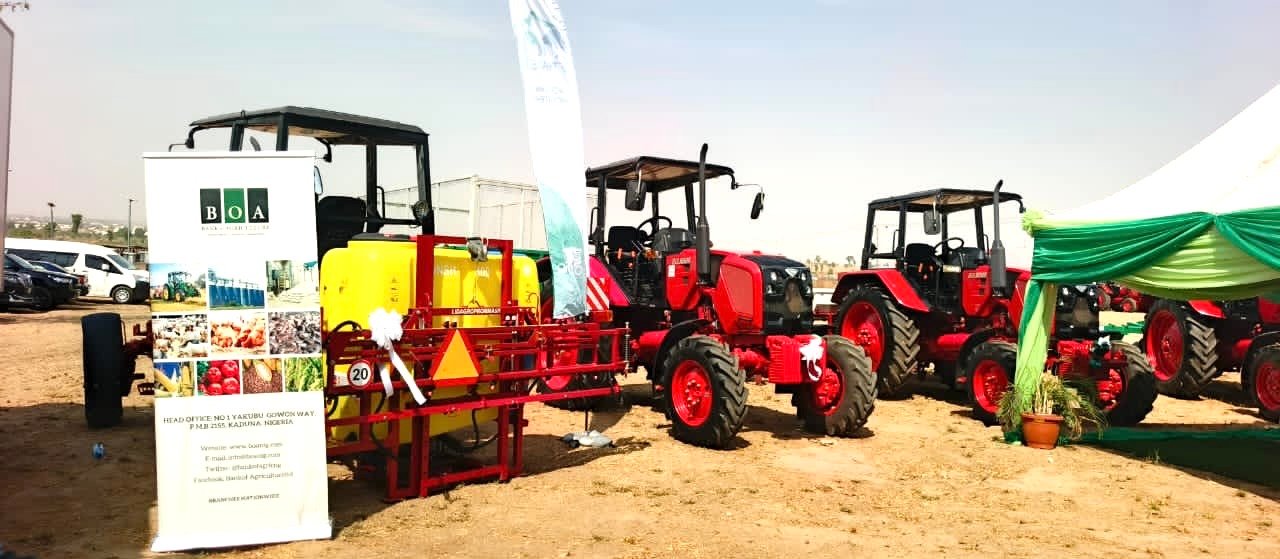
Nigeria has taken a major step toward addressing food insecurity as the Bank of Agriculture (BOA) commenced the phased rollout of 2,000 tractors under the Renewed Hope National Agricultural Mechanisation (NAM) Programme.
The initiative, unveiled on Tuesday, is designed to boost food production, modernize farming practices, and establish a sustainable mechanization framework across the country.
Managing Director and Chief Executive Officer of the Bank of Agriculture, Ayo Sotinrin, described the programme as a strategic response to Nigeria’s persistently low agricultural productivity. He said the effort aligns with the agricultural transformation agenda of President Bola Tinubu, who has positioned food security as a cornerstone of economic stability.
Sotinrin underscored the urgency of mechanization, revealing that Nigeria currently operates just 13 tractors per 100 square kilometres of arable land—far below the global average of 200. With a population exceeding 230 million and projected to double by 2050, he noted that scaling up production has become critical.
Despite possessing about 70 million hectares of arable land, only 34 million hectares are currently cultivated. Furthermore, about 95 per cent of farmers—who account for nearly 90 per cent of national food output—still rely on manual labour. This dependence contributes to delayed planting seasons, reduced yields, post-harvest losses, and recurring food shortages.
Unlike previous mechanization interventions that faltered due to poor maintenance and widespread loan defaults, the NAM Programme adopts a revolving fund model. Under this structure, repayments from tractor beneficiaries will be reinvested to procure additional equipment, ensuring sustained expansion and access.
To guarantee viability, eligibility criteria have been set high. Only applicants capable of cultivating a minimum of 600 hectares annually qualify, ensuring they can generate sufficient revenue to cover operational costs and repay financing obligations.
Three-Tier Funding Structure
The programme operates on a three-tier funding model:
-Tier One allocates 10 per cent of the tractors to agribusinesses and large-scale commercial farmers to accelerate financial returns.
-Tier Two, which comprises the largest share—1,200 tractors—partners with state and local governments to empower youth and women entrepreneurs. Repayments under this tier will be drawn from service fees generated through tractor hiring operations.
-Tier Three targets experienced mechanization service providers with proven capacity and operational track records.
To ensure sustainability, the scheme includes the establishment of 40 mobile maintenance units and seven major service centres distributed across Nigeria’s six geopolitical zones. These facilities will provide repairs, spare parts, technical training, and digital tracking services. Each tractor is fitted with GPS technology to enable real-time monitoring and prevent misuse.
The programme also benefits from a $7 million recoverable seed funding injection by Heifer International through AFI Nigeria. The funding will support operations during the first two years, with the programme expected to achieve full self-sufficiency by the fifth year through internally generated revenues.
Minister of Agriculture and Food Security, Abubakar Kyari, pledged strict oversight to prevent diversion and abuse of the equipment. He disclosed that over 9,000 precision farming implements have already been deployed nationwide as part of broader mechanization efforts.
Meanwhile, Director-General of the National Agricultural Seeds Council, Fatuhu Mohammed Buhari, addressed a recent administrative mix-up, revealing that his office received 2,000 applications mistakenly submitted there instead of to the appropriate channels. He expressed optimism that the official launch would restore clarity, build stakeholder confidence, and accelerate progress toward national food security goals.
By combining modern equipment, innovative financing, maintenance support, and digital oversight, the Renewed Hope NAM Programme represents one of the most comprehensive mechanization drives in Nigeria’s history—positioning the country to transform its agricultural landscape and secure its food future.

1 comment
Our Agency, an MDA in Nigeria needs at least one of these tractor.
08033824752