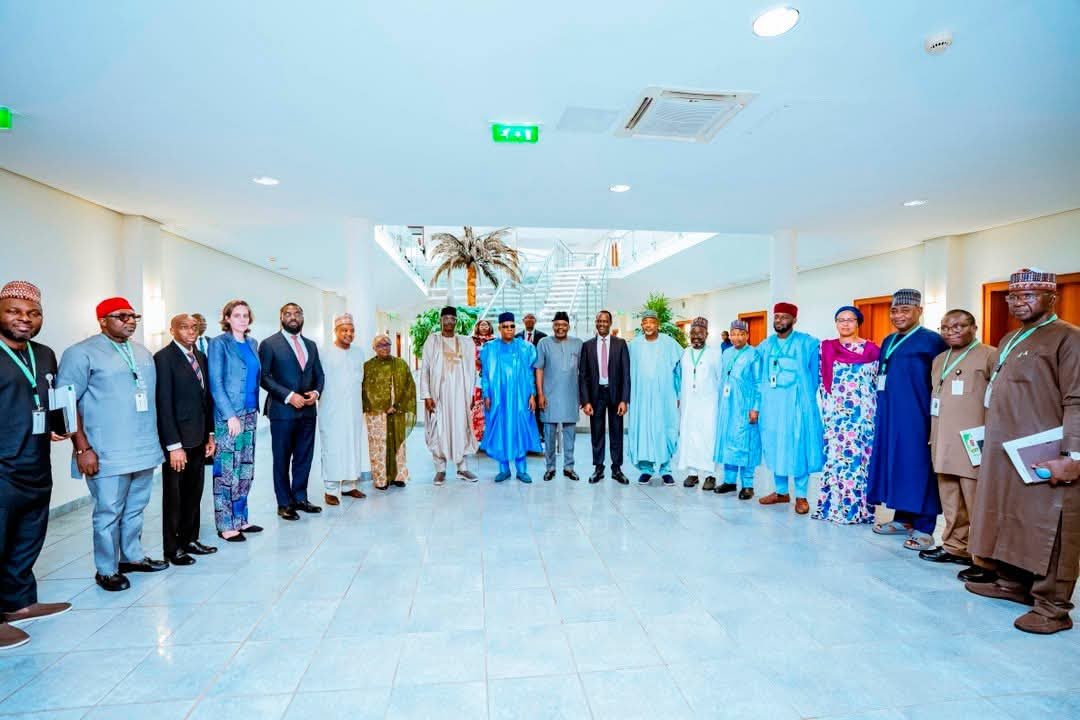

The Federal Government has received the final report of the National Technical Working Group on the World Bank-supported US$500 million Sustainable Agricultural Value Chains for Growth Programme (AGROW), signalling the end of the programme’s design phase and the beginning of its implementation.
Vice President Kashim Shettima received the report on Tuesday during a briefing at the Presidential Villa, Abuja, where he said the AGROW programme was helping to bridge the long-standing gap between farmers and the national planning and policymaking systems that shape the sector.
The Vice President noted that the persistent challenge in Nigeria’s agricultural sector had been the distance between farmers who till the land and the systems that determine the value of their labour, and said government was now working to close that gap.
He described the report as “the conclusion of a design process that restores the farmer to the centre of our national economic reasoning, where he has always belonged.”
The AGROW programme was developed through seven zonal consultations spanning 32 states, a process officials say reflects growing commitment among subnational governments to agricultural development and their willingness to take on greater responsibility for productivity, infrastructure, extension services, and market development.
With the design phase now concluded, attention shifts to the rollout of the programme, which is expected to strengthen agricultural value chains, improve farmer access to markets, and support broader national efforts to boost food security and rural livelihoods.