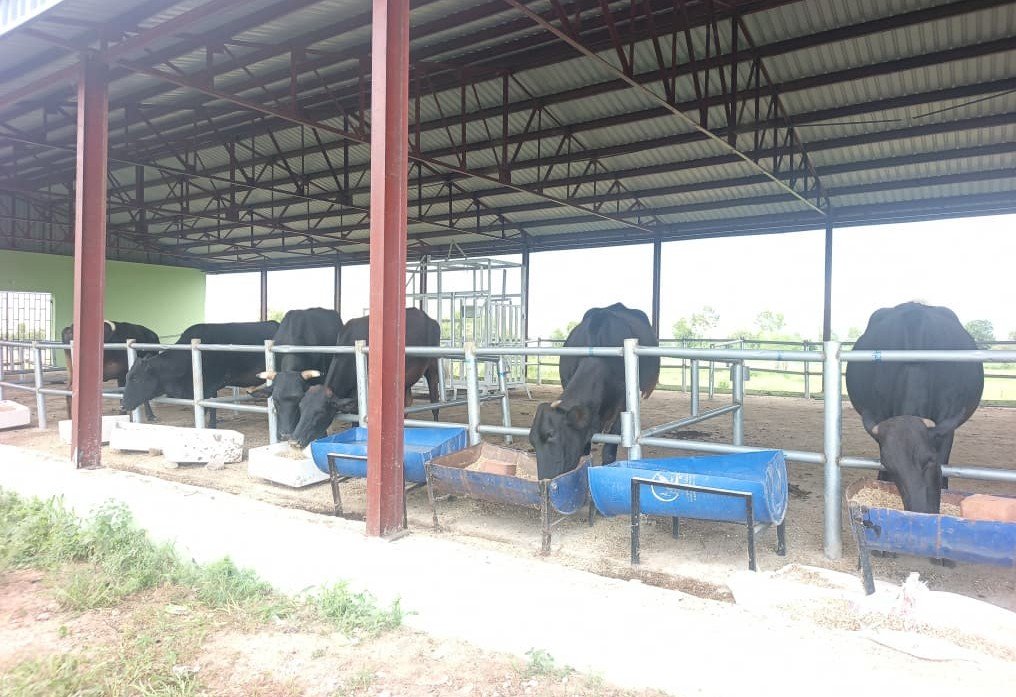

The Federal Government has inaugurated Nigeria’s second International Border Animal Quarantine Facility at Jaba-Jaba, a Nigerian-Cameroonian border community in Maiha Local Government Area of Adamawa State.
The Minister of Livestock Development, Idi Mukhtar, disclosed this on Friday while inaugurating the facility, describing it as a significant development in the government’s efforts to improve animal health and advance livestock production across the country.
The facility was constructed under the World Bank-supported Livestock Productivity and Resilience Support (L-PRES) Project, making it the second international border animal quarantine centre established under the initiative.
According to the minister, the only other facility of its kind in the country is located at Nfum in Etung Local Government Area of Cross River State.
He explained that the Jaba-Jaba facility would be used to inspect cattle, sheep and goats entering Nigeria through the international border, while also enhancing the country’s capacity to monitor and respond to animal health threats.
Mukhtar disclosed that over 10,000 cattle herds reportedly enter Nigeria every week through the Jaba-Jaba international cattle route from the Central African Republic, Sudan, Chad and Cameroon.
He said, “Some of the animals entering the country are uncertified, while others are sick, putting Nigerians at risk of various animal diseases.
“The facility will reduce the risk of transboundary animal diseases that threaten livestock production, public health and food security, as well as the national economy.”
The minister said the establishment of the quarantine centre was an important step in advancing President Bola Ahmed Tinubu’s Renewed Hope Agenda for the livestock sector.
He further disclosed that the Federal Government was planning to establish additional quarantine facilities in Borno, Niger, Kano, Kebbi and Sokoto states.
Representing Governor Ahmadu Fintiri at the event, Deputy Governor Kaletapwa Farauta commended the Federal Government for siting the facility in Adamawa.
She said, “Adamawa has the highest number of cattle herds in the country,” adding that the state government had invested significant resources in transforming the livestock sector.
Farauta appealed to residents of the border community to safeguard the facility and cooperate with authorities to ensure its effective operation.
Earlier, the National Coordinator of the L-PRES Project, Sanusi Abubakar, described the inauguration as another important achievement in the implementation of the World Bank-supported programme.
Abubakar explained that the facility was developed under the project’s Innovation and Institutional Systems Strengthening component to reinforce the statutory responsibilities of the Nigeria Agricultural Quarantine Service (NAQS), particularly in preventing the introduction of diseased animals into Nigeria.
He said the centre would further improve disease monitoring and livestock traceability, while supporting pastoral advisory services through geospatial technology.
According to him, the facility is also expected to contribute to peaceful relations between livestock owners and farming communities.
The coordinator said the centre had been fitted with modern facilities, including a large-animal holding pen, solar-powered water supply system, spray race, cattle dip, cattle crush, office spaces and training facilities.
He added that the infrastructure would enhance operational effectiveness, promote animal welfare and strengthen Nigeria’s ability to prevent and control transboundary animal diseases.
In addition to the quarantine facility, the minister inaugurated a Model Veterinary Clinic in Jaba-Jaba and the Strategic Artificial Insemination Centre at Adamawa State University, Mubi.