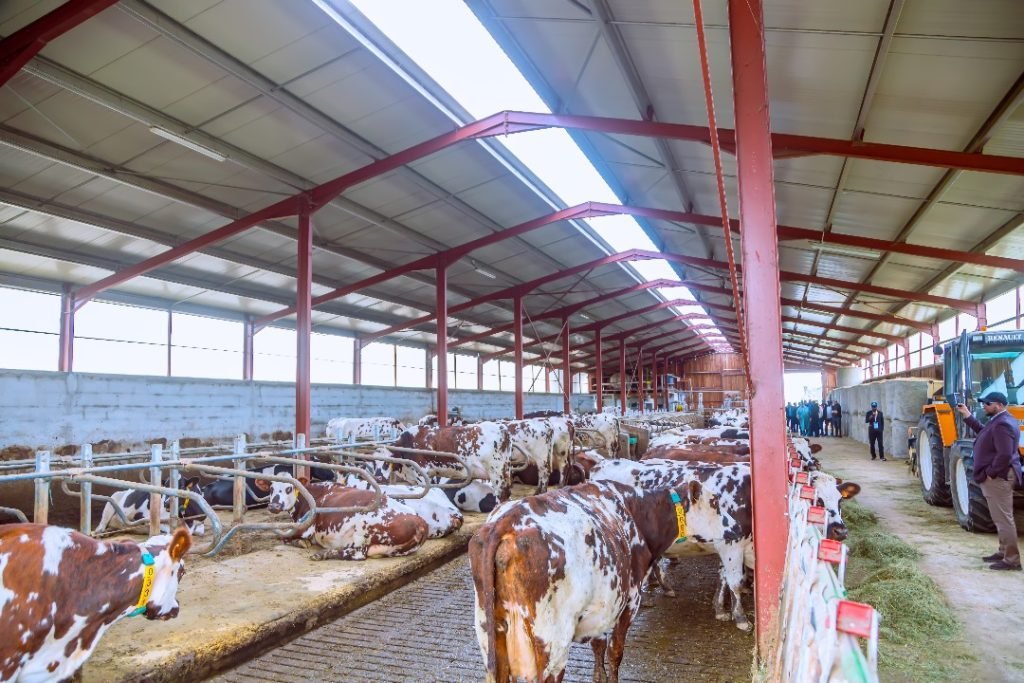

The Federal Government has identified livestock development as a major pathway to accelerate economic expansion, strengthen food security and advance Nigeria’s long term ambition of building a one trillion dollar economy.
During a stakeholders’ roundtable organised by the Abuja Chamber of Commerce and Industry, the Minister of Budget and Economic Planning, Abubakar Bagudu, said renewed attention is being given to reposition the sector for higher productivity and stronger private sector participation.
He noted that livestock production already exists across all regions of the country, yet its economic contribution remains limited.
According to him, this is largely due to weak coordination and the slow shift toward modern systems of production and value addition.
Bagudu explained that the sector contributes about five percent to the nation’s Gross Domestic Product but has the potential to expand significantly if supported with the right policies, investment and institutional reforms.
He added that the government is putting together a comprehensive strategy aimed at improving efficiency from production to processing and distribution.
The minister linked the initiative to the broader reform agenda of President Bola Ahmed Tinubu, which focuses on unlocking growth in critical sectors of the economy.
He also disclosed that the National Economic Council under Vice President Kashim Shettima is ensuring collaboration among federal, state and local authorities to deliver measurable outcomes.
As part of these efforts, the establishment of a dedicated Ministry of Livestock Development is expected to drive rapid transformation in the industry.
Bagudu said the government aims to build a competitive and inclusive livestock economy capable of generating employment and raising incomes, particularly for small scale farmers.
He further explained that government intervention will focus on creating a stable business environment, improving infrastructure and reducing investment risks, while encouraging private capital to play a leading role.
Public resources, he added, are also being directed toward addressing longstanding challenges and boosting productivity.
Bagudu pointed out that Nigeria’s large population presents a ready market for livestock products, as well as opportunities for export growth.
He drew parallels with countries such as Brazil and Indonesia, where the sector has contributed significantly to national output.
On recurring conflicts associated with livestock activities, the minister said pressure on land and outdated practices remain key factors.
He stressed that adopting modern techniques and better resource management will help ease tensions and foster cooperation among communities.
He commended the Abuja Chamber of Commerce and Industry for convening stakeholders from across sectors to deliberate on practical solutions, expressing confidence that with proper coordination and sustained investment, the livestock industry can become a major driver of jobs, exports and overall economic growth.