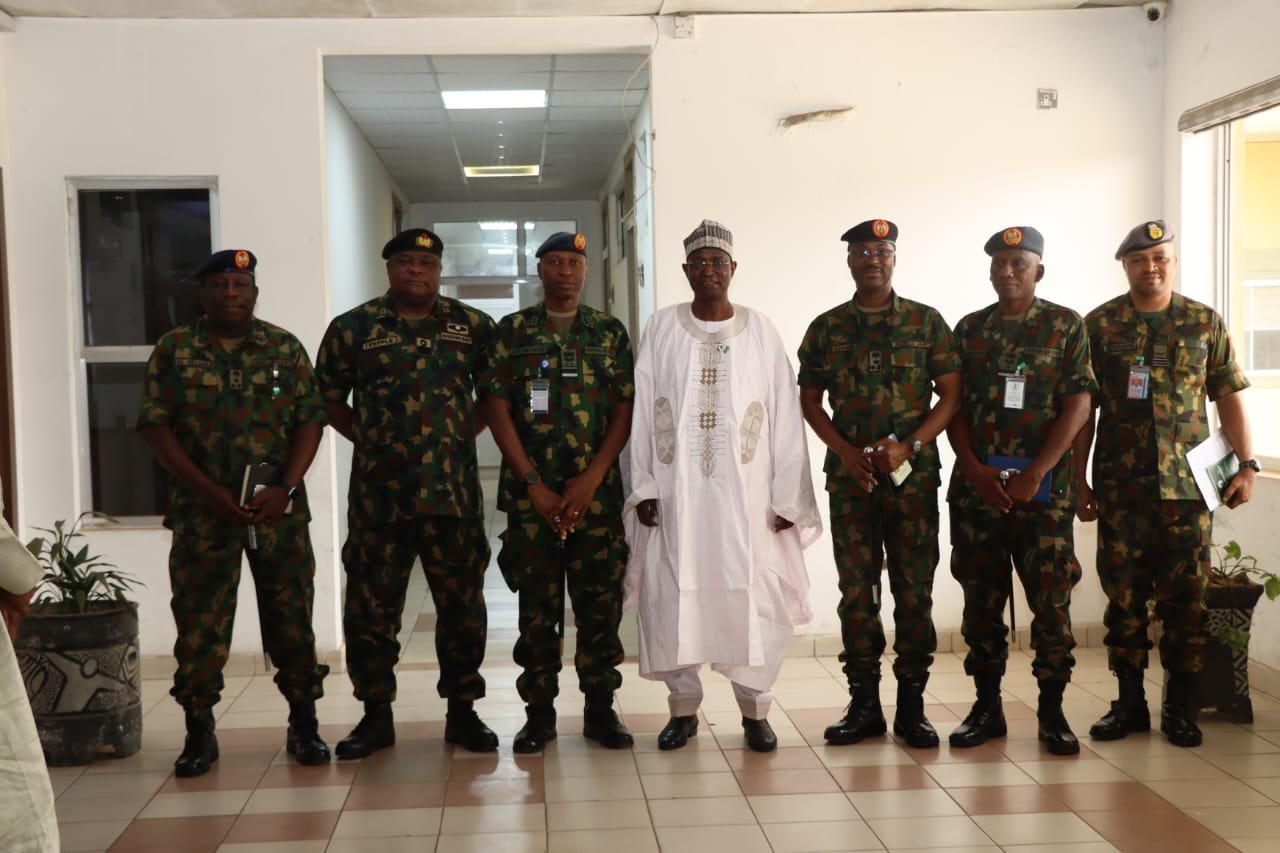

The Federal Ministry of Livestock Development has expressed readiness to partner with the Nigerian Armed Forces to drive large-scale livestock production, strengthen food security, and support rural economic growth across Nigeria.
This was made known in a statement by Ogochukwu Igboamalu, the ministry’s Assistant Chief Executive Officer (Information) and made available to Agronigeria on Thursday.
According to the statement, the Honourable Minister of Livestock Development, Idi Mukhtar Maiha, disclosed the move on Wednesday, 18th February 2026, in Abuja while receiving a delegation from the Defence Holding Company Limited.
He stated that the collaboration will begin with joint technical assessments of military farm formations nationwide to evaluate existing livestock operations, identify capacity gaps, and deploy targeted government support to boost productivity and self-sufficiency within military establishments.
“We will visit your farm formations, assess what is on ground and work with you to close the gaps. Our goal is to ensure proper standards, align with national food security objectives, and enable the Armed Forces progressively produce their own food while contributing to national supply,” the Minister said.
Maiha emphasised that the initiative aligns with the Federal Government’s priorities of food sovereignty, job creation, and community stabilisation.
He further revealed that the Ministry has developed an integrated grazing reserve model, beginning with Wase, Plateau State, featuring internal road networks, residential settlements, schools, veterinary clinics, dams, and dedicated crop and pasture production zones designed to support modern ranching systems.
Earlier, the Group Managing Director of Defence Holding Company Limited, Air Vice Marshal Anthony Ndace, explained that the organisation coordinates commercial and agricultural ventures of the Armed Forces and is expanding non-kinetic interventions such as livestock farming to promote food security, reduce insecurity, and support community reintegration.
He requested technical collaboration from the Ministry for the development of approximately 1,000 hectares of livestock and agricultural facilities in Wase, Plateau State.
The partnership is expected to create a replicable model integrating security institutions into national agricultural production and rural development frameworks.
[10:21 PM, 2/20/2026] Clarion: Agric Experts Warn Farmers Against Agrochemical Abuse
Some experts in agriculture have advised local farmers about the misuse of agrochemicals in crop cultivation in separate interviews on Thursday in Lagos.
A strategic agriculture communication expert, Olawale Ismail, explained that agrochemicals cannot be completely boycotted in crop cultivation; rather, their use must be restricted.
He urged the farmers to ensure strict adherence to technical measurement and safety rules.
Omotunde Banjoko, an agricultural analyst and farmer, said farmers could adopt organic farming systems rather than chemical-intensive farming systems.
“To boycott the use of agrochemicals, we will have to start adopting what is called the organic mode of agriculture, where we use biological means to control pests, biological means to fertilise the crops, and then the best practice in agriculture generally.
“So, it’s possible, though it might not be 100 per cent in most cases, because you might still need to maybe use one or two things that are non-natural, but at least it can be greatly reduced.
“However, even in most markets, both local and international, products of organic grade are always more expensive than the inorganic, so we must also be ready for the price variation,” Mr Banjoko said.