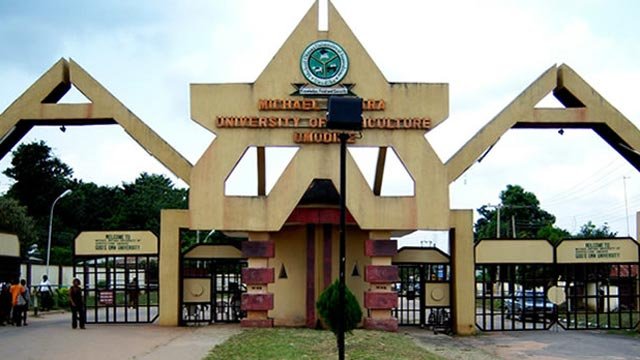

The Vice-Chancellor of Michael Okpara University of Agriculture, Umudike (MOUAU), Prof. U. N. Akanwa, has called for strengthened collaboration between research institutions to drive food security and agricultural transformation in Nigeria.
This was made known by the Vice-Chancellor at the National Root Crops Research Institute (NRCRI) Annual Research Review and Planning Workshop held in Umudike, Abia State.
Speaking at the event, Prof. Akanwa noted the need for innovative, climate-smart, and economically viable agricultural systems, describing the workshop theme, “Resilient Root and Tuber Cropping Systems for Scaling Productivity, Economic Impact and Entrepreneurship in Nigeria,” as both timely and strategic.
He noted that root and tuber crops remain central to Nigeria’s food system and agro-industrial value chain, stressing that collaborative research efforts are critical to improving productivity, enhancing livelihoods, and driving sustainable development.
The Vice-Chancellor commended NRCRI for its sustained contributions to agricultural research, particularly in the development of improved crop varieties, promotion of best agronomic practices, and support for agribusiness development.
Prof. Akanwa further emphasised that the workshop provides a valuable platform for knowledge exchange and strategic planning, expressing optimism that its outcomes would deliver practical solutions to strengthen the sector.
His words: “As a University ,with a strong mandate in agricultural education, research, and extension, Michael Okpara University of Agriculture, Umudike (MOUAU) recognizes and deeply appreciates the pivotal role NRCRI continues to play in advancing research on root and tuber crops commodities remain central to Nigeria’s food system and agro-industrial value chain. Your sustained efforts in developing improved varieties, promoting best agronomic practices, and supporting agribusiness develop1nent are commendable and impactful.
“This workshop provides an important platform for critical reflection, knowledge exchange, and forward planning. I am confident that the deliberations will yield practical solutions and actionable strategies that will not only boost productivity but also foster entrepreneurship and economic resilience among farmers and stakeholders across the value chain.”
He reaffirmed MOUAU’s commitment to deepening partnerships with NRCRI in research, capacity building, and innovation to address emerging challenges and support national food systems transformation.
Meanwhile, the Chairman of the Board of the National Root Crops Research Institute NRCRI Umudike, Hon. (Sir) Basil Ejidike, JP, has called on researchers and stakeholders to intensify efforts toward developing resilient root and tuber cropping systems that can drive productivity, economic growth, and entrepreneurship in Nigeria.
The Chairman described the gathering as a critical platform for assessing progress, addressing challenges, and shaping future strategies.
He noted that the meeting marked his first formal engagement with the Institute’s scientific community since his initial visit in 2025.
He emphasised that the theme of the meeting, focused on resilient cropping systems, aligns with the Renewed Hope Agenda of President Bola Ahmed Tinubu, stressing that agricultural research must play a central role in achieving national food security and economic stability.
According to him, Nigeria’s agricultural sector faces multiple challenges, including climate variability and supply chain disruptions, making it imperative for research outputs to extend beyond laboratories and experimental farms.
He urged scientists to develop innovations that ensure stable yields, consistent market supply, and affordability of food for Nigerians.
The Chairman reiterated the Institute’s mission to create and disseminate technologies that benefit farmers and processors, particularly smallholder farmers who remain the backbone of food production in the country.
He challenged researchers to ensure that their work translates into tangible economic benefits and entrepreneurial opportunities.
Highlighting key institutional priorities, he outlined four core pillars guiding the Institute’s operations.
These include advancing research and development to address emerging agricultural challenges, strengthening human capacity through knowledge sharing, fostering collaborations with local and international partners, and improving infrastructure to support high quality research.
On staff welfare, the Chairman assured employees of the Board’s commitment to improving working conditions.
He noted that a motivated workforce is essential for achieving excellence and maintaining the Institute’s leadership position in agricultural research.
He called on participants to make the review sessions impactful by offering practical recommendations.
He stressed the need for solutions that are not only scientifically sound but also economically viable and capable of strengthening the entire agricultural value chain from production to utilization.
In his closing remarks, he expressed appreciation to President Bola Ahmed Tinubu and the Minister for Agriculture and Food Security, Abubakar Kyari, for their continued support of agricultural research.
He also commended the Executive Director of NRCRI, Chiedozie Egesi, and his management team for their leadership and dedication.
The Chairman urged all researchers and staff to ensure that their contributions reflect the resilience and innovation required to build a stronger and more prosperous NRCRI.
The two day meeting is expected to feature presentations, technical reviews, and strategic discussions aimed at enhancing the Institute’s impact on Nigeria’s agricultural sector.