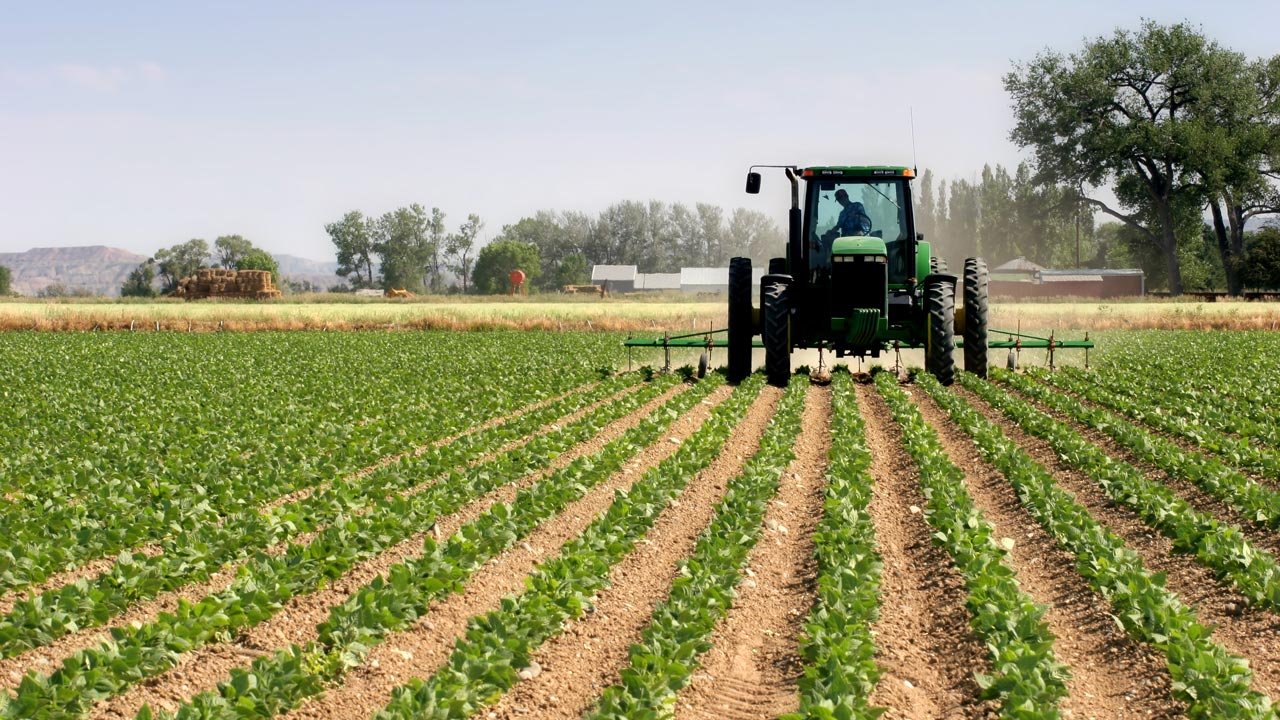

Former Abia State Commissioner for Agriculture, Chief Israel Amanze, has called on the Nigerian government to commit more efforts in encouraging mechanised farming in order to improve food production in the country.
While briefing journalists in Umuahia on Tuesday, Amanze, a recipient of many awards in agriculture, said the world has gone past subsistence farming, saying that the modern method of food production around the world is mechanized farming.
According to him, a push towards mechanised agriculture could transform rural farming communities in Abia in particular and Nigeria as whole, even as he urged stakeholders in the agricultural sector to be in the vanguard to replace manual labour with modern equipment.
This, he argued, would improve productivity and guarantee accelerated markets for farm produce.
Amanze, a veteran agri-business and a national officer of the Maize Association of Nigeria (MAN), expressed optimism over emerging partnerships between Nigeria and some foreign firms aimed at introducing tractors, modern farm machinery and structured off take arrangements for farmers.
Commending a recent effort by an indigenous firm in Abia, OMEC Investment, Nationwide Agricultural Mechanisation Company of Nigeria Ltd (NAMCON) and a Chinese company, Zoomlion Manufacturing, to introduce the mechanised agriculture in Abia State, Amanze regretted that Nigeria’s agricultural growth had long been limited by reliance on crude tools, “leaving farmers exhausted and yields low.”
According to him, the introduction of mechanised farming marks a critical turning point for food security and rural livelihoods.
“For many years, farmers worked with hoes and knives. Today, we’re talking about tractors and machines that can do in one day what hundreds of people cannot achieve”, he said.
The renowned agriculturist described the move into mechanised agriculture as timely, saying that mechanisation must go beyond equipment to include value addition, training and sustainable maintenance.
He used the opportunity to state that past agricultural interventions failed because farmers were encouraged to produce without assured markets, leaving harvests wasted.
“This time, there is a commitment to off take. Farmers are being told clearly that what they produce will be bought. That removes the fear of losses and encourages serious production,” he added.
The former Abia agric commissioner emphasised that machinery introduced to rural areas must be appropriate to local conditions and skill levels.
He stressed that sustainability depends on training farmers and technicians to operate and maintain equipment, rather than deploying machines that quickly become unusable.
He used the forum to call for stronger collaboration with agricultural extension workers to bridge the gap between innovation and the grassroots, pointing out extension services are essential for teaching farmers modern techniques, improved crop varieties and efficient use of fertilisers and herbicides.
Amanze, a federally licensed fertiliser blender, announced his readiness to partner with stakeholders to produce affordable organic and inorganic fertilisers locally and that local production would reduce costs, create jobs and ensure farmers have timely access to critical inputs.
“Mechanisation will only succeed if inputs are produced locally, by our own people, and made affordable. That is how agriculture becomes truly inclusive,” he said.
He, therefore, praised community leaders and facilitators for bringing the initiative closer to rural farmers, noting that practical demonstrations of tractors in villages had already begun to change perceptions.