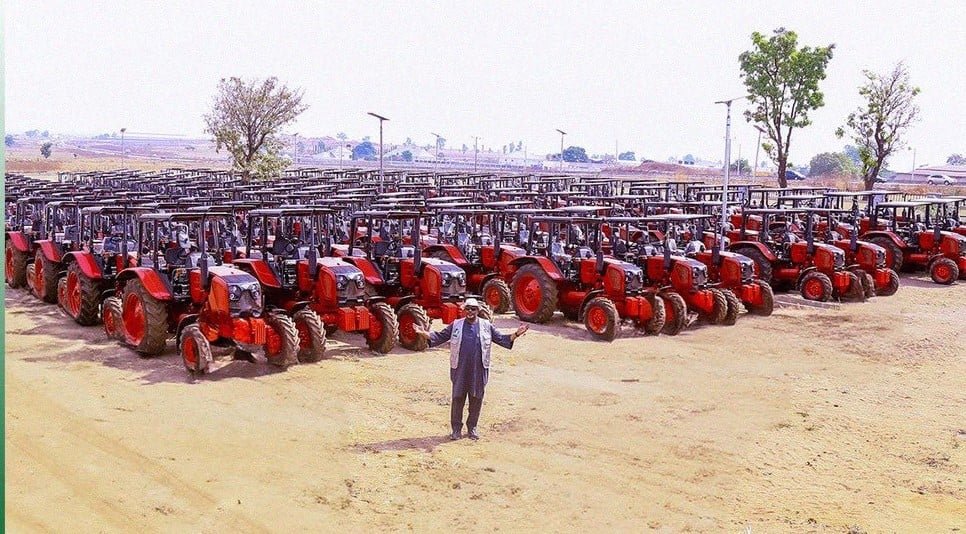

Seven months after the Federal Government launched 2,000 tractors under its agricultural mechanisation drive, federal lawmakers have demanded explanations over why the machines have yet to be deployed to farmers across the country.
The Minister of State for Agriculture and Food Security, Senator Sabi Abdullahi, faced intense questioning on Tuesday when he appeared before the Joint Senate and House of Representatives Committees on Agricultural Production to review the ministry’s 2025 budget performance and defend its 2026 estimates.
President Bola Tinubu had formally unveiled the tractors and other equipment on June 23, 2025, as part of efforts to boost food production nationwide. However, the continued delay in distribution has raised concerns within the National Assembly.
A member of the House of Representatives from Rivers State, Awaji Inombek, pressed the minister for clarity on the status of the tractors shortly after his opening remarks, demanding to know why farmers were yet to benefit from the highly publicised intervention.
Responding, Abdullahi explained that the tractors were procured under the Renewed Hope Agricultural Mechanisation Programme, which comprises three components, including the Belarus Mechanisation Programme already being implemented.
He disclosed that the Federal Government acquired 2,000 tractors of varying capacities, 75 and 85 horsepower models alongside combined harvesters, more than 9,000 agricultural implements and 12 mobile workshops.
Describing the concerns as legitimate, the minister said the government was deliberately restructuring the deployment process to avoid past failures, where tractors were allocated to non-farmers, poorly maintained and eventually abandoned. He noted that Nigeria currently has over 7,000 dysfunctional tractors due to flawed past interventions.
According to Abdullahi, President Tinubu directed that the new mechanisation programme must prioritise access and affordability for genuine farmers. To achieve this, the Bank of Agriculture has been mandated to manage the process, with advertisements already published targeting three beneficiary categories: youths, women in agriculture and established agricultural practitioners.
He said thousands of applications have been received and are undergoing due process, adding that the programme will operate through Agricultural Mechanisation Service Centres to be established across the six geopolitical zones.
Under the model, farmers regardless of farm size will access tractor services on a pay-per-use basis, while trained operators will be responsible for maintenance and repairs. Abdullahi added that spare parts for the newly procured tractors have already been supplied and young Nigerians are being trained to handle technical maintenance.
He assured lawmakers that rollout would begin gradually as the rainy season approaches, stressing that the delay was aimed at ensuring sustainability and efficiency.
Beyond mechanisation, Abdullahi said the ministry’s strategy aligns with the food security emergency declared by President Tinubu, focusing on scaling production across value chains and strengthening farmers’ resilience despite financial constraints. He acknowledged marginal increases in output based on government surveys but emphasized the need to address structural bottlenecks in the sector.
On budget performance, the minister revealed that while personnel costs under the 2025 budget have largely been implemented, capital project execution has been hampered by delayed fund releases. He disclosed that about 30 per cent of the ministry’s capital allocation approximately N18 billion—remains unreleased.
Lawmakers, however, expressed broader concerns about declining agricultural funding. Chairman of the House Committee on Agricultural Production and Services, Bello Ka’oje, warned that reduced allocations could undermine Nigeria’s food security ambitions and slow economic recovery if not urgently addressed.
He stressed that legislative oversight would ensure that public spending translates into tangible improvements in citizens’ lives.
Similarly, Chairman of the Senate Committee on Agriculture, Saliu Mustapha, urged the Federal Government to prioritise timely and adequate funding for the sector. He noted that while total national expenditure is projected to rise to N58.47 trillion in 2026, allocation to the agriculture ministry declined from N2.22 trillion in 2025 to N1.45 trillion in 2026.
Mustapha cautioned that insufficient funding and low capital implementation could deepen food insecurity and weaken productivity gains, calling for urgent corrective measures to safeguard national food security objectives.