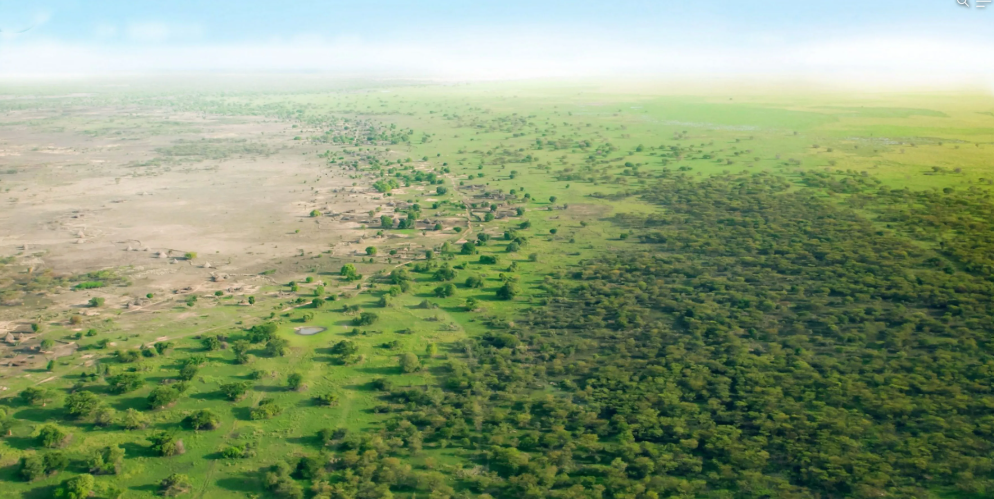

The United Nations Deputy Secretary-General, Amina Mohammed, says more than 20 million hectares of land have been restored through efforts associated with Africa’s Great Green Wall initiative.
Mohammed disclosed this at the opening of a high-level meeting of the UN Convention to Combat Desertification in Ulaanbaatar, Mongolia.
She said the initiative demonstrated the potential of African-led solutions to address land degradation, drought, food insecurity and declining livelihoods across the continent.
“Africa’s Great Green Wall offers one example of what scaling up could look like. More than 20 million hectares have been restored through efforts associated with the initiative and beyond its original corridor, including five million hectares regenerated by farmers in Niger,” she said.
According to Mohammed, the Great Green Wall has evolved from its original concept of establishing a line of trees across the Sahel into a broader development strategy linking land restoration with food production, job creation and economic opportunities.
She said the approach was particularly important in the Sahel and Lake Chad Basin, where drought, land degradation, conflict and insecurity continue to place pressure on vulnerable communities.
“Restoring land will not end conflict, but it can help to restore the livelihoods and opportunities that give people a stake in peace,” she said.
Mohammed noted that land degradation was reducing farmers’ and herders’ incomes, increasing food prices and weakening agricultural productivity, while placing additional pressure on water and energy systems.
She added that drought was also imposing significant economic costs on governments, which were forced to spend more on emergency responses, subsidies and reconstruction while losing tax revenues and, in some cases, taking on additional debt.
According to her, countries were investing too little in restoring degraded land even as the economic cost of inaction approaches $1 trillion annually.
She called on governments to move beyond isolated restoration projects by implementing national land restoration and drought resilience plans, supported by predictable financing and greater decision-making power for communities that depend directly on land resources.
Globally, up to 40 per cent of the world’s land is degraded, undermining food production and livelihoods. The frequency and duration of droughts have also increased by 29 per cent since 2000, with as many as three in four people potentially affected by drought by 2050.
Mohammed said more than 70 countries had developed national drought plans with support from the UN Convention to Combat Desertification, but stressed that securing the resources required to implement the plans remained a major challenge.
“You should not be asked to develop national plans and then be left to search for the means to deliver them. Finance has to be in place to invest in the priorities that countries have set for themselves,” she said.
She urged countries to integrate land restoration and drought resilience into national development and fiscal planning, while reforming subsidies that encourage unsustainable practices.
Mohammed also encouraged governments to explore innovative financing mechanisms, including green bonds and drought insurance, to strengthen investment in land restoration and climate resilience.