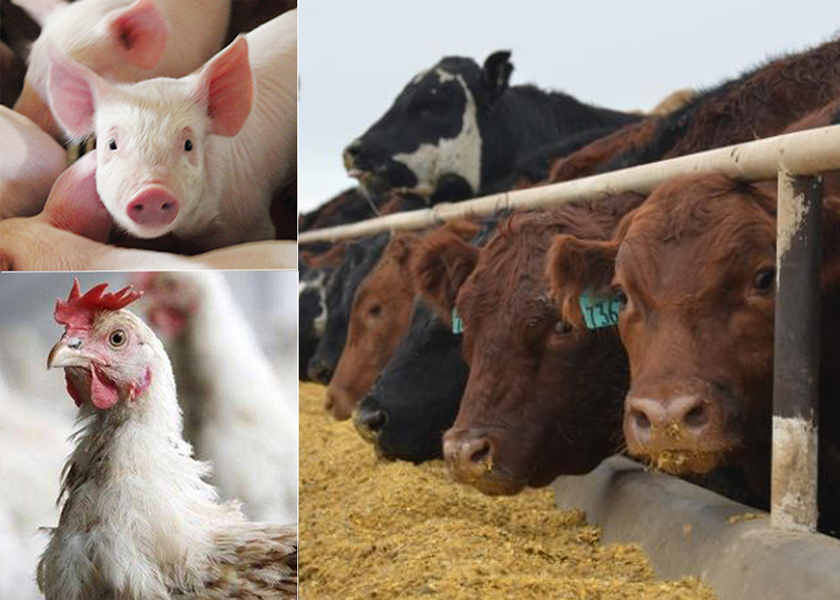

The Federal Ministry of Livestock Development (FMLD) has announced a new partnership framework that will see states select and develop specialised “Livestock Development Centres” in collaboration with the federal government and private investors, as part of a broader push to overhaul Nigeria’s livestock industry.
The plan was unveiled at a ministerial press briefing on Friday in Abuja.
Under the framework, participating states will, after consulting producers, community leaders and other stakeholders, choose the livestock species or value chain best suited to their agro-ecology, resources and market demand. States will provide land and infrastructure, while the FMLD supplies technical standards, coordination and regulatory oversight. Private investors and producer cooperatives will finance and run the commercial operations within each centre.
The ministry stressed that the centres are not intended to function as government-run farms, but as commercially driven hubs combining public infrastructure with investable businesses — spanning feed production, breeding, animal health, processing, cold-chain storage, hides and skins, and related services.
Rapid growth in state-level engagement was cited as evidence of momentum behind the initiative. When the FMLD was created in July 2024, only three states had dedicated livestock ministries; that number has since grown to twenty, with several others coordinating through their agriculture ministries’ veterinary and animal husbandry services.
The initiative is framed as the delivery mechanism for the National Livestock Growth Acceleration Strategy (NL-GAS), a ten-pillar roadmap approved by the National Economic Council that aims to raise the livestock sector’s contribution to GDP from $32 billion to at least $74 billion by 2035.
Officials pointed to several projects already under way or planned as examples of the model, including a 15,000-hectare centre for cattle, dairy and leather in Ubahu-Nkanu East, Enugu State; the MilkyWay Dairy in Bokkos, Plateau State; a 900-hectare goat ranch in Vandeikya, Benue State; a ₦120 billion livestock centre in Gombe State; and the Mafa Livestock Development Village in Borno State. Pig-focused centres were also cited in Yandev (Benue), Okpuje (Enugu) and Kachia (Kaduna).
The ministry said the approach responds to Nigeria’s regional imbalance in livestock trade, in which northern states hold the bulk of livestock while demand is concentrated in the south, forcing risky cattle movements of over 1,000 kilometres. Officials argued that state-specific investment plans built around local comparative advantage would be more secure and efficient than a uniform national model.
The framework also sets out distinct roles for each tier of government: the federal ministry will set standards, biosecurity and traceability protocols, and facilitate investment; states will handle land allocation, local infrastructure, security coordination and community engagement; and private investors will finance, build and operate the commercial assets.
The ministry said the centres are also designed to expand opportunities for women and young people beyond short-term training, positioning them for roles in enterprise ownership, value addition and service delivery across dairy, poultry and small-ruminant value chains.
Describing the plan as a way to convert national ambition into “local, investable action,” the ministry said the partnership model was designed to strengthen food security, create jobs, support rural development and reduce farmer-herder conflict as the sector expands.