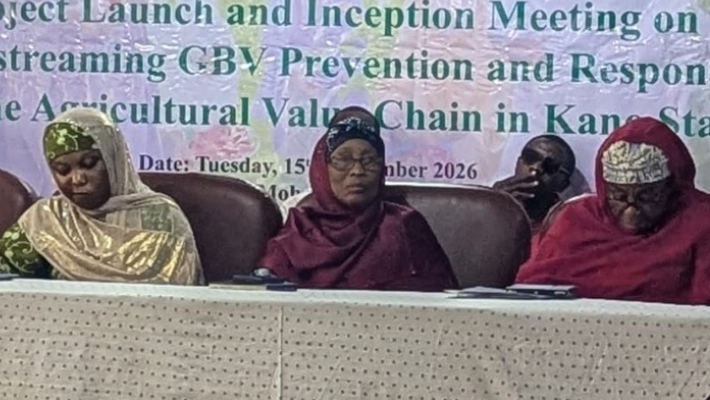

The Kano State Government has launched an intervention to tackle gender-based violence (GBV) affecting women in agriculture and strengthen their protection as they participate in agricultural value chains.
The initiative, implemented in collaboration with development partners, seeks to integrate GBV prevention and response into women’s economic activities, particularly agriculture, where women continue to play important roles in production and value addition.
The Commissioner for Women Affairs, Children and Persons with Special Needs, Hajiya Sajja Amina-Abdullahi, disclosed this on Tuesday at the project’s inception meeting and launch in Kano.
Amina-Abdullahi said the intervention was in line with the state’s Women Economic Empowerment (WEE) policy, which seeks to expand women’s economic participation through agriculture, skills acquisition and other livelihood opportunities.
She said the state government had so far empowered 5,200 women through various skills programmes, while development partners, including the African Enterprise Challenge Fund (AECF), Development Research and Projects Centre (dRPC), Fable Foundation and Isa Wali Empowerment Initiative, had supported women in agriculture and other economic activities.
The commissioner said the new intervention would address violence, discrimination and denial of women’s rights, while strengthening mechanisms for reporting and responding to cases.
She said the Ministry of Women Affairs had designated three GBV desk officers to coordinate prevention and response activities and urged women to report cases to enable the government to provide support to survivors and maintain accurate records.
Amina-Abdullahi also called on traditional and community leaders to speak out against violence against women and avoid stigmatising survivors.
She cited the case of a woman who sustained burns after allegedly being attacked with hot water by her husband, saying the ministry had intervened to secure medical attention and protect her rights.
“With the consent of the state government, the ministry has taken measures to protect her rights and ensure that she receives the necessary medication,” she said.
The Technical Adviser on the dRPC project, Nafisa Ado, said the intervention would work with traditional leaders, community members and beneficiaries of AECF-supported initiatives in selected communities.
Ado said the project was expected to reach 16,000 people, with 285 traditional leaders to be trained and 460 gender champions engaged to raise awareness on violence against women, girls and children.
She said communities including Rano, Bebeji and Dawakin Kudu would be covered, with the intervention focused on strengthening community-based mechanisms for preventing and responding to GBV.
Women involved in agricultural value-chain activities also participated in the launch, where discussions centred on preventing violence and improving support systems for women within their communities.