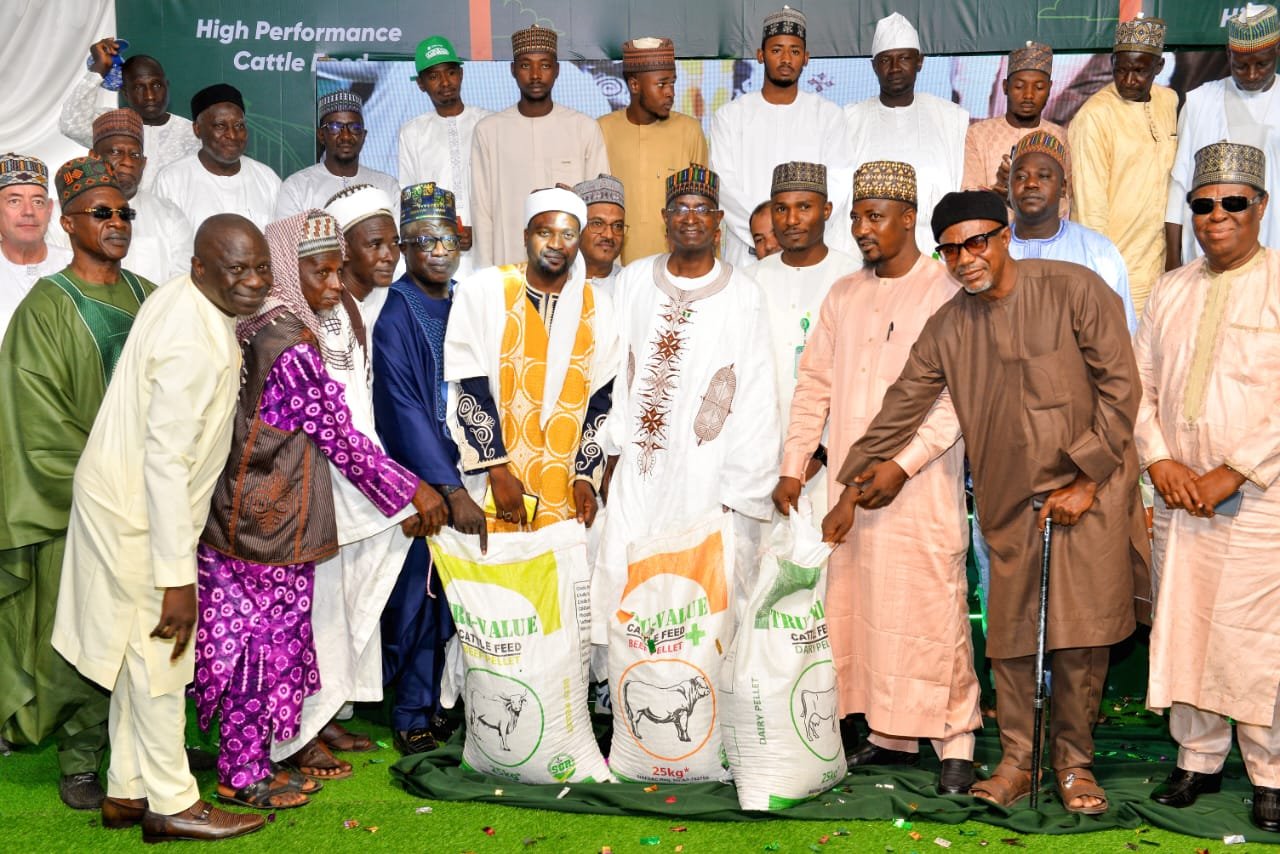

…Launches OlamAgri True Value Cattle Feeds
by Hassan Samuel
The Minister of Livestock Development, Idi Mukhtar Maiha, has identified access to adequate, affordable and nutritionally balanced feed as one of the major constraints to livestock productivity in Nigeria, saying the launch of OlamAgri’s True Value Cattle Feeds could help accelerate the modernisation of the sector.
Maiha made the remarks at the unveiling of OlamAgri’s Beef and Dairy Feed line, branded True Value Cattle Feeds, where he stressed that feed quality and availability have a direct impact on animal health, growth, milk production, fertility and the profitability of livestock enterprises.
According to him, concentrate feed is particularly important to the development of commercial feedlot systems for both large and small ruminants.
He said when combined with quality fodder, clean water and sound herd management, concentrate feed could improve feed conversion, accelerate weight gain, shorten finishing periods and enable farmers to take better-conditioned animals to market.
The minister said the Federal Government was also investing in critical infrastructure across the livestock value chain, including modern abattoirs, noting that groundbreaking had already taken place on two facilities, with more expected to follow.
He disclosed that an abattoir was being constructed in Abuja with the capacity to process 1,000 bulls and 3,000 small ruminants daily, describing the development as a major source of new demand for livestock producers across the country.
Maiha reaffirmed the government’s commitment to transforming Nigeria’s red meat value chain to meet domestic demand while positioning the country to compete in the international market.
He said a stronger feed industry would ensure a reliable supply of quality cattle, sheep and goats to abattoirs while stimulating investment in feedlots, processing, cold-chain infrastructure, packaging, transportation and marketing.
The minister said the same principle applied to dairy production, stressing that milk-producing animals require properly balanced energy, protein, minerals and vitamins.
He noted that improved nutrition would increase milk yields, enhance herd health, reduce the cost of producing a litre of milk and improve the supply of quality raw milk to processors.
Maiha, however, cautioned that introducing new feed products would not by itself solve Nigeria’s livestock productivity challenges, calling for a broader effort to organise and professionalise the country’s feed and fodder industry.
He advocated stronger collaboration among fodder growers, crop farmers, feed millers, livestock producers, researchers, financial institutions and processors, as well as improved feed testing, proper ration formulation, certification of commercial feeds and stricter monitoring for contaminants such as mycotoxins.
He also called for increased investment in pasture development, irrigated fodder, commercial fodder farms, hay and silage production, improved fodder seed systems and extension services to address seasonal feed shortages, particularly in northern Nigeria during the long dry season.
The minister urged OlamAgri to ensure that its feed products remained accessible and affordable to commercial farmers, cooperatives, pastoralists and smallholder producers. He also encouraged the company to support farmer training, feeding demonstrations and partnerships with relevant regulators.
He said the broader objective was to build a livestock industry capable of creating jobs, increasing rural incomes, strengthening food and nutrition security, promoting social harmony and serving both domestic and export markets.
According to Maiha, Nigeria is already attracting interest from prospective red meat buyers in the Gulf, the wider Middle East, Egypt and West Africa, making increased livestock productivity critical to unlocking the sector’s export potential.
He identified the National Livestock Growth Acceleration Strategy, approved by the National Economic Council, as the roadmap for transforming the sector. The strategy targets an increase in the value of Nigeria’s livestock economy from $32 billion to $74 billion within a decade by moving the industry from fragmented, subsistence-level operations towards a commercially organised and competitive system.
Maiha said the strategy prioritises livestock development centres rather than grazing reserves or Ruga, with states expected to determine the species and value chains that best suit their local ecology and economies.
He said considerations would include water availability, site suitability, transparent land allocation and market demand, while stressing that the Federal Government had no intention of taking land from citizens.
Under the proposed model, he explained, the Federal Government would work with state governments and private investors to establish the centres, while private operators would take responsibility for day-to-day management and governments would provide the enabling environment.
He described feed and fodder as central to the success of the livestock development centres, requiring coordinated action from the Ministry of Livestock Development, state governments and private sector operators.
Maiha also disclosed that the Nigerian Livestock Economy Advancement Program would soon be launched to help producers capture and retain more value by connecting them with financiers, insurers, breeders, aggregators and marketers.
He said OlamAgri’s True Value launch aligned with this objective by strengthening livestock production at the grassroots.
Drawing from his field experience, the minister said he had witnessed the impact of properly formulated concentrate feed on livestock performance, citing cases of calves gaining about 1.3 kilogrammes daily, reaching breeding age earlier and, in some cases, attaining weights of about 450 kilogrammes at 13 months.
He said the results demonstrated what could be achieved through proper nutrition, knowledge and sound management, while commending Olam Agri’s board, management and staff for what he described as a significant milestone for Nigeria’s livestock industry.
Speaking on behalf of the Kaduna State Government, the Senior Special Assistant to Governor Uba Sani on Land Matters said the governor had positioned Kaduna as a hub for food security, industrialisation and agricultural growth, with support from the Ministry of Livestock Development.
He said Kaduna had domesticated most federal agricultural policies in line with the state’s priorities, adding that its strategic location made it a gateway between the northern and southern parts of the country.
He congratulated OlamAgri on the investment and pledged the state government’s support for investors.
Speaking with AgroNigeria on the sidelines, Sharad Gupta, President and Global Head of OlamAgri’s Animal Feeds and Proteins Business, said the company would source between 98 and 99 per cent of the raw materials for its animal feed operations locally as it enters Nigeria’s ruminant feed market.
Gupta said the strategy was designed to reduce production costs and improve livestock productivity, adding that it mirrored the company’s poultry feed operations, which rely almost entirely on locally sourced inputs including maize, soybean, rice bran, groundnut cake, minerals and limestone.
He said OlamAgri would leverage its existing supply chains, production capacity and distribution network, which currently includes more than 500 feed dealers and an estimated 40,000 to 50,000 poultry farmers, while also working with dealers already active in the cattle market to reach beef and dairy producers.
According to Gupta, the company intends to compete through scale and efficiency rather than subsidies or credit facilities, arguing that large-scale local production would provide a cost advantage that could ultimately be passed on to farmers.
He added that OlamAgri’s position as one of Nigeria’s major wheat millers provided an additional advantage, with wheat bran from its milling operations serving as a key ingredient in cattle feed.
Gupta said the company’s broader strategy was to improve efficiency across sourcing, manufacturing and distribution to ensure farmers had access to quality feed at competitive prices.
Describing the launch as a “humble beginning,” he said OlamAgri had studied the government’s Livestock Economy Advancement Programme and found its clarity, ambition and vision closely aligned with the company’s expansion plans in the cattle feed market.
He recalled that Olam Agri commenced its feed business in Nigeria in September 2017 and had since built significant experience in poultry and aquaculture feed production.
Gupta said the company’s expansion into cattle feed was driven by the enormous need among Nigeria’s traditional livestock farmers, particularly in the northern region, and expressed Olam Agri’s readiness to serve as an implementation partner in delivering the government’s livestock development agenda.
The company also warned that Nigeria must urgently raise livestock productivity to close its protein deficit as the country’s population is projected to approach 400 million by 2050.
Sameer, Vice President for Poultry and Agribusiness at OlamAgri, said Nigeria would require 115 per cent more beef and 175 per cent more milk to meet projected demand, making increased livestock productivity imperative.
He said the average Nigerian currently consumes about 45 grammes of protein daily, below the 53.8 grammes recommended by the Food and Agriculture Organisation, describing the gap as one that Nigeria must urgently address.
Sameer said a six-month market assessment conducted by OlamAgri found that farmers were struggling with poor access to quality feed and inconsistent supplies of raw materials.
He noted that many farmers continued to depend on traditional knowledge and, even where they understood the nutritional requirements of their animals, were often forced to use whatever feed ingredients were available.
According to him, such compromises ultimately affect livestock quality and productivity.
He said OlamAgri’s intervention would focus on balanced nutrition, standardised quality and consistency, adding that the company’s experience in poultry and aquaculture feed production had provided a strong foundation for supporting the transformation of Nigeria’s cattle industry.