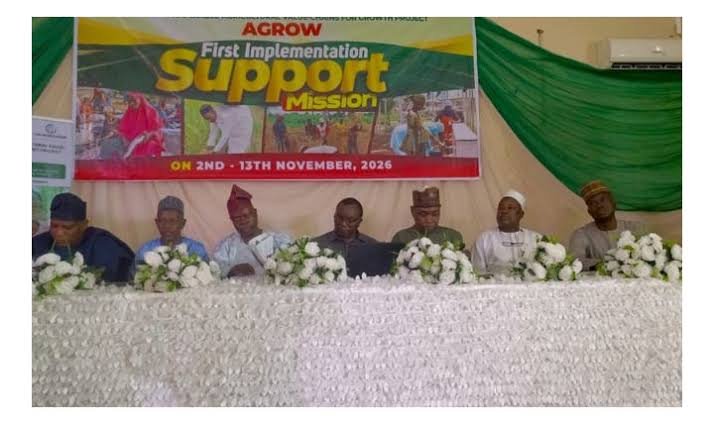

The Federal Ministry of Agriculture and Food Security has identified 89 issues requiring clarification and resolution in the draft implementation manuals for Nigeria’s $500 million Sustainable Agricultural Value Chains for Growth (AGROW) Project.
The Federal Director of the Department of Development Partners Projects, Dr Emmanuel Akogun, disclosed this on Monday in Minna during the project’s first implementation support mission and stakeholder consultation, hosted by the Niger State Government.
Akogun said the issues were identified in the draft Project Implementation Manual and the Agricultural Development Matching Grant Facility Operations Manual, and grouped into six key areas.
They include the flow of funds for matching grants, governance of the grant facility, provisions of sub-grant and state agreements, eligibility criteria, results verification, and environmental and social risks and grievances.
He said the two-day consultation was convened to review the draft documents, clarify outstanding issues and ensure the manuals were ready for finalisation.
The review is part of the preparations for the World Bank-backed project, which is awaiting the completion of implementation arrangements before it can become effective.
The World Bank’s Lead Agricultural Economist and AGROW Task Team Leader, Hardwick Tchale, said the bank’s Board approved the project in March 2026, but the necessary arrangements for its implementation were still being put in place.
He explained that the first support mission was assessing the readiness of federal and state institutions responsible for delivering the project.
Tchale said the $500 million initiative would help smallholder farmers improve productivity and gain access to structured markets through off-takers.
“AGROW will help targeted farmers move from farming as a livelihood to farming as a business, a source of improved income and a source of decent jobs,” he said.
The project will deploy a performance-based matching grant facility to support investments across primary production, aggregation, processing and value addition.
Tchale said “its initial priority commodities are rice, maize, soybeans and cassava, while participating states may identify other commodities based on their priorities and market opportunities”.
He added that the initiative would provide support for improved crop varieties, digital farmer registries, weather information and digital soil advisory services to help farmers make informed production decisions.
The number of participating states is yet to be determined, he said, noting that the Federal Ministry of Agriculture and Food Security would make the decision in consultation with state governments.
The National Project Coordinator of AGROW, Engr Ibrahim Alkali, said the implementation manuals must clearly outline procedures for farmers, agribusinesses and implementing institutions.
He said the documents should specify eligibility requirements, application procedures and how beneficiaries could access the matching grant facility.
Also speaking, the Permanent Secretary of the Niger State Ministry of Agriculture, Dr Ahmed Mathew, said the state had communicated its readiness to participate through the National Project Coordinator, citing its agricultural potential.
The representative of the Federal Ministry of Finance, Mrs Anthonia Udo, urged implementing institutions and state governments to uphold transparency, accountability and prudent management of project funds while fulfilling the financial and institutional requirements for implementation.