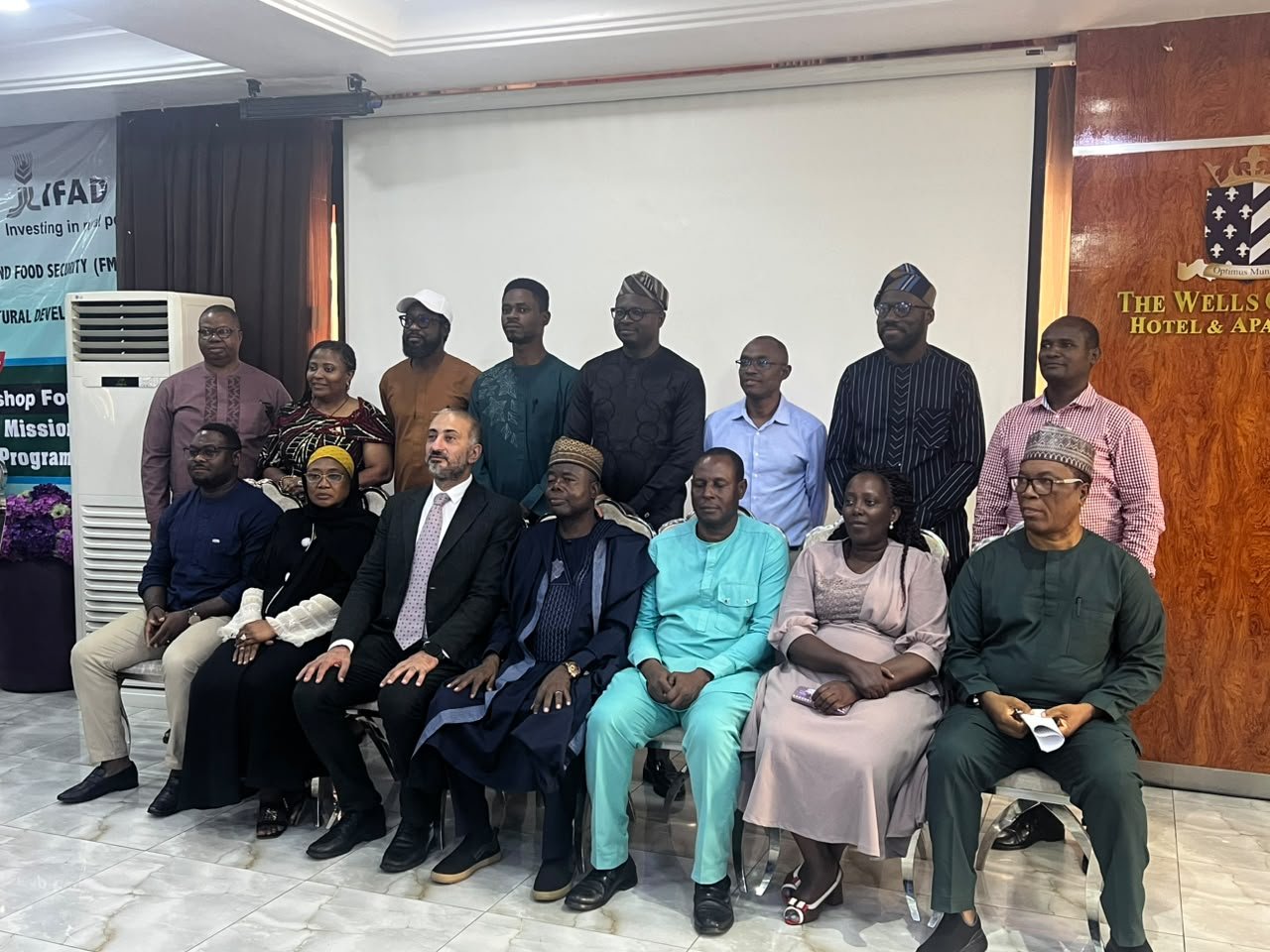

The Federal Government and the International Fund for Agricultural Development (IFAD) have commenced the 13th Joint Supervision Mission of the Value Chain Development Programme (VCDP), with stakeholders commending the project’s performance and urging measures to sustain its achievements as it approaches completion.
The mission, inaugurated on Tuesday at an inception workshop at Wells Carlton Hotel, Asokoro, Abuja, is scheduled to run from October 12 to November 6, 2026. It will assess the programme’s implementation and financial performance, review compliance with previous recommendations and evaluate preparedness for completion.
Stakeholders at the workshop acknowledged VCDP’s contributions to Nigeria’s rice and cassava value chains, particularly in improving agricultural productivity, expanding processing and storage infrastructure, strengthening market access and supporting the livelihoods of rural households.
Speaking at the event, the Director of the Federal Department of Development Partners Projects, Federal Ministry of Agriculture and Food Security, Dr Emmanuel Oladipo Akogun, said the programme remained broadly on track, with overall implementation rated satisfactory and more than 98 per cent of its outreach target achieved.
He said VCDP had facilitated the development of rice and cassava processing and storage facilities, promoted improved agricultural practices and seed adoption, and strengthened collaboration among farmers, private sector operators and financial institutions.
However, Akogun stressed that the remaining implementation period was critical to completing outstanding activities and consolidating the programme’s gains.
He identified delays in fund disbursement, procurement and contract processing, gaps in counterpart funding, poor sequencing of activities and financial management challenges as issues requiring urgent attention.
He also called for sustainable financing arrangements for infrastructure maintenance, stronger farmer organisations and commodity aggregation centres, continued private sector partnerships and clearer institutional responsibilities at federal and state levels.
According to him, the mission should ensure that recommendations are linked to specific institutions and implementation deadlines, while preparations for the endline evaluation, programme completion report, audit and asset management are strengthened.
The IFAD Country Director, Mr Mohamed El-Ghazaly, said the mission would focus on resolving outstanding challenges, strengthening accountability and establishing practical arrangements to sustain the programme’s impact beyond its lifespan.
He noted that VCDP had expanded from six to nine states through additional financing, extending support to rural households involved in rice and cassava production and processing.
El-Ghazaly urged government institutions and development partners to agree on actionable measures, with clearly defined responsibilities and timelines, to address implementation gaps and secure lasting development outcomes.
Also speaking, the Director of International and Economic Relations at the Federal Ministry of Finance, Mr Stanley George, represented by Mr Andrew Arebun, commended the programme’s progress in improving market access, increasing rice and cassava productivity and enhancing the livelihoods of women and young people.
“Our experiences and data from VCDP have clearly demonstrated what is possible when structural support meets rural resilience,” Arebun said.
He, however, warned that delayed fund disbursement, inadequate compliance with counterpart funding obligations and bureaucratic bottlenecks could undermine implementation and affect rural households whose livelihoods depend on agriculture.
Arebun said the ministry would continue engaging state governments to facilitate the timely release of counterpart contributions, while urging implementing agencies to address administrative delays and strengthen climate-resilient infrastructure to protect programme investments.
On sustaining the project’s gains, he advocated a transition towards commercially viable agricultural models that connect smallholder farmers to reliable markets and reduce dependence on subsidies.
He said stronger partnerships with commodity buyers would help farmers secure markets, improve incomes and sustain their enterprises after direct project support ends.
Arebun also called for stronger monitoring and evaluation systems to provide timely and verifiable evidence of programme outcomes and guide public investment decisions in agricultural development.
“A supervision mission is not a policing exercise; it is a collaborative diagnostic health check,” he said.
The National Programme Coordinator of VCDP, Dr Fatima Aliyu, described the mission as an opportunity to assess progress against agreed targets, identify emerging challenges and develop practical solutions to improve programme delivery and sustainability.
She explained that VCDP, implemented by the Federal Ministry of Agriculture and Food Security with IFAD support, was designed to improve the productivity, processing, marketing and market access of smallholder farmers and other actors across Nigeria’s rice and cassava value chains.
According to her, the programme’s interventions extend beyond increased production to include stronger farmer organisations, improved access to quality inputs and appropriate technologies, rural market infrastructure and financial services.
Aliyu said women, young people and persons with disabilities remained priority beneficiaries through targeted capacity development, financial inclusion initiatives and enterprise support.
She listed the nine participating states as Anambra, Benue, Ebonyi, Enugu, Kogi, Nasarawa, Niger, Ogun and Taraba.
The coordinator said the mission would review performance against the annual work plan and budget, fund disbursement and utilisation, procurement, financial management, safeguards, monitoring and evaluation, and the performance of key programme components.
The exercise would also involve engagements with state programme teams and beneficiaries to obtain firsthand feedback, document successful interventions and identify bottlenecks requiring management attention.
“We view supervision not merely as a compliance exercise, but as an important opportunity for learning, problem-solving, accountability and strategic realignment,” Aliyu said.
She emphasised that sustaining VCDP’s achievements would require strong federal and state ownership, functional farmer organisations, viable agribusinesses, effective market linkages and continued access to financial services.
Aliyu further highlighted the importance of knowledge management and documenting lessons from the programme to inform agricultural policies and the design of future development interventions.
The Federal Government and IFAD reaffirmed their commitment to working with participating states and other stakeholders to ensure that VCDP investments translate into sustained improvements in rural incomes, agricultural productivity, food security and resilience beyond the programme’s completion.