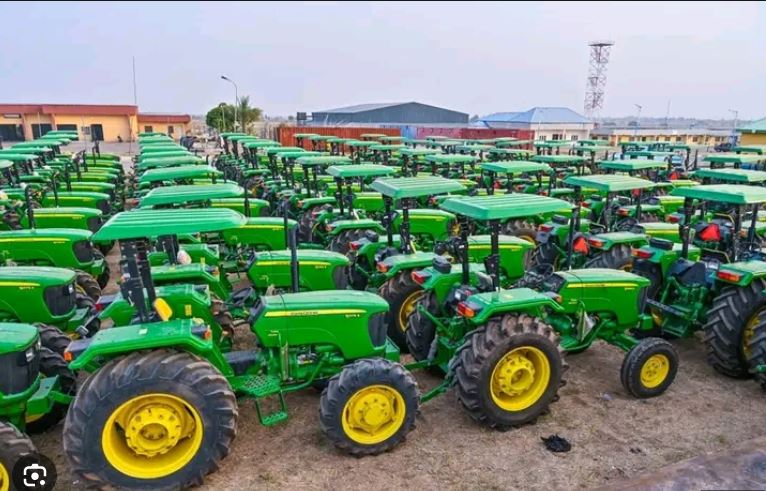

The Federal Government has proposed sweeping institutional and structural reforms in the agricultural sector, alongside digitalisation, mechanisation and improved coordination among government agencies, as part of efforts to boost food production, reduce food inflation and strengthen food security across the country.
The Senior Special Adviser on Agricultural Innovation to the Federal Ministry of Agriculture and Food Security, Professor Ademola Adenle, disclosed this during an interview, where he outlined the government’s plans to address longstanding challenges affecting agricultural productivity and food affordability.
Adenle said digitalisation would enable the government to identify farmers, monitor agricultural production, ensure transparent distribution of farm inputs and expand farmers’ access to markets.
He explained that the National Agricultural Growth initiative had introduced a system in which agro-dealers distribute inputs to verified farmers, while monitoring their production activities and performance.
According to him, the intervention has contributed to a 30% increase in production, with wheat output rising from an annual baseline of 420,000 tonnes to 480,000 tonnes.
However, he acknowledged that increased production alone would not automatically translate into lower food prices, stressing the need to address institutional weaknesses and structural inefficiencies that have affected the agricultural sector for decades.
He said previous agricultural programmes had largely concentrated on production and the distribution of inputs without adequately addressing challenges relating to institutional capacity, food security and agro-industrialisation.
Adenle called for an overhaul of the ministry’s administrative and legal structures, noting that accumulated bureaucratic bottlenecks and inefficiencies had limited the effectiveness of agricultural interventions.
He identified poor coordination among federal, state and local governments as one of the major challenges confronting the sector, advocating harmonised agricultural policies across the three tiers of government.
He also proposed performance-based agricultural financing, annual key performance indicators, stronger monitoring and evaluation mechanisms, data-driven decision-making and legislation to promote accountability and transparency.
On the persistent increase in food prices, Adenle identified the alleged illegal movement of agricultural produce across Nigeria’s borders and the hoarding of food commodities as factors contributing to domestic supply shortages and food inflation.
He said the movement of food outside the country could create artificial scarcity in local markets, while the stockpiling of grains could further drive up prices.
He disclosed that the Nigeria Customs Service and the Federal Competition and Consumer Protection Commission were working with other security agencies to address the challenges.
Adenle also recommended a coordinated border protection and food security framework involving relevant government agencies to tackle illegal food movements and other disruptions to domestic supply.
On measures to improve agricultural productivity, he said the government was scaling up mechanisation, irrigation, the adoption of high-yielding crop varieties and soil improvement initiatives.
He explained that under the Renewed Hope National Agricultural Mechanisation Programme (RHNAMP) that is managed by the Bank of Agriculture, farmers and service providers could access tractor financing through a flexible ownership arrangement.
He said farmers would access tractors through service providers and organised farmer clusters, paying for the services to ensure the sustainability of the financing arrangement.
Addressing insecurity in farming communities, Adenle said agricultural innovation could not succeed without an integrated security framework involving security agencies, farmers, farmers’ associations and other stakeholders.
He stressed that insecurity, transportation challenges and disruptions to farming activities were interconnected problems requiring coordinated interventions rather than isolated solutions.
Adenle said the changes were intended to strengthen institutional focus on crop production, food security and sustainable agriculture.
He further disclosed that the ministry was working towards placing food security at the centre of the country’s agricultural framework, with a target of reducing food inflation to single digits.
According to him, the government also intends to develop integrated agricultural value chains and promote agro-industrialisation to create jobs, stimulate economic growth, increase value addition and reduce poverty.
He said the proposed reforms would contribute to the administration’s ambition of building a $1 trillion economy by 2030.
He however noted that there is still a gap between the government’s agricultural production targets and the immediate concerns of households, particularly the high cost of food, farmers’ exposure to insecurity and persistent weaknesses in storage, processing, transportation and distribution.
Adenle maintained that addressing these challenges would require sustained institutional reforms and collaboration among stakeholders across the agricultural value chain.