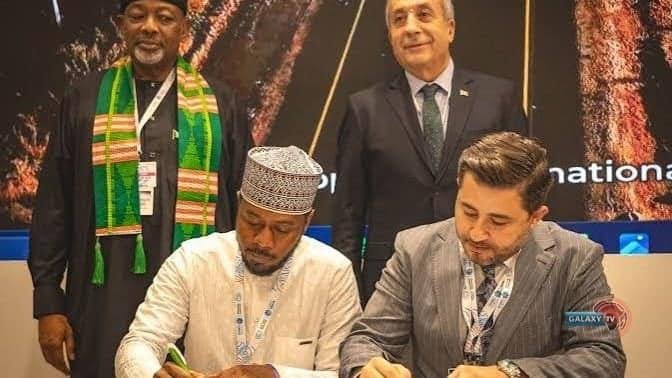

Nigeria has secured a $3 million investment agreement to establish 1,000 climate-smart greenhouses for tomato production in Kano State, as part of efforts to attract private investment and strengthen sustainable food production.
The agreement was signed at the ongoing COP31 climate summit in Türkiye on Wednesday, with the Minister of Agriculture and Food Security, Abubakar Kyari, witnessing the signing of a memorandum of understanding under the Special Agro-Industrial Processing Zones (SAPZ) programme.
The pilot project will involve the Bank of Agriculture, SAPZ and Turkish firm Direkci Group, with plans to deploy approximately 1,000 climate-adapted greenhouses.
Under the arrangement, the Bank of Agriculture will contribute $1.5 million to establish a financing mechanism for participating farmers, while Direkci Group will provide another $1.5 million in private-sector financing, greenhouse technology, engineering, installation and technical support.
Kyari described the agreement as a practical step towards modernising agriculture and attracting private capital into the sector.
“Our ambition must go beyond producing more food. The President of Nigeria, Bola Tinubu, has given us that marching order and has demanded since he declared an emergency on food, that we must build an agricultural sector that is modern, productive, commercially viable, and capable of creating wealth for our people,” he said.
He said the initiative demonstrated how government institutions and private investors could collaborate to move agriculture towards technology-driven and market-oriented production.
The minister added that women and smallholder farmers would be prioritised through access to productive assets, financing, technical mentorship and market linkages.
He disclosed that the partners would conduct a joint performance review after nine months, with a possible commercial expansion involving greenhouse systems and equipment valued at a minimum of $30 million, subject to agreed acquisitions and performance targets.
However, Kyari stressed that the project’s success would depend on effective implementation, transparent farmer selection, timely infrastructure delivery and measurable outcomes.
A representative of Direkci Group expressed confidence in Nigeria and the company’s readiness to expand its investments in the country.
“We believe in a great Nigeria. When we look at the history, Nigeria already has a great future, and we believe in the future of Nigeria, and we are still in Nigeria to make it more invest,” the representative said.
The representative added that the company was willing to extend its technology and expertise to other parts of Nigeria, describing the initiative as an investment in women, young people and the country’s future.
Earlier, the Director-General of the National Council on Climate Change, Tenioye Majekodunmi, said Nigeria was seeking partnerships that would translate climate commitments into investments in communities, industries and infrastructure.
“For Nigeria, climate implementation must mean economic opportunity,” she said.
Majekodunmi said the country was shifting from climate policy formulation to practical implementation, with emphasis on attracting finance, promoting technology transfer and creating green jobs.
She added that a just energy transition must be equitable, adequately financed and responsive to the development needs of emerging economies.
The Nigeria Day event also featured the launch of the Nigeria Oil and Gas Industry Emission Tracker (NOGIET) by the Nigerian Upstream Petroleum Regulatory Commission (NUPRC), in partnership with Stakeholder Democracy Network, Global Methane Hub and other Nigerian regulators.
The platform is expected to strengthen emissions monitoring and support the implementation of Nigeria’s upstream decarbonisation policies.
At a separate NUPRC side event, the Commission Chief Executive, Oritsemeyiwa Eyesan, said Nigeria had the potential to become a leading carbon capture, utilisation and storage hub in Africa.
She identified the country’s depleted oil and gas reservoirs, existing energy infrastructure and regulatory framework as key advantages for developing carbon storage projects.
“The global conversation on climate action is increasingly shifting from commitments to execution. Countries are now being judged not by the targets they announce, but by the projects they deliver, the emissions they reduce, and the capital they mobilise,” Eyesan said.
She said Nigeria must reduce emissions while safeguarding energy security, economic growth and social development.
Eyesan disclosed that assessments by the Clean Air Task Force indicated that methane-abatement measures in Nigeria could reduce emissions by about 533 kilotonnes annually, with some implementation costs recoverable through the commercialisation of captured gas.
She also said the country’s Gas Flare Commercialisation Programme could support projects utilising up to 250 million standard cubic feet of gas daily and unlock investment opportunities estimated at $2.2 billion.
According to her, the regulator was working to turn decarbonisation into an investment opportunity through demand for methane measurement, leak detection, emissions monitoring, flare-gas recovery and carbon-management technologies.
The Nigeria Day event was formally opened by the Minister of State for Foreign Affairs, Ambassador Sola Enikanolaiye, who commended Nigerians at the summit for promoting the country’s climate initiatives and development priorities.
He described the conference as an opportunity to showcase Nigeria’s domestic efforts and attract international partnerships to support its climate and national development programmes.
The activities highlighted Nigeria’s efforts to use COP31 as a platform to attract investments and partnerships capable of delivering practical projects across agriculture and the energy sector.