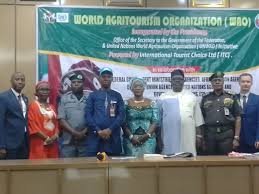

Nigeria has intensified its campaign for global recognition of agritourism, using the commemoration of the third World Agritourism Day in Abuja to rally international support for the adoption of May 16 as an official United Nations observance.
The event, held at the Conference Hall of the Office of the Secretary to the Government of the Federation in Maitama, attracted diplomats, policymakers, development institutions, and government agencies who discussed strategies to strengthen agritourism as a tool for food security, employment creation, and rural development.
Speaking at the gathering, President of the World Agritourism Organization, Amb. Arc. Trust Henry Ogboi, said Nigeria was positioning itself at the forefront of a new global movement that connects agriculture with tourism and investment opportunities. According to him, the organization, which was inaugurated through the Office of the Secretary to the Government of the Federation, is designed to support sustainable economic growth through partnerships with both local and international investors.
Ogboi stated that Nigeria’s history in global tourism advocacy dates back decades, recalling the role played by Ignatius Amaduwa Atigbi in the establishment of World Tourism Day, now celebrated worldwide every September 27. He explained that the inauguration of World Agritourism Day on May 16, 2023, marked another milestone for the country’s tourism and agricultural sectors.
He disclosed that Nigeria would formally present a proposal for the establishment of a United Nations World Agritourism Organization at the 81st Session of the United Nations General Assembly scheduled for September 8, 2026, in New York. He added that the Federal Ministry of Foreign Affairs had been mandated to coordinate diplomatic engagements aimed at securing global backing for the initiative.
Participants at the ceremony also witnessed the unveiling of an Agritourism Global Perspectives Practice Policies Guidelines and Framework Roadmap, a document intended to provide direction for countries and investors seeking to develop agritourism projects.
Representing the Secretary to the Government of the Federation, George Akume, government officials described agritourism as an important bridge between agriculture, tourism, trade, and cultural preservation. They noted that expanding the sector could boost rural economies through educational visits, farm based enterprises, festivals, and direct agricultural sales while supporting Nigeria’s food security targets under the Renewed Hope Agenda.
Foreign diplomats at the event expressed support for deeper international cooperation in the sector.
Burundi’s envoy, Mr. Desire Hpfubuja, said agritourism aligns with Burundi’s long term development plans aimed at transforming agriculture and achieving food sufficiency. He noted that agriculture remains the primary source of livelihood for the majority of Burundians and stressed that the sector could create opportunities for women and young people.
Russia’s Agricultural Attaché, Vladimir Efremov, said Russia had successfully turned farms into recreational and educational destinations for city residents seeking closer ties to agriculture. He emphasized that partnerships between governments and private investors are essential for improving food production and tackling hunger.
India’s Deputy High Commissioner, Ms. Voultihe Rowat, highlighted India’s agricultural transformation through technological innovation and major agricultural reforms. She pointed to India’s globally recognized spice gardens, tea plantations, and orchards as examples of thriving agritourism destinations and pledged support for collaboration with Nigeria.
Also speaking, Ghana’s Deputy High Commissioner, Dr. Gladys Deddy Akyoa, said Africa possesses enormous agricultural potential due to its vast uncultivated arable land. She said agritourism could stimulate economic activity in rural communities, create jobs, and open new income streams for young Africans.
The Nigerian Tourism Development Authority, represented by Lucas Nelson Shehu on behalf of Director General Ola Awakan, reaffirmed the agency’s commitment to promoting agritourism as part of efforts to diversify the economy and encourage youth participation in productive sectors.
Representatives of the Federal Ministry of Agriculture, the Federal Road Safety Corps, Nigeria Correctional Services, SMEDAN, and other agencies also attended the programme. Stakeholders at the event agreed that agritourism remains a vital pathway toward achieving the United Nations Sustainable Development Goals on poverty reduction and zero hunger.