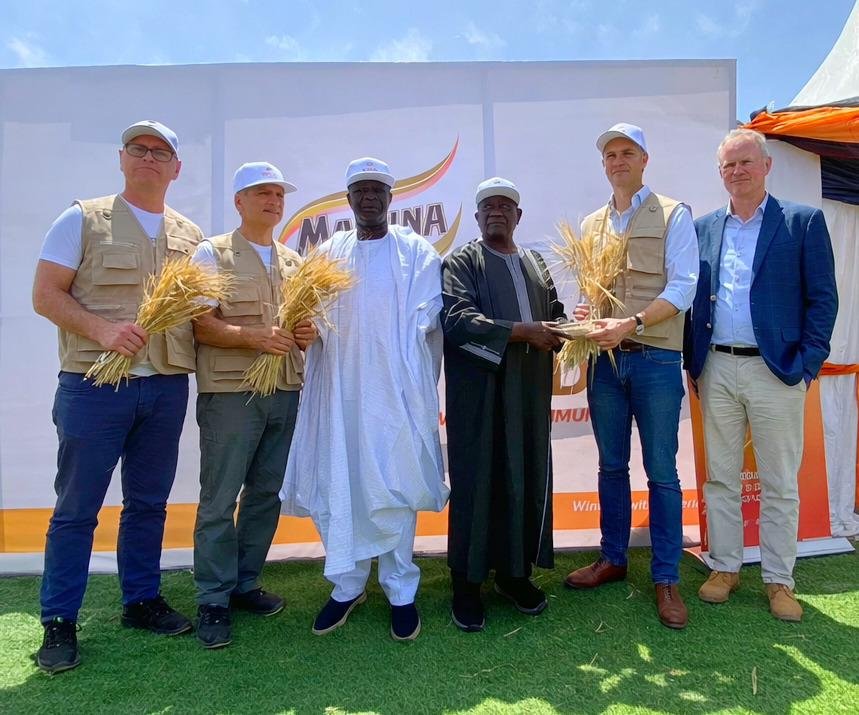

Nigeria’s ambition to develop a domestic barley industry has received a fresh push as Nigerian Breweries Plc declared that the country has the potential to achieve self-sufficiency in the crop if government and key stakeholders support efforts to scale up local production.
The Managing Director and Chief Executive Officer of the company, Thibaut Boidin, said successful cultivation trials have demonstrated that barley can thrive in Nigerian soil, marking an important step toward reducing the country’s heavy dependence on imports.
Boidin spoke during the 2026 Barley Field Day held in Ringim, where farmers and industry stakeholders were presented with the agronomic proof of concept for domestic barley production.
He explained that the company’s long-term vision is to establish a barley value chain driven by Nigerian farmers and capable of supplying the quality standards required by the brewing industry.
“Our ambition is clear—to develop a barley value chain rooted in Nigerian soil and powered by Nigerian farmers,” he said, noting however that achieving that target would require sustained collaboration across the agricultural ecosystem.
Boidin stressed that while the private sector had initiated the programme, large-scale success would depend on strong and consistent government support as well as partnerships with financial institutions, research organisations and input providers.
Nigeria’s brewing industry currently imports about 200,000 tonnes of malted barley annually, a dependence that drains more than $150 million from the economy each year.
According to Boidin, the company’s Maltina Barley Programme has already brought over 1,000 smallholder farmers into barley cultivation this season, with production expected to exceed 1,000 tonnes.
Although the output demonstrates the potential of the crop under Nigerian conditions, he acknowledged that it represents only a small portion of the country’s overall demand, making expansion critical for long-term success.
Also speaking, the company’s Supply Chain Director, Federico Agressi, described the development of a sustainable barley value chain as a gradual process that would require persistence and coordinated contributions from multiple stakeholders.
He noted that farmers, seed companies, input suppliers, financiers, aggregators and government agencies all have vital roles to play in ensuring the success of the initiative.
The company added that sustained policy support would also be required during the transition period, including import allowances that would help maintain stability within the brewing industry while local production capacity is gradually expanded.
It further revealed that the groundwork for local barley cultivation had already been established through years of research and development conducted with the Lake Chad Research Institute and Secobra Research.
Through the partnership, three high-yield barley varieties—Traveler, Explorer and Prunella—were successfully registered in 2024 for cultivation in Nigeria.
A joint assessment carried out with IDH and Dalberg also identified more than 400,000 hectares of suitable farmland across northern Nigeria for barley farming.
The programme aims to empower about 20,000 farmers by 2030, with the company noting that achieving this target would depend on strong collaboration with government, development partners and private investors to provide financing, infrastructure and policy stability needed to scale production nationwide.