

The National Agricultural Development Fund (NADF) has introduced a new blended finance framework designed to stimulate greater private-sector participation in Nigeria’s agricultural industry by reducing investment risks and unlocking substantial capital for agribusiness development.
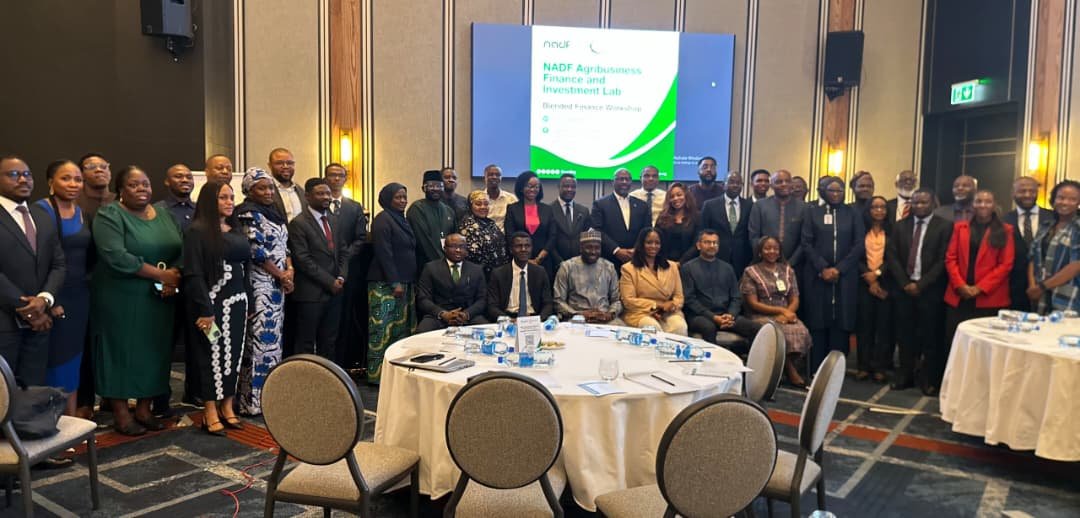
The initiative was presented on Tuesday during a Blended Finance Workshop for Fund Managers hosted by NADF in collaboration with Convergence Blended Finance, an international platform dedicated to increasing private investment in emerging economies.
Addressing participants at the workshop, the Chief Executive Officer of NADF, Mohammed Ibrahim, stated that achieving meaningful transformation in Nigeria’s agricultural sector would require funding levels beyond what government resources alone could provide.
Represented by the General Manager of Partnerships and Investor Relations at NADF, Nasir Ingawa, Ibrahim emphasised the strategic importance of agriculture to national food security, employment generation, industrial development, export growth and economic advancement.
He noted that government financing by itself would be insufficient to drive the level of transformation required in the sector, adding that private investors would remain cautious unless investment risks were properly identified, distributed and mitigated.
“NADF is positioning itself as a catalyst within the agricultural finance ecosystem by connecting investors with credible agribusiness opportunities and helping to structure investments that can attract commercial funding.
“The fund will serve as a convener capable of bringing together capital providers, technical experts, guarantee institutions and agribusiness operators.
“Our role is to facilitate, convene, curate credible and investable pipelines, and expose those opportunities to partners who have the capital, technical expertise and market discipline required to take them forward,” he said.
In his remarks, the Head of Africa at Convergence Blended Finance, Aakif Merchant, highlighted the significance of agriculture to Nigeria’s economy, noting that the sector contributes roughly 30 per cent to the country’s Gross Domestic Product (GDP) and provides employment for about 35 per cent of the workforce.
Despite its importance, Merchant observed that agriculture continues to attract limited private-sector funding due largely to concerns about investment risks.
He pointed out that recent policy adjustments allowing pension fund administrators to invest up to 10 per cent of their portfolios in alternative asset classes could create new opportunities for directing institutional capital into agriculture.
According to Merchant, blended finance provides an effective structure for attracting such investments by combining development funding with private-sector resources to lower risk and enhance the viability of agricultural ventures.
“Unfortunately, agriculture in Nigeria is perceived as a high-risk sector.
“This forum is intended to explore the use of blended finance as a financial structuring approach to de-risk investments and mobilise capital that is currently sitting on the sidelines into the sector for the benefit of the country,” he said.
Merchant further explained that blended finance relies on catalytic capital from governments, development agencies and philanthropic organisations to encourage commercial investors to support sectors that traditionally face financing challenges.
He noted that successful blended finance models are generally anchored on three core elements: leveraging capital, delivering development outcomes and generating returns for investors.
The Convergence Africa executive identified exchange-rate fluctuations, elevated transaction costs and insufficient scale as key issues discouraging investment. He stressed the importance of consolidating viable projects and strengthening both export-driven and import-substitution agricultural value chains.
He also noted that Nigeria possesses significant opportunities to cut import dependence in commodities such as palm oil and fish while simultaneously creating jobs and preserving foreign exchange earnings.
“We heard that Nigeria imports significant volumes of palm oil, even though palm oil originated from this region.
“The same applies to fish in spite of the country’s extensive coastline. Import substitution remains a significant opportunity,” he said.

3 comments
There’s definately a great deal to know about this
issue. I like all the points you made.
Howdy are using Wordpress for your blog platform?
I’m new to the blog world but I’m trying to get started and create my own. Do you require any html coding knowledge to make
your own blog? Any help would be greatly appreciated!
It’s impressive that you are getting ideas from this
post as well as from our dialogue made at this place.