

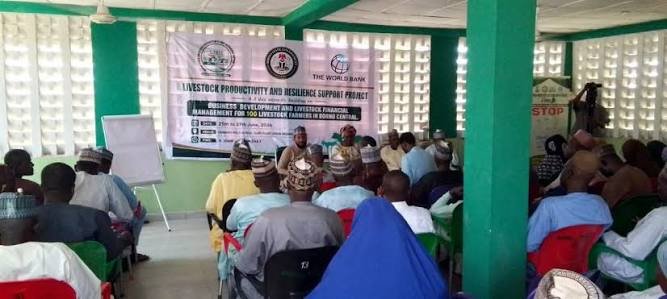
The Livestock Productivity and Resilience Support Project (L-PRES), in partnership with the Borno State Government, has begun training 100 livestock farmers in business development, modern production techniques and financial management as part of efforts to build stronger and more resilient livestock enterprises across the state.
The beneficiaries, selected from Borno’s three senatorial districts, are undergoing intensive capacity-building aimed at equipping them with practical knowledge to improve productivity, manage their businesses efficiently and position themselves for long-term growth.
Speaking during the training in Maiduguri on Thursday, the Borno State Coordinator of L-PRES, Makinta Ali, said the programme was designed to address the business knowledge gap among livestock farmers, noting that sustainable enterprise growth requires more than access to grants or loans.
According to him, participants are being trained to understand business planning, assess market dynamics, identify risks and develop strategies that will enable them to build profitable and resilient livestock businesses.
He explained that the initiative also focuses on strengthening participants’ business management skills to help them expand their operations while improving overall livestock production in the state.
Ali urged the beneficiaries to apply the knowledge gained from the training, stressing that sound business management and the adoption of modern livestock farming practices remain critical to achieving sustainable growth in the sector.
Representing the National Coordinator of L-PRES, the project’s National Value Chain Consultant, Ronke Akanni, described the programme as a transformative opportunity for the selected farmers.
She said the project places high priority on supporting small and medium-scale livestock enterprises by helping beneficiaries develop viable businesses, access financing and scale up their operations.
Akanni added that participants would receive guidance on meeting the requirements for accessing loans after the training, enabling them to invest in improved livestock production and sustain their enterprises.
One of the beneficiaries, Halima Abubakar, who has been rearing sheep for more than six years, said the training had inspired her to expand beyond her current small-scale operation.
She expressed optimism that the skills acquired would help her grow her farm into a larger enterprise capable of creating employment opportunities and mentoring other aspiring livestock farmers.

1 comment
Aliyu Zubairu Turawa Soba 09019923880