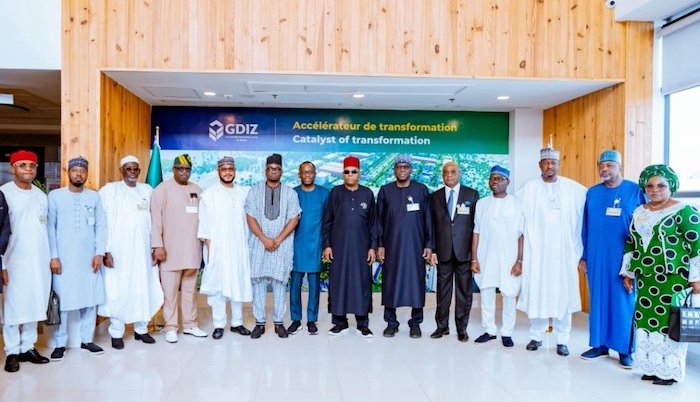

Six Nigerian governors have pledged to adapt the Glo-Djigbé Industrial Zone (GDIZ) model in the Republic of Benin to revive the country’s textile industry, strengthen agro-processing and accelerate industrialisation across their states.
The commitment followed an inspection tour of the integrated industrial hub near Cotonou led by Vice President Kashim Shettima as part of the Federal Government’s efforts to establish Special Agro-Industrial Processing Zones (SAPZs), boost value addition and reduce dependence on raw commodity exports.
The delegation included Governors Hope Uzodimma (Imo), Dauda Lawal (Zamfara), Caleb Mutfwang (Plateau), AbdulRahman AbdulRazaq (Kwara), Dikko Radda (Katsina) and Umar Namadi (Jigawa).
Speaking after the tour, AbdulRazaq, who chairs the Nigeria Governors’ Forum, described the visit as an African peer-learning mission aimed at helping Nigerian states adopt proven industrial practices. He said the delegation examined cotton, cashew and soybean value chains and would apply the lessons as Nigeria rolls out industrial processing zones with support from the Federal Government and development partners.
Namadi said the visit provided practical insights for Jigawa’s implementation of the SAPZ programme, noting that value addition to agricultural produce would drive industrialisation, create jobs and expand economic opportunities for the state’s growing youth population.
For Zamfara Governor Dauda Lawal, the visit rekindled memories of the state’s once-thriving textile industry, where textile mills, cotton ginneries and oil mills employed thousands of workers. He said the Benin model had strengthened his resolve to restore cotton production and textile manufacturing, describing the revival of the sector as one of the legacies he hopes to leave behind.
Uzodimma said African countries must deepen collaboration by learning from one another’s development successes instead of working in isolation. He commended President Bola Tinubu for initiating the study visit, expressing confidence that adapting the model to each state’s comparative advantage would create jobs and stimulate economic growth.
Radda said the production systems at GDIZ could be replicated in cotton- and soybean-producing states such as Katsina, adding that stronger links between agriculture and industry would generate wealth, expand processing capacity and provide employment for young people.
Mutfwang described the industrial zone as proof that deliberate planning, political commitment and competent leadership can transform ambitious ideas into thriving industrial ecosystems. He said the experience reinforced President Tinubu’s vision of building a one-trillion-dollar economy through increased production, value addition and industrial processing rather than continued export of raw commodities.
The governors agreed that the GDIZ model demonstrates how strategic investment, reliable infrastructure and strong public-private partnerships can unlock agricultural value chains, reduce raw commodity exports and position manufacturing as a major driver of economic growth in Nigeria.