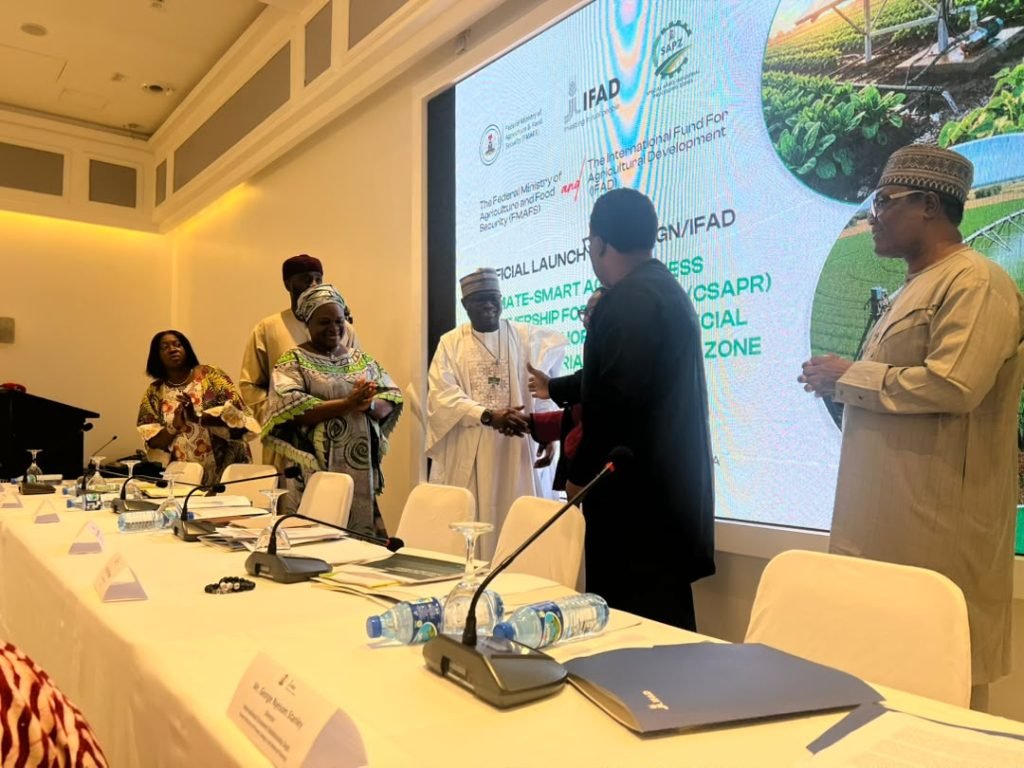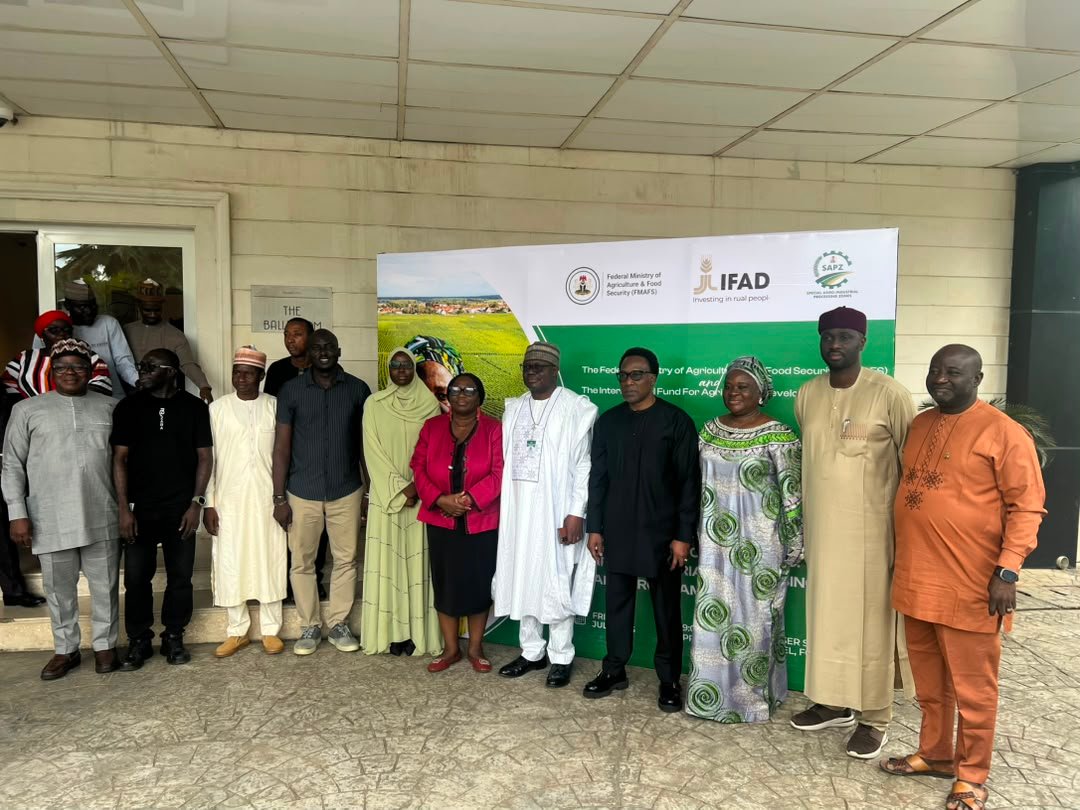

The Federal Government of Nigeria, through the Federal Ministry of Agriculture and Food Security (FMAFS), has officially launched the Climate-Smart Agribusiness Partnerships for Resilience (CSAPR) Project in Abuja, in collaboration with the International Fund for Agricultural Development (IFAD), the Special Agro-Industrial Processing Zones (SAPZ) Programme and the Nigerian Meteorological Agency (NiMet).
The project, financed by the Gates Foundation and executed by IFAD, will run from 2026 to 2028 and is designed to strengthen the resilience, productivity and profitability of Nigeria’s agricultural value chains by embedding Climate Information Services (CIS) into commercially viable agribusiness products and services delivered through public-private partnerships.
Declaring the project open, the Permanent Secretary of FMAFS, Dr Marcus Olaniyi Ogunbiyi, called for renewed commitment among government, development partners, the private sector, financial institutions, researchers and farmers to confront the growing threat of climate change to the country’s food system.
He described the launch as another milestone in Nigeria’s journey toward a more resilient, productive and climate-smart agricultural sector, noting that floods, droughts, erratic weather patterns, desertification and rising temperatures continue to threaten productivity, rural livelihoods and food security.
Dr Ogunbiyi said the federal government, under President Bola Ahmed Tinubu, remains committed to agricultural transformation through the National Agricultural Technology and Innovation Policy (NATIP), the Presidential Food Security Agenda and related initiatives.
He explained that CSAPR grew out of extensive stakeholder consultations, including a policy dialogue and best-practice workshop on public-private partnerships for climate-friendly services held in Abuja in August 2025, which produced consensus that climate solutions work best when embedded within agricultural finance, insurance, extension services, input supply and market information systems. The SAPZ programme was chosen to drive the initiative, he said, describing farmer-based organisations, producer groups, youth and women’s organisations and rural entrepreneurs as the heartbeat of the project.
Speaking on behalf of IFAD, Country Director Dede Ekoue said CSAPR would place climate resilience at the heart of Nigeria’s agricultural transformation. She noted it is the third ASAP-supported intervention in IFAD’s Nigerian portfolio, following earlier work in the northeast, northwest and through the Value Chain Development Programme in the north-central region, which she said reflects IFAD’s long-term commitment to mainstreaming climate resilience.
Ekoue explained that the central aim of CSAPR is to expand and make financially sustainable climate information services through practical public-private partnerships that complement, rather than replace, public provision of such services. By enabling private-sector delivery of climate services, she said, lenders and insurers can better manage climate risk and design scalable financial products, while agribusinesses gain the intelligence needed to reduce operational risks.
She thanked ministry leadership for securing inter-ministerial support, including from the Federal Ministry of Finance, and urged continued collaboration from partners such as the African Development Bank and the Islamic Development Bank, calling CSAPR a “game-changing” initiative that will require bold thinking and sustained cooperation.
The Director-General and Chief Executive Officer of NiMet, Prof. Charles Anosike, described the project as a timely response to the mounting climate risks facing Nigerian agriculture, citing erratic rainfall, floods, droughts, shifting planting seasons and pest outbreaks as threats to food security, farmers’ incomes and national development.
He said access to accurate and actionable weather and climate information is essential to enable farmers to make informed planting and input decisions and to help agribusinesses, insurers and investors manage climate-related risks.
Anosike noted that the project aligns with President Tinubu’s Renewed Hope Agenda and reaffirmed NiMet’s commitment to supporting it through seasonal climate predictions, agrometeorological bulletins, impact-based forecasts, early warning advisories and digital climate advisory platforms, while stressing the need to keep women, youth and smallholder farmers at the centre of implementation.
Also speaking, SAPZ Programme Operations Manager Dr Zakari Tsiga, representing SAPZ National Programme Coordinator Dr Kabir Yusuf, said the initiative complements ongoing IFAD-supported interventions to build resilient agrifood systems, improve productivity and attract investment. He noted that SAPZ has already expanded farmers’ access to climate information by leveraging NiMet’s weather forecasts, automated weather stations installed in Ogun and Kano states, and digital devices distributed to farmer-organisation leaders to disseminate weather advisories to farming communities.
He thanked FMAFS, IFAD, the Gates Foundation, NiMet and other partners for their support and urged stakeholders to actively contribute to discussions on scaling up the project.
AgroNigeria gathered that the Abuja launch workshop was convened to follow up on the 2025 FMAFS/IFAD policy dialogue on public-private partnerships for climate information services, present the approved CSAPR project and its links to the SAPZ programme, and build stakeholder consensus on pathways for collaboration. It brought together government institutions, financial institutions, agribusinesses, farmer organisations and cooperatives, development partners, civil society groups and research and academic institutions.
Dr Ogunbiyi urged all partners to sustain the spirit of collaboration shown throughout the consultation process and pledged that the government would continue to provide the policy leadership, coordination and enabling environment required for its successful implementation.
He described the launch as the beginning of a transformative partnership that will empower farmers with knowledge, strengthen agribusinesses with innovation, reduce risk in agricultural investment and position Nigeria as a continental leader in climate-smart agricultural development.