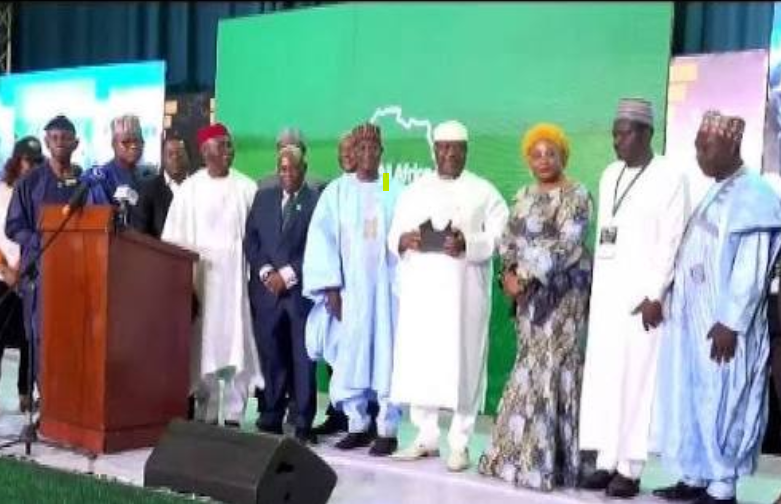

The President, Bola Ahmed Tinubu has reaffirmed the Federal Government’s commitment to transforming Nigeria’s livestock sector into a modern, technology-driven and commercially competitive industry capable of driving economic growth, creating jobs and strengthening national food security.
The President made this known at the opening ceremony of the 9th All Africa Conference on Animal Agriculture (AACAA), held on Monday in Abuja.
Speaking, he highlighted ongoing reforms and investment initiatives aimed at unlocking the economic potential of Nigeria’s livestock industry.
According to him, the establishment of the Federal Ministry of Livestock Development in July 2024 marked a major step towards repositioning the sector from predominantly subsistence production to a modern and globally integrated industry.
“Since the inception of our administration, we have placed agriculture and food security at the centre of our Renewed Hope Agenda. Recognising the enormous potential of the livestock industry, our administration took the historic decision to establish the Federal Ministry of Livestock Development in July 2024,” he said.
According to him, the reform is being supported by institutional changes, including the implementation of recommendations from the Presidential Committee on Livestock Reforms, with the aim of improving productivity, strengthening governance, promoting peaceful livestock production systems and creating an enabling environment for private investment.
The president said Nigeria currently has one of Africa’s largest livestock populations, comprising over 58 million cattle, 64 million sheep, 124 million goats and 660 million poultry, adding that the sector contributes more than $32 billion annually to the national economy.
He stated that the administration had introduced the National Livestock Growth Acceleration Strategy (NL-GAS) to unlock opportunities across the livestock value chain, with emphasis on productivity, animal health, genetics, feed production, climate-smart production, value addition and investment.
He added that the strategy would also support ranching and modern livestock production systems while strengthening veterinary services, disease surveillance, breeding and livestock infrastructure.
He further noted that the government was pursuing partnerships with international organisations, development partners and private investors to expand livestock value chains and increase the participation of women and young people in livestock enterprises.
“Beyond contributing to economic growth, the livestock sector is one of the largest sources of employment opportunities through its divergent value chain—from animal production to feed manufacturing, veterinary services, transportation, processing, marketing, leather production, dairy enterprises, and export activities,” he said.
The President also disclosed that the administration was targeting more than a doubling of the livestock sector’s contribution to the economy as part of efforts to position Nigeria as a leading livestock production and processing hub in Africa.
He said the government was taking steps to reduce the country’s dependence on imported livestock products, particularly dairy, through its dairy transformation programme.
According to him, the programme seeks to increase domestic milk production through improved animal genetics, nutrition, modern breeding systems, pasture development, commercial feed production, milk collection infrastructure and investment in modern processing facilities.
Tinubu further said access to finance, digital technologies, innovation and private-sector partnerships would be strengthened to make livestock production more attractive to young people and women.
The President emphasised the importance of regional cooperation in addressing challenges such as animal diseases, climate change, food insecurity and transboundary livestock movements.
His words; “This conference therefore provides a unique opportunity to deepen collaboration among African nations in the areas of animal health and disease control; climate-smart livestock production; livestock genetics and breed improvement; regional trade and market integration; youth and women empowerment; research and innovation; as well as investment and value-chain development.”
He called on participants to develop practical recommendations that would advance Africa’s livestock agenda and contribute to the objectives of the African Union’s Agenda 2063.
The President reaffirmed Nigeria’s readiness to work with African countries, development partners, research institutions and the private sector to build a productive, sustainable and globally competitive livestock industry.
He also stressed the importance of stronger regional standards, disease surveillance, research collaboration and value-chain integration under the African Continental Free Trade Area (AfCFTA) to expand intra-African trade in livestock and livestock products.
The President formally declared the 9th All Africa Conference on Animal Agriculture open, urging delegates to use the conference to chart a resilient path for livestock development across the continent.