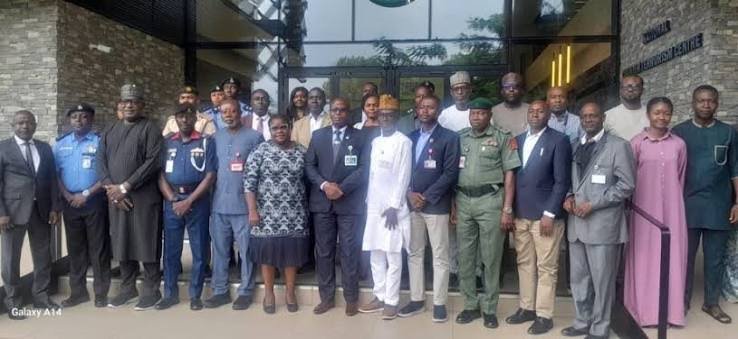

The Federal Government has launched the AgriShield Initiative in Borno State to strengthen the link between security and agricultural production, with a focus on helping farmers return safely to their farms and move their harvests to markets.
The initiative, led by the National Counter-Terrorism Centre (NCTC) under the Office of the National Security Adviser (ONSA) in partnership with TAG International, will initially cover Maiduguri Metropolitan Council, Jere and Mafa Local Government Areas from October to December.
Special Adviser to the National Security Adviser on Strategic Communication and Civil Society Liaison, Dr Chido Onumah, said the initiative was designed to make security interventions more meaningful to communities by connecting protection with livelihoods, agricultural recovery and food supply.
According to him, AgriShield’s message, “Our Presence is Your Peace,” is built around the everyday realities of farming communities, where security means being able to access farmland, tend crops throughout the season and take produce to market without fear.
Onumah said findings from a baseline survey of 1,409 residents across 18 wards in the three local government areas revealed a significant gap between government security efforts and public awareness of them.
He said only 17 per cent of respondents were aware of local initiatives to counter violent extremism, while awareness of the NCTC stood at about two per cent, despite 86 per cent expressing strong interest in information on how government protects them.
The survey also identified unemployment, cost of living and food insecurity as major concerns, cited by 81 per cent, 70 per cent and 57 per cent of respondents respectively, while 29 per cent identified terrorism as a concern.
Onumah said the findings showed the need for government communication to move beyond security statistics and demonstrate how interventions were improving safety, livelihoods and economic activity in affected communities.
The pilot will use radio programmes, community town halls, local drama, farmer testimonies and digital content, with four radio stations scheduled to air 24 talk shows and 80 jingles in Hausa and Kanuri. Six town hall meetings will also bring farmers, traditional and religious leaders, young people, women and security agencies together to discuss local concerns.
He said radio was selected as a major channel because 67 per cent of respondents accessed information through it, while 41 per cent identified it as their most trusted source. Facebook and TikTok will also be used to reach younger audiences, alongside SMS and telephone engagement for farmers with limited internet access.
The initiative has brought together the Nigeria Police Force, Defence Headquarters, Nigeria Security and Civil Defence Corps, Department of State Services, Nigeria Immigration Service, Federal Radio Corporation of Nigeria, National Orientation Agency, Institute for Peace and Conflict Resolution and NIRSAL Plc.
Onumah said the NSCDC would contribute through its Agro-Rangers mandate, while the National Orientation Agency would deploy its grassroots structures for community mobilisation and local-language engagement. Defence Headquarters would also provide strategic communication and media platforms.
The initiative will further draw on the Network of Civil Society Organisations in Borno State, which brings together about 200 organisations, while TAG International will provide technical support in research, campaign design, content development, monitoring and evaluation.
Onumah said the participating agencies would operate through a coordinated communication framework to ensure that information released to the public was verified, consistent and did not compromise security operations or expose communities to additional risks.
He said the campaign would also measure its impact through an endline survey in December, focusing on changes in public awareness, trust and understanding of government security interventions.
According to him, AgriShield reflects the government’s recognition that food security is inseparable from human security, as safer farming communities are better positioned to produce food, sustain livelihoods and resist the conditions that violent groups exploit.
He said the initiative ultimately seeks to create an environment where farmers can cultivate their land and secure their livelihoods without allowing fear to determine whether they can produce food for their families, communities and the wider Nigerian market.