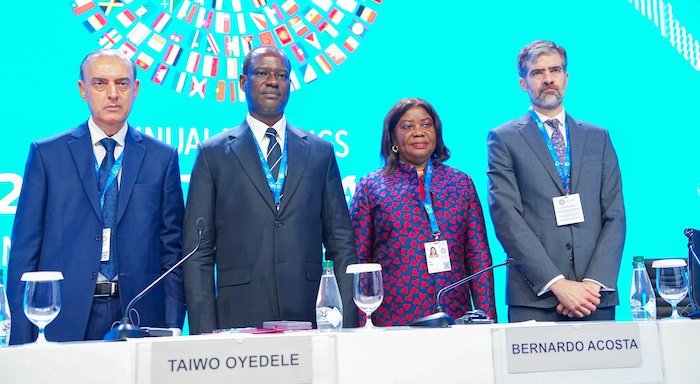

Nigeria’s Minister of Finance and Coordinating Minister of the Economy, Taiwo Oyedele, has identified infrastructure gaps and agricultural inefficiencies as investment opportunities, urging investors to commit long-term capital to boost food security and create jobs.
Oyedele made the call at an investors’ forum in Bangkok, Thailand, where stakeholders discussed ways to mobilise private financing for food systems and infrastructure development.
He said inadequate storage, processing, transportation and electricity infrastructure continued to constrain agricultural productivity, increase business costs and contribute to losses of farm produce in Nigeria.
The minister noted that Africa possesses about 60 per cent of the world’s remaining uncultivated arable land but still relies heavily on food imports, making investment across agricultural value chains critical to unlocking the continent’s production potential.
Oyedele said attracting long-term financing would require bankable projects, policy consistency and mechanisms to share investment risks. He added that the Federal Government would work with development partners, including the World Bank Group, to strengthen risk-mitigation arrangements and improve investor confidence.
He also reaffirmed the government’s commitment to predictable policies, legal certainty and deeper domestic capital markets, ruling out a return to subsidies or deficit monetisation.
The minister called for investment initiatives to be assessed by measurable results, including completed deals, commercialised farms, jobs created and food delivered, rather than expressions of interest alone.
Earlier, Zainab Ahmed, Executive Director representing Angola, Nigeria and South Africa on the World Bank Board, urged governments and project sponsors to turn investment proposals into projects capable of attracting financing.
Ahmed said the forum would help stakeholders establish priorities, clarify funding needs and agree on time-bound actions, adding that the World Bank Group could support projects through advisory services, project preparation, guarantees and other financing instruments.
She stressed that investments must also create opportunities for local businesses, farmers, women and young people.
The discussions underscored the need to connect private financing with practical projects that address infrastructure constraints, strengthen agricultural value chains and improve food availability.