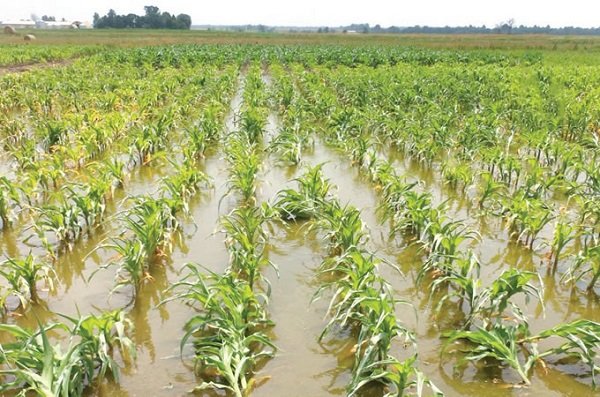

Farmers across Lagos State are grappling with significant losses after prolonged flooding submerged farmlands, destroyed crops and disrupted planting activities, sparking concerns over reduced harvests and declining incomes during the current farming season.
Large expanses of vegetable, maize and cassava farms in Ikorodu, Ojo, Imota and Epe have remained flooded for several days following continuous rainfall, leaving many farmers uncertain about the outlook for this year’s production.
In separate interviews in Lagos, the affected farmers expressed concern that the flooding would significantly reduce crop yields and negatively impact their livelihoods.
A vegetable farmer in Ikorodu, Akin Ojo, said weeks of investment and labour were wiped out after floodwaters engulfed his farmland.
“I planted vegetables expecting a good harvest, but after the heavy rainfall, most of the crops were submerged. I have lost a large part of my investment,” he said.
Ojo explained that the destruction had made it difficult for him to recover his production expenses or raise funds for another planting cycle.
Another farmer, Bose Adewale, described flooding as a recurring problem that continues to threaten the survival of smallholder farmers across the state.
She added that increasing costs of essential farm inputs, including seeds, fertiliser and labour, had further worsened the situation.
“We borrow money to farm with the hope of making profits after harvest. When floods destroy our farms, repaying those loans becomes a serious challenge,” she said.
The former Chairman of the Imota Farm Settlers Cooperative Society, Babatunde Shadeko, said many farmers had postponed planting because excessive rainfall had left their farmlands unsuitable for cultivation.
“At the moment, no farmer can plant anything because the soil is still compressed after the flooding and is not suitable for cultivation.
“For now, any farmer hoping to make a profit will have to wait until conditions improve. Vegetable farmers are the only ones that can still farm during this period,” he said.
A maize farmer in Ikorodu, Sola Adebayo, also said extensive portions of farmland remained waterlogged, forcing many producers to suspend farming activities.
“We have no option but to wait for the rains to reduce. Planting now will only lead to more losses because the soil is still too wet,” he said.
Similarly, a cassava farmer in Epe, Funke Oladipo, said the flooding had disrupted farming schedules and reduced farmers’ willingness to invest during the rainy season.
She noted that many farmers were unwilling to obtain fresh loans because there was no guarantee that crops would survive if heavy rainfall continued.
“If this situation continues, many of us may not harvest enough this season. That will affect our income and eventually food supply in the markets,” she said.
Several farmers warned that if the flooding persists, continued crop losses could lead to lower food supplies and higher prices in local markets.
Stakeholders, however, urged governments and relevant agencies to strengthen flood-control infrastructure, expand access to agricultural insurance, provide affordable financing and promote climate-smart farming practices to safeguard farmers’ livelihoods and improve food production.