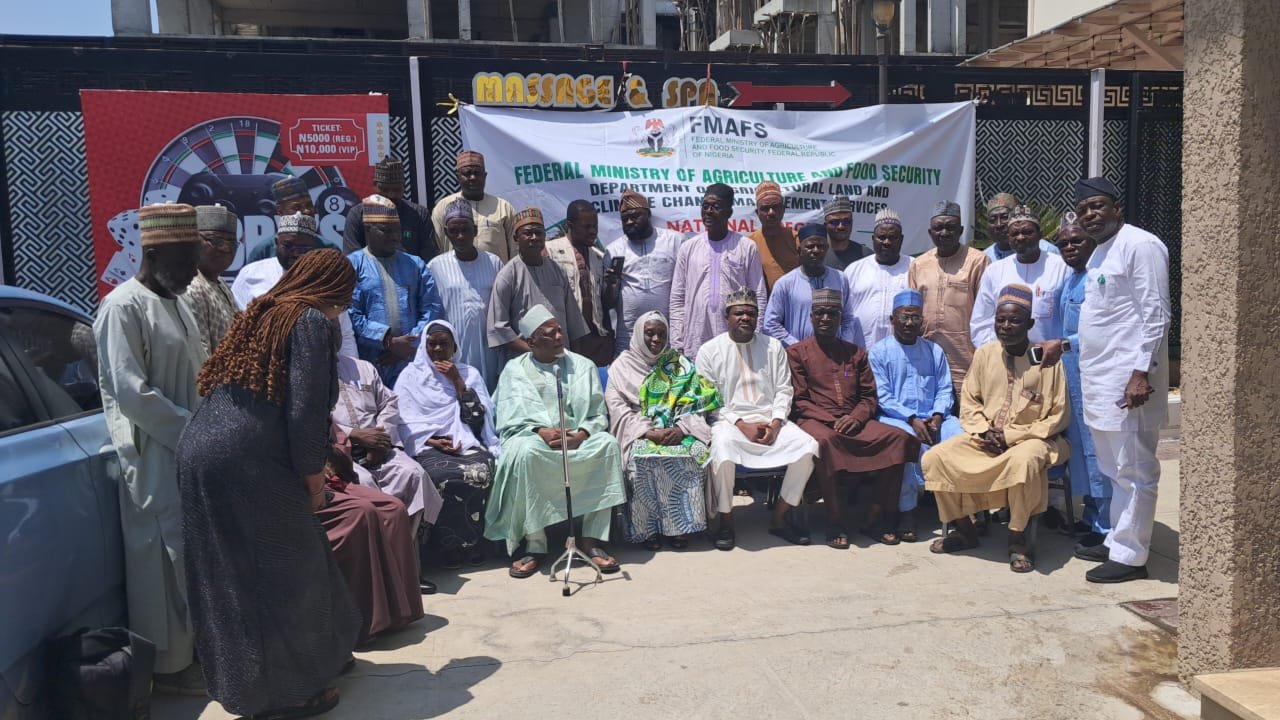

The Federal Ministry of Agriculture and Food Security has commenced a regional stakeholder consultation as part of efforts to review Nigeria’s Agricultural Land and Soil Management Policy.
The two-day North-West zonal workshop in Kano is designed to gather input from key stakeholders on the development of a sustainable framework for managing the country’s agricultural land and soil resources.
The Director of Agricultural Land and Climate Change Management Services, Olanipẹkun Oshadiya, said the policy review was necessary to strengthen Nigeria’s drive towards achieving food security.
Oshadiya, who was represented at the workshop by his Personal Assistant on Gender and Innovation, Wasiu Oyediran, described land and soil resources as fundamental to the country’s food production system.
He explained that maintaining productive and healthy soils was essential not only for increasing agricultural output but also for improving livelihoods, conserving the environment and supporting broader national development.
The director noted that Nigeria’s agricultural land and soil resources were under increasing pressure from several factors, including degradation, erosion, declining soil nutrients, deforestation, climate change and population growth.
He added that rapid urbanisation and rising competition for land were also placing additional strain on the sustainable use of agricultural resources.
According to Oshadiya, the effects of these challenges are increasingly reflected in declining soil fertility, lower farm productivity and greater exposure of farmers to climate-related risks.
He further pointed to the loss of soil organic matter, erosion and desertification as major threats to agricultural production and the country’s food security.
“If soil quality deteriorates, agriculture will inevitably suffer,” Oshadiya said, warning of wider consequences for food availability and industrial development.
“A decline in agriculture means a lack of food for our citizens, insufficient raw materials for industries and a deficit in commodities for foreign exchange,” he added.
Oshadiya said Nigeria could no longer afford to ignore the situation or depend heavily on imported food to meet the needs of its estimated 230 million people.
He explained that the proposed review was intended to achieve more than simply updating the existing policy document, saying it would seek to create an inclusive, science-based and practical framework for managing the country’s agricultural resources.
According to him, the revised framework would have to respond to existing pressures on agricultural land and soil while also anticipating emerging threats that could affect the sector in the future.
He called on stakeholders to give priority to sustainable soil management, climate-smart agriculture, land restoration, effective governance and proper land-use planning.
Oshadiya also highlighted the need to strengthen soil information systems, research and innovation, as well as financing and investment in land and soil management.
He said the revised policy should encourage farming practices capable of restoring soil fertility, increasing organic matter and making agricultural production systems more resilient to climate-related challenges.
Among the threats he identified were drought, flooding, extreme temperatures and other climate-related conditions that are increasingly disrupting farming activities and affecting agricultural communities across the country.
The director advocated stronger collaboration between federal, state and local governments, traditional institutions, local communities, research organisations, development partners and private-sector stakeholders.
He said accurate and accessible information on soil characteristics, land capability, degradation and suitability would be essential for effective, evidence-based agricultural planning.
Oshadiya disclosed that the ministry was developing systems designed to make soil information and digital agricultural advisories available at the Local Government Area level.
He explained that the platform would provide farmers with information such as soil pH levels, organic matter content and fertiliser recommendations tailored to the conditions of their farms.
The director also disclosed that the ministry was incorporating the National Fertiliser and Soil Health Strategy into the ECOWAS Regional Fertiliser Hub.
He cited the ministry’s partnership with the Bill and Melinda Gates Foundation under the GP Soil Matters initiative in Nigeria as another effort aimed at improving soil management.
He added that modern laboratory equipment was being supplied to 12 states to improve the country’s capacity for soil testing and management.
According to him, plans were also underway to revitalise soil-testing laboratories across all 36 states and the Federal Capital Territory.
Oshadiya further said Agricultural Development Programme agents would undergo additional training in soil health diagnostics to strengthen the quality of extension services available to farmers.
He reaffirmed the ministry’s commitment to ensuring that the revised policy remained farmer-focused, affordable, locally relevant and responsive to gender considerations.
He said the policy would be structured to ensure that smallholder farmers could access and benefit from improved soil management practices while also supporting the growth of commercial agriculture.
The Country Director of the Soil Values Programme, Joshua Arogunyo, said the initiative would collaborate with Nigerian institutions to improve the management and conservation of soil resources.
Arogunyo stressed the need for soil management to be fully integrated into agricultural development strategies and national efforts to achieve food security.
Sanusi Mohammed-Gaya, Director of the Centre for Dryland Agriculture at Bayero University, Kano, described the consultation as coming at an important time.
Mohammed-Gaya said the combined effects of climate change and increasing pressure on agricultural resources had made sustainable soil management more urgent.
He urged participants to ensure that the outcomes of the consultation resulted in practical measures that would have a direct impact on farmers.
The Permanent Secretary of the Kebbi State Ministry of Agriculture, Faruk Sarki, commended the Federal Government for commencing the policy review.
Sarki, who represented the North-West states at the event, said agriculture remained a major pillar of the region’s economies and a key source of livelihood for its people.
He called for policies that would improve the resilience of agriculture while encouraging sustainable management of land resources across the region.
The President of the Soil Science Society of Nigeria, Jibrin Mohammed Jibrin, also emphasised the importance of effective soil management to the achievement of sustainable food production.
James Jayeoba, Lead Consultant for the National Agricultural Land and Soil Management Policy (NALSMP), provided participants with an overview of the policy development process, its objectives and the expected outcomes.
Jayeoba also facilitated discussions on agro-ecological, land and soil zones, with participants examining regional priorities and local conditions that should inform the revised policy.
Representatives of the agriculture commissioners from Kaduna, Kano, Katsina, Jigawa, Zamfara, Kebbi and Sokoto states were present at the consultation.
Representatives of farmers’ groups, the All Farmers Association of Nigeria (AFAN), Sasakawa Africa Association, smallholder farmers and other stakeholders also delivered goodwill messages at the workshop.