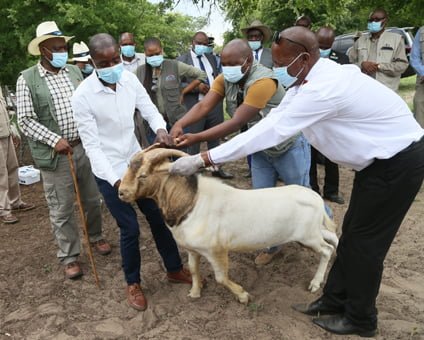

The Federal Government has announced plans to comprehensively review Nigeria’s strategic framework for the control and eradication of peste des petits ruminants (PPR), also known as goat plague, as part of efforts to strengthen the country’s response to the highly contagious livestock disease.
The Chief Veterinary Officer of Nigeria (CVON), Samuel Anzaku, disclosed this on Friday in Abuja during a two-day workshop convened to review the National Strategic Plan for the Control and Eradication of PPR.
According to the Food and Agriculture Organisation (FAO), PPR, commonly referred to as goat plague, is a highly infectious viral disease capable of killing up to 90 per cent of infected sheep and goats.
The workshop was organised by the Pan-African Secretariat for the Eradication of PPR (PAPS) with funding from the European Union under the African Union–Inter-African Bureau for Animal Resources (AU-IBAR), in collaboration with the Federal Ministry of Livestock Development.
Anzaku said the review would strengthen implementation, improve disease surveillance and monitoring, and support the development of an updated assessment roadmap, performance benchmarks and regional coordination mechanisms within the Economic Community of West African States (ECOWAS).
He explained that the planned restructuring was essential to ensure that investments by both the public and private sectors deliver measurable, science-based progress towards eliminating the disease in Nigeria.
According to him, Nigeria remains one of the priority countries in the global campaign against PPR because of its large livestock population and extensive movement of animals within the country and across borders with Niger, Benin, Cameroon and Chad.
“For us to unlock the true economic and food security potential of our livestock sector, we must systematically eliminate the threat of PPR,” he said.
Also speaking, the Team Lead of Propcom+, Adiya Ode, described PPR as one of the most economically damaging diseases affecting sheep and goats across Africa and several parts of Asia.
She noted that beyond livestock mortality, the disease poses serious threats to food security, household incomes, nutrition, employment and the resilience of rural communities.
Ode stressed that effective control and eventual eradication of PPR would create significant opportunities for millions of smallholder livestock farmers, particularly women and young people who depend on sheep and goats for their livelihoods and financial stability.
“The establishment of the FMLD underscores the Nigerian government’s determination to unlock the enormous potential of the livestock sector as a driver of economic growth, job creation, poverty reduction, and national development.
“In this regard, strengthening animal health systems through effective disease surveillance, prevention, control, and eradication initiatives is a technical necessity and a strategic investment in the future of the livestock economy,” she said.
She added that Propcom+ recognises the importance of resilient livestock systems in improving rural livelihoods, increasing productivity, expanding market participation and enhancing climate resilience.
“We also understand that disease outbreaks such as PPR can reverse years of progress, erode household assets and deepen vulnerability among already disadvantaged populations.
“Propcom+ remains committed to supporting market-based and inclusive approaches that improve livestock productivity, strengthen veterinary and extension services, facilitate private-sector participation, and create opportunities for smallholder producers, especially women and young people, to thrive.
“We believe that investments in animal health, vaccination systems, disease surveillance, and institutional capacity are critical pillars for building a competitive and sustainable livestock sector,” Ms Ode said.
The National President of the Sheep and Goat Development Association of Nigeria (NASHGODAN), Abdullateef Ahmed, commended the Federal Government for its commitment to combating the disease.
Ahmed reaffirmed the association’s readiness to collaborate with the government in implementing the national PPR eradication programme.
“We will continue to mobilise our members to participate in activities in the vaccination campaigns, disease surveillance, reporting suspected cases, livestock identification and traceability issues and public awareness programmes that promote animal health,” he said.