
The Federal Government has announced plans to roll out a one-stop-shop (OSS) framework for the Special Agro-Industrial Processing Zones (SAPZ) Programme, a move designed to cut bureaucratic bottlenecks and position Nigeria as Africa’s top destination for agro-industrial investment.
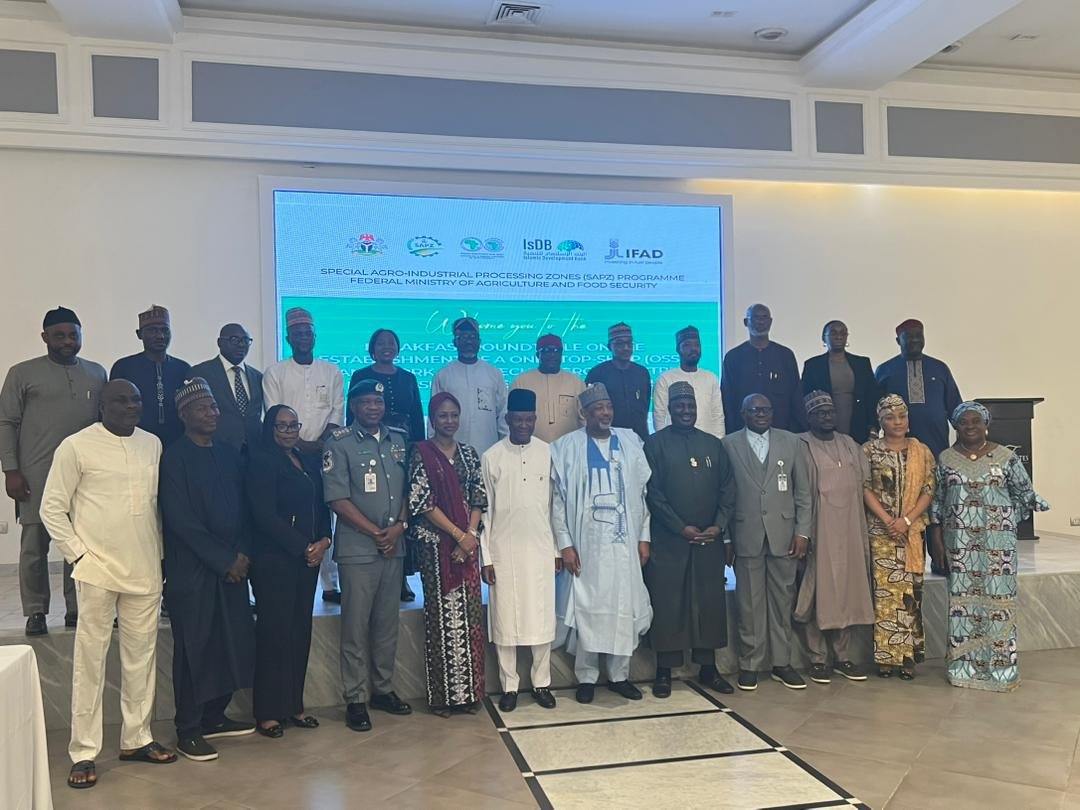
The announcement came at a Breakfast Roundtable Meeting in Abuja themed “Facilitating Seamless Investment Entry and Operations in Nigeria’s Special Agro-Industrial Processing Zones.” Minister of Agriculture and Food Security, Senator Abubakar Kyari, told stakeholders that global investors are no longer chasing markets alone but ecosystems where policy, infrastructure, and institutions work in sync. With the African Continental Free Trade Area opening access to a market of roughly 1.3 billion people, he said Nigeria is positioning itself to capture a significant share of that opportunity.
The proposed one-stop-shop SAPZ framework would fold approvals, regulatory services, investment facilitation, and operational coordination into a single platform, eliminating the delays that have historically frustrated investors. Kyari stressed that the SAPZ Programme is more than an agricultural initiative, it is a structural economic reform tool meant to anchor Agro-Industrial Hubs and Agricultural Transformation Centres linking farms to processing plants, infrastructure, and global markets.
Minister of Industry, Trade and Investment, Dr Jumoke Oduwole, echoed the call for tighter government coordination, noting that Nigeria’s exports hit $6.1 billion in 2025, up 11.5% year-on-year. She insisted the next leap must come from processed agricultural exports rather than raw commodities, with agencies like the Bank of Industry, NEXIM, and SMEDAN expected to back the push through financing and enterprise support.
Minister of State for Agriculture and Food Security, Senator Aliyu Sabi Abdullahi, said Nigeria must move beyond primary production to unlock real economic value. He noted that despite being the world’s largest cassava producer, at 60–66 million metric tonnes annually, the country captures only a fraction of global market value due to weak processing capacity. He cited similar gaps in tomato and ginger production, where heavy post-harvest losses and costly tomato paste imports persist alongside untapped potential in ginger oil and oleoresin exports.
Minister of State for Industry, Trade and Investment, Senator John Owan Enoh, described SAPZ as a strategic intervention capable of driving industrialisation through agricultural transformation. While commending progress recorded under the programme’s first phase, he said resolving challenges around regulatory approvals, infrastructure delivery, counterpart funding, and procurement timelines remains critical to its success.
The National Project Coordinator of SAPZ, Dr Kabir Yusuf, drove home the cost of inaction, pointing to cocoa as a stark example. Nigeria, Ghana, Cameroon, and Côte d’Ivoire supply over 70% of the world’s cocoa for a $148 billion global industry, yet farmers earn less than 2% of that value because the crop is exported raw rather than processed into chocolate and other finished goods. He drew comparisons with India’s industrial rise and the Netherlands, which he said generates about 65 billion euros annually from a single agricultural value chain despite its small size.
Officials say the success of the SAPZ one-stop-shop initiative will ultimately be judged not by funding pledges but by the number of businesses established, jobs created, and farmers integrated into commercial value chains.
Also present at the event were Permanent Secretary, Federal Ministry of Agriculture and Food Security, Dr Marcus Olaniyi Ogunbiyi; Comptroller-General of the Nigeria Customs Service, Bashir Adewale Adeniyi; and heads of relevant ministries, departments and agencies, alongside development partners, private sector investors and agribusiness leaders.
By Hassan Samuel