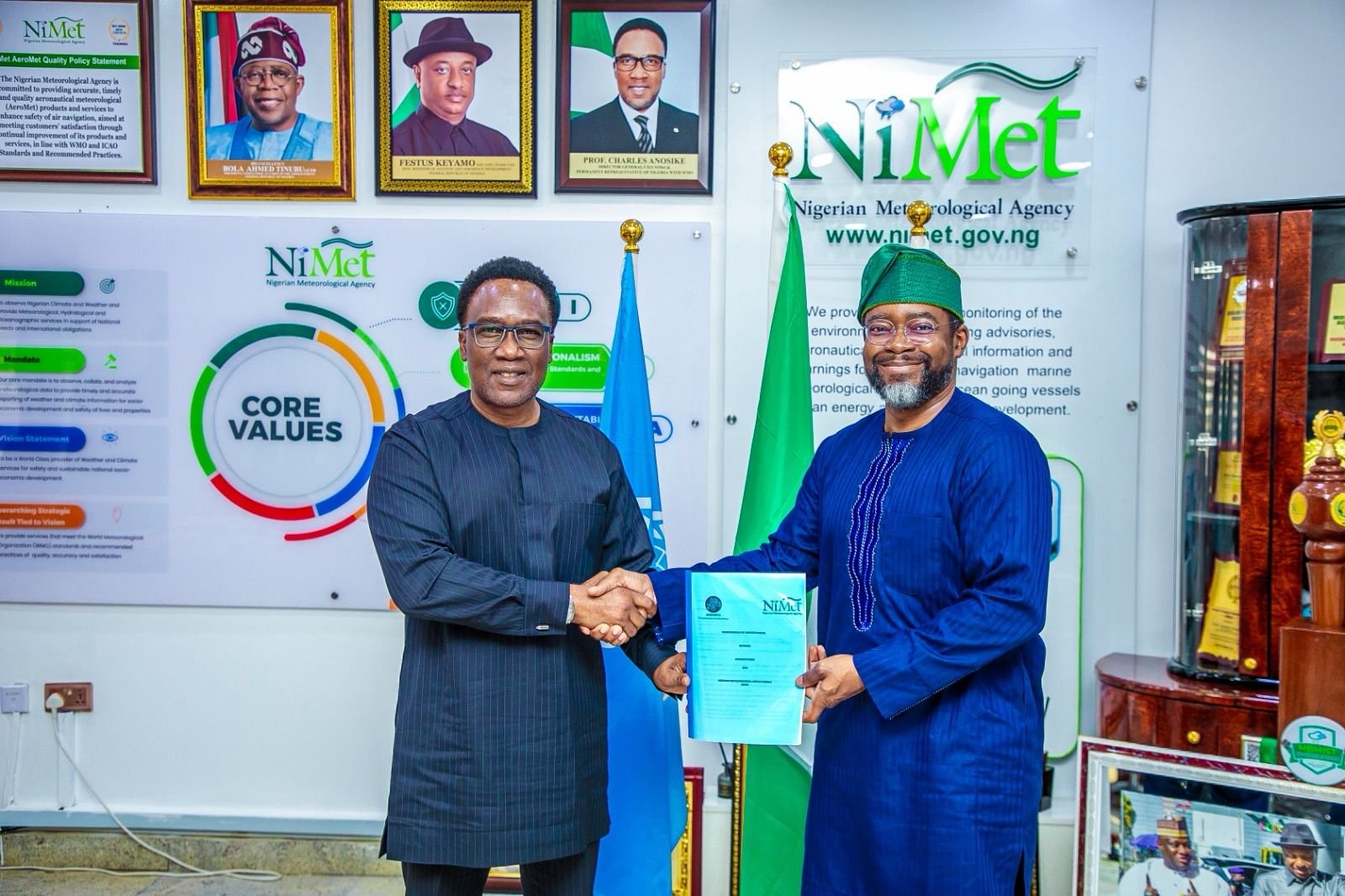

The Nigerian Meteorological Agency (NiMet) and Kigali-based pan-African non-profit research organization, AKADEMIYA2063, have formalised a strategic partnership aimed at strengthening climate monitoring, food security, and sustainable development across Nigeria and Africa.
The partnership was sealed through a Memorandum of Understanding (MoU) that will see both organisations collaborate on artificial intelligence (AI), big data analytics, research, and capacity development to improve the use of climate and agricultural data for decision-making.
The agreement follows a courtesy visit by the Managing Director of AKADEMIYA2063, Dr. Debisi Araba, to NiMet’s headquarters in Abuja, where he met with the agency’s Director General and Chief Executive Officer, Prof. Charles Anosike.
During the engagement, both organisations identified the need for stronger institutional collaboration to advance climate adaptation, strengthen food systems, and promote sustainable development. The discussions eventually led to an agreement to formalise their partnership through an MoU.
Speaking on the collaboration, Prof. Anosike reaffirmed NiMet’s commitment to providing reliable weather and climate services that support national development.
He noted that NiMet already has in-house expertise in the application of AI and machine learning to enhance data collection, analysis, and weather forecasting, adding that the new partnership would help expand research and innovation in critical areas.
According to him, the collaboration will support initiatives focused on drought monitoring, flood analysis, and agricultural planning, areas that are increasingly important to Nigeria’s efforts to strengthen food security and build resilience to climate change.
On his part, Dr. Araba said AKADEMIYA2063 is committed to strengthening Africa’s food systems by promoting climate resilience and developing a stronger data and knowledge ecosystem.
He highlighted persistent challenges facing many African countries, including inadequate agricultural data, limited analytical capacity, and weak links between research findings and public policy.
Araba stressed that addressing these challenges would require stronger knowledge infrastructure and improved mechanisms for translating research into practical, evidence-based policies that can deliver measurable development outcomes.
The NiMet-AKADEMIYA2063 partnership comes as part of NiMet’s broader efforts to deepen strategic collaboration and modernise its data and knowledge infrastructure.