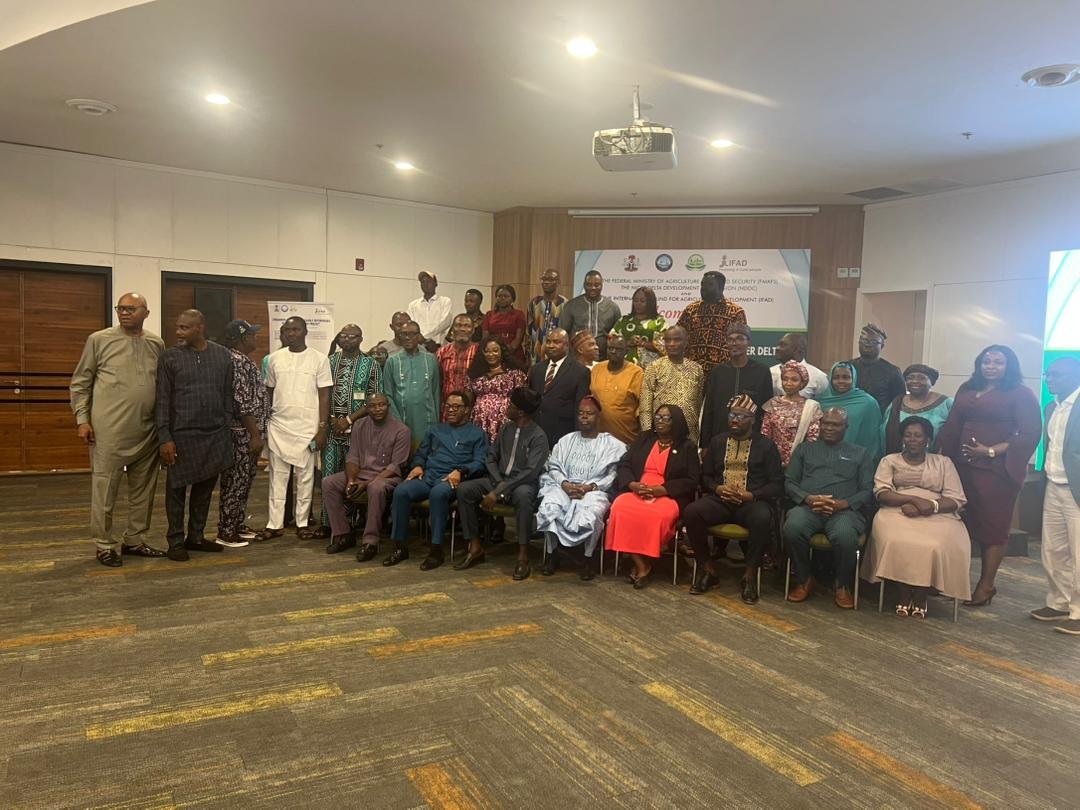

The Federal Government, the International Fund for Agricultural Development (IFAD) and the Niger Delta Development Commission (NDDC) have launched the 6th Joint Supervision Mission of the Livelihood Improvement Family Enterprises–Niger Delta (LIFE-ND) Project, with stakeholders pledging to consolidate the project’s gains and tackle implementation bottlenecks.
The mission was formally declared open on Tuesday in Abuja at an inception workshop attended by the IFAD Country Director, Dede Ekoue; the Director, Federal Department of Development Partners Projects and Projects Coordination Unit (PCU), Federal Ministry of Agriculture and Food Security, Dr Emmanuel Oladipo Akogun; the Director, International Economic Relations Department (IERD), Federal Ministry of Finance, Mr George Stanley; and the Director of Agriculture and Fisheries at the NDDC, Engr. Dr Albert Ehimhen Eigbe.
The exercise, which will run from September 1 to 30, 2026, is expected to assess the project’s implementation progress, review performance against set targets, identify bottlenecks and develop practical measures to strengthen its impact on rural women and youths across the Niger Delta.
Ekoue described the mission as a major milestone in the partnership between IFAD, the Federal Government and the NDDC, noting that it underscored their shared commitment to improving the livelihoods of rural women and youths through sustainable agribusiness development. She said the fifth supervision mission had shown significant progress, with LIFE-ND reaching more than 16,000 beneficiary households in 2025, over 90 per cent of its target,while supporting 966 incubators and facilitating the creation of 23,751 new enterprises.
She urged the IFAD team, Federal Government representatives, Niger Delta state governments and the NDDC to use the current mission to accelerate implementation, strengthen sustainability and scale up successful interventions, stressing that the project’s additional financing must translate into measurable and lasting improvements in the lives of beneficiaries.
Speaking on behalf of the Federal Ministry of Agriculture and Food Security, Akogun said LIFE-ND was designed to boost incomes, food security and job creation for rural women and youths through sustainable agri-enterprise development across nine Niger Delta states. He noted that since entering into force in February 2019, the programme had evolved into one of the ministry’s most impactful rural transformation initiatives, supporting agribusiness in priority commodities such as rice, cassava, plantain, oil palm, cocoa, poultry and fish through its Incubator-plus-Incubatee model.
Akogun disclosed that the project had reached more than 60,500 beneficiaries as of the most recent reporting period, with beneficiaries recording increased production, productivity and profitability, as well as improved access to financial services and better nutrition outcomes. He said LIFE-ND had now entered a three-year additional financing phase aimed at deepening agri-business incubation, strengthening rural producer organisations and expanding opportunities for apprentices and beneficiaries of business development services, and called on participants to openly identify challenges around staff capacity, institutional service delivery and financial reporting.
Representing the Federal Government as the borrower, Stanley said the mission would serve as a key mechanism for institutional accountability, risk management and value-for-money validation as LIFE-ND transitions into its additional financing phase running through 2028. He said the Federal Ministry of Finance was committed to ensuring that the additional capital invested in the project translated into tangible economic benefits at the grassroots, and urged stakeholders to address procurement, administrative and field-level bottlenecks to prevent further delays. He added that the ministry expected a candid, data-driven assessment backed by strict financial tracking and transparent reporting to justify Nigeria’s portfolio choices to both international lenders and citizens.
On his part, Eigbe reaffirmed the NDDC’s commitment to LIFE-ND, describing it as more than an agricultural intervention but a programme designed to create jobs, develop entrepreneurs, strengthen value chains, raise household incomes and promote agricultural enterprises across the Niger Delta. He said the project’s incubation model equips youths and women with skills, mentorship, productive assets and business opportunities to build sustainable agribusinesses, and noted that the NDDC’s involvement was driven by the need to convert the region’s agricultural potential into jobs and stronger local economies.
He said the initiative had also helped reduce youth unrest in the region, as more young people now saw the NDDC as a partner rather than an adversary, adding that some beneficiaries who started as incubatees had since progressed to becoming incubators, a sign, he said, of the programme’s potential to sustain impact beyond the life of direct project support.
Eigbe, however, identified the difficulty of reaching beneficiaries in remote hinterlands, creeks and riverine communities as an ongoing challenge, and urged participants in the supervisory mission to approach the exercise with openness, professionalism and a commitment to results.
The LIFE-ND Project is being implemented across nine Niger Delta states to improve rural livelihoods through sustainable agricultural enterprise development, with particular emphasis on women and youths.