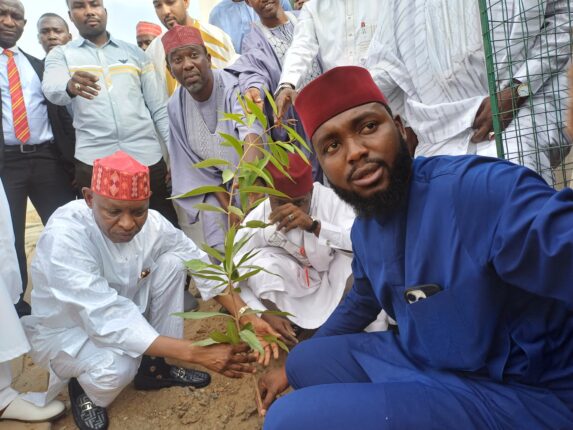

The Kano State Government has outlined significant achievements recorded in the agriculture sector and food security over three years, driven by investments in irrigation, mechanisation, farmer support, and livestock development.
The commissioner for agriculture and natural resources, Danjuma Mahmud, disclosed this on Tuesday during an interactive session with journalists in Kano while reviewing the ministry’s achievements and preparations for the 2026 wet season.
Mr Mahmud said the ministry established a comprehensive database of farmers across the state in line with Governor Abba Kabir Yusuf’s development blueprint.
According to him, the database provides accurate information on farmers, farm locations, sizes, and contact details, enabling government and development partners to plan and implement interventions effectively.
“We generated reliable data from the farm gate level and tested it through direct communication with farmers. We recorded an 82 per cent response rate, giving us confidence in the integrity of the database,” he said.
The commissioner said the database had strengthened collaboration with development partners, including the World Bank, the Islamic Development Bank, the African Development Bank, the European Union, and the International Fund for Agricultural Development.
He said the government had also improved agricultural infrastructure and productivity across the state.
“About 1,300km of cattle routes had been demarcated to reduce clashes between farmers and herders, while irrigation facilities were rehabilitated to restore over 1,230 acres of cultivable land,” he said.
Mr Mahmud said the state had recovered the Kadawa irrigation facility and returned it to state ownership to boost production.
He said more than 630 trucks of fertiliser had been procured and distributed over the last three years, with some consignments supplied free of charge to farmers.
“The state also benefited from federal government support through the provision of urea, SSP, and NPK fertilisers, many of which were distributed free. The ministry facilitated the construction of about 72km of rural roads to ease the movement of produce from farms to markets and storage facilities,” the commissioner added.
Mr Mahmud said the government had intensified livestock vaccination programmes and promoted climate-smart, drought-resistant, and early-maturing seed varieties to improve yields and resilience.
He said modern equipment, including tractors, combine harvesters, transplanters, spraying machines, and rice processing facilities, had been acquired and would soon be deployed.
“The state also secured solar-powered irrigation pumps to reduce farmers’ dependence on fossil fuels and enhance dry-season farming,” he said.
In the livestock sector, he said 20 milk collection centres equipped with storage and solar-powered facilities had been established in partnership with development partners to improve dairy production and marketing.
Mr Mahmud described the construction of a major irrigation dam at Tansosia as the state’s most ambitious irrigation project.
“The two-kilometre dam will store up to three billion cubic litres of water and irrigate about 1,250 acres upon completion. A 14km access road is being constructed to ease the evacuation of produce,” Mr Mahmud said.
He added that 11 small earth dams had been developed across Albasu, Shanono, Gari, Dawakin Kudu, Rogo, and Bichi, with a combined irrigation capacity of about 1,200 acres.
“Improved designs at some sites could expand the irrigable area to about 2,000 acres. An independent evaluation commissioned by the state government rated the ministry’s implementation of agricultural targets at about 80 per cent.
The assessment was conducted using the milestones, benchmarks, and key performance indicators in the administration’s development blueprint. We are encouraged by the outcome and remain committed to achieving greater results in productivity, food security, and poverty reduction,” he said.