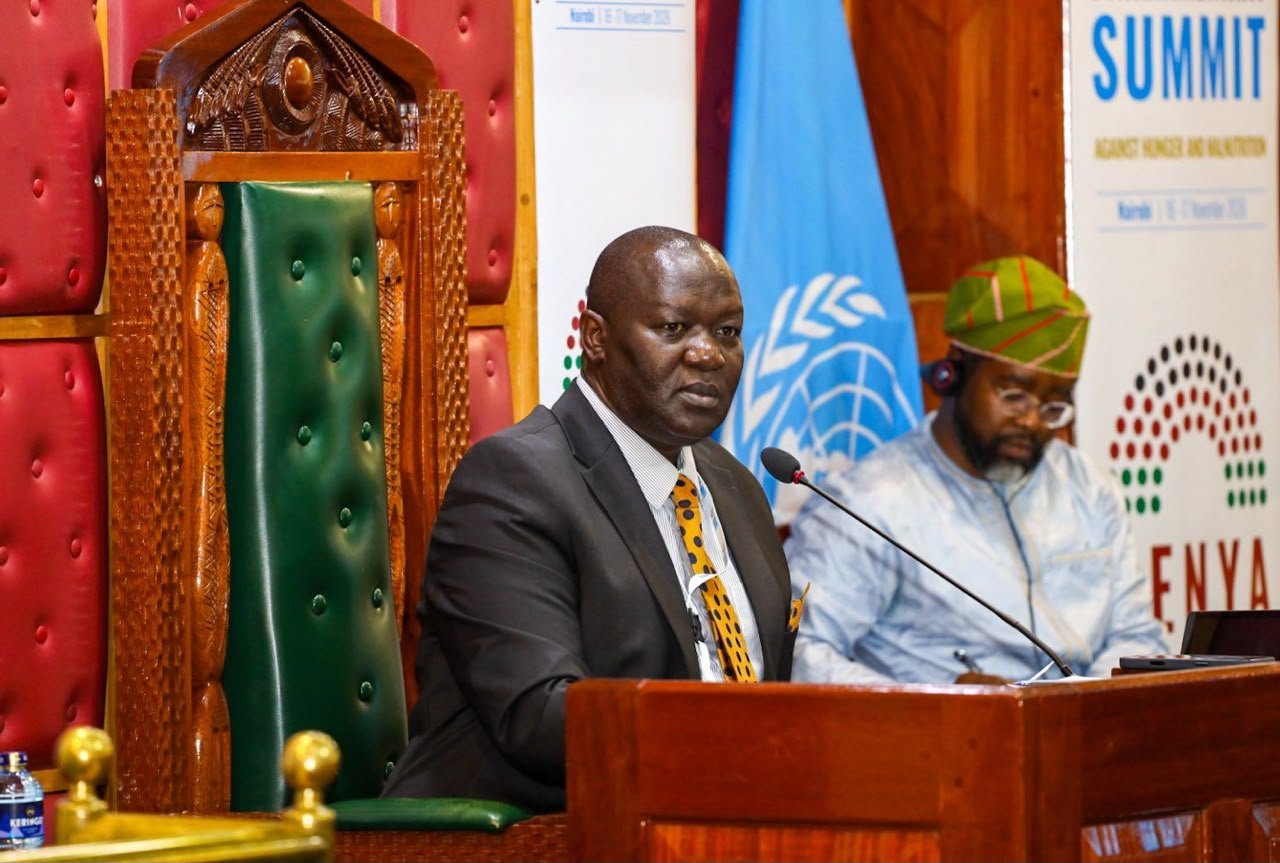

The Managing Director of AKADEMIYA2063, Dr Debisi Araba, has called on African governments to mainstream climate resilience into agricultural budgets, legislation and public spending, warning that escalating climate shocks could deepen food insecurity and worsen economic inequalities across the continent.
Araba made the call at the Third Global Parliamentary Summit against Hunger and Malnutrition, held at the Parliament of Kenya in Nairobi, where he urged African leaders and legislators to translate existing policy commitments into coordinated action, sustained financing and evidence-based investments.Citing the 2025 State of Food Security and Nutrition in the World (SOFI) report, he noted that approximately 645 million people were experiencing hunger globally, with Africa projected to account for 56 per cent of the world’s hungry population by 2030.
He warned that intensifying climate shocks, including forecast El Niño conditions in 2026 and 2027, could further undermine agricultural productivity, food availability and affordability if governments failed to strengthen the resilience of their food systems. According to Araba, Africa’s average temperature has increased by approximately 0.3°C per decade since 1991, while climate-related damages reached an estimated $8.5 billion in 2022, affecting more than 110 million people.
He also cited research conducted by AKADEMIYA2063 in Rwanda, which indicated that climate change had reduced the country’s projected Gross Domestic Product by 4.6 per cent, with agriculture accounting for 70 per cent of the losses. The research further showed that poor rural households experienced a 7.7 per cent decline in consumption, compared with 1.7 per cent among wealthier urban households.
Describing the broader socioeconomic consequences of climate change, Araba said, “Climate change is a hunger multiplier. It is also an inequality multiplier.” He explained that climate-related disruptions extend beyond agricultural production, affecting household incomes, purchasing power, access to nutritious food and the livelihoods of vulnerable populations. Despite existing continental commitments, Araba observed that progress in strengthening climate resilience across Africa remained below expectations.
Referencing the final Malabo-era Comprehensive Africa Agriculture Development Programme (CAADP) Biennial Review, he said African countries recorded an average score of 6.3 out of 10 on resilience to climate variability, against a benchmark of 9.55. None of the 45 reporting countries achieved the overall Malabo Declaration benchmark.
He identified fragmented government policies, inadequate financing and limited access to timely research as major obstacles to implementation, noting that climate, agriculture and nutrition programmes frequently operate under separate ministries with disconnected priorities, plans and budgets. “We are rich in commitments. We are poor in three things: coherence, money, and knowledge that reaches decision-makers in time,” he said. On climate financing, Araba disclosed that agrifood systems receive just under $95 billion annually, representing approximately seven per cent of global climate finance, despite an estimated annual requirement of $1.1 trillion by 2030.
He added that only 14 per cent of the financing goes towards adaptation, while Sub-Saharan Africa receives less than $8 billion. To bridge the gap, he urged legislators to strengthen oversight of agricultural, water and nutrition budgets by examining climate adaptation allocations and demanding measurable evidence of resilience outcomes. He also advocated closer coordination among government ministries to ensure that climate, agriculture and nutrition policies are implemented through aligned targets, financing frameworks and development plans. Araba further called on African governments to honour the Kampala CAADP Declaration’s commitment to allocate at least 10 per cent of public expenditure to agrifood systems.
The declaration sets additional targets for 2035, including placing 30 per cent of agricultural land under sustainable management, protecting 40 per cent of households against shocks and ensuring that 60 per cent of the population can afford a healthy diet.
Highlighting Kenya’s National Agri-Food Systems Investment Plan for 2026–2030, valued at approximately 1.08 trillion Kenyan shillings, Araba described coordinated investment as an important pathway for translating continental commitments into practical national programmes.
The financing framework comprises approximately one-third government contributions, nearly half from the private sector and the remainder from development partners. He also emphasised the importance of research, innovation and technology in strengthening agricultural planning, citing AKADEMIYA2063’s Africa Agriculture Watch platform, which uses satellite data and machine learning to forecast staple crop production across nearly 50 African countries.
Another initiative, GAMA, applies artificial intelligence and Earth observation technologies to monitor agricultural adaptation. Araba disclosed that AKADEMIYA2063, the African Food Systems Parliamentary Network and the Shamba Centre for Food and Climate were developing the African Repository for Parliamentary Action (ARPA), a platform designed to provide legislators with accessible research, policy briefs, data and opportunities for collaboration.
The initiative will draw on the African Growth and Development Policy Modelling Consortium (AGRODEP), a network of nearly 300 African economic modellers, to strengthen evidence-based parliamentary engagement. Calling for greater investment in shared research and data infrastructure, Araba urged development partners and foundations to support systems that enable governments to make informed decisions on climate financing and agricultural development.
“The highest-return climate investment you will ever make is in the evidence that tells a government where to spend its next dollar. Fund the systems, not only the projects,” he said. He maintained that addressing hunger and malnutrition requires more than increasing food production, stressing that agricultural sustainability, responsible natural resource management and households’ capacity to withstand climate shocks must remain central to government policies and investment decisions.