
The Federal Government has expressed its readiness to enact a legal framework for protecting endangered species in the country to address the risk of extinction.
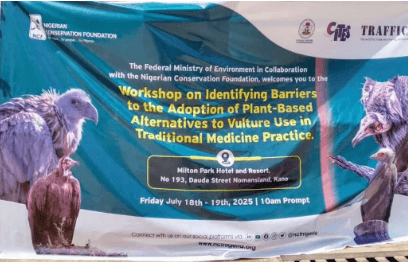
The Director of the Forestry Department, Federal Ministry of Environment, Dr Ama Moses, said this during a two-day workshop on ‘Reducing Demand for Vultures in Traditional Medicine Practices’, on Friday in Kano.
Speaking at the workshop organised by the ministry in collaboration with the Nigerian Conservation Foundation (NCF), the director said that the bill had been passed by the National Assembly and would be signed into law soon.
Represented by a staff member in the ministry, Tijjani Zakirai, he said when the law is enacted, the legislation would prescribe stiffer penalties for those involved in hunting endangered species to serve as a tool to curb wildlife trade.
Moses said that the Federal Government had taken several measures to address the menace, such as the development of a National Vulture Conservation Plan aimed at reversing the declining population of vultures.
He added that other measures included nationwide awareness, education, and sensitisation campaigns, as well as stakeholder engagement on the ecological importance of vultures.
In his remarks, the Director-General of NCF, Dr Joseph Onoja, represented by the Species Programme Lead, Dr Stella Egbe, said the forum provided an opportunity to promote vulture conservation efforts across the country.
In his welcome address, NCF Northern Zonal Coordinator, Alhaji Garba Boyi, said the engagement aimed to bring stakeholders together to strategise on reducing threats to endangered species.
Also, Special Adviser to Gov. Abba Yusuf on Wildlife Conservation, Alhaji Ahmad Sawaba, said the state government was honoured to host the event, which aimed at protecting endangered species nationwide.
The workshop, themed ‘Reducing the Demand for Vultures in Belief-Based Use Practices’, feature paper presentations and was attended by traditional healers, herbal medicine practitioners, conservation groups, NGOs, government agencies, and the media.