
by Hassan Samuel
The United Nations has urged the Nigerian government to move beyond policy pronouncements and strengthen the actual implementation of gender-responsive agricultural policies, as the country prepares to mark the International Year of the Woman Farmer (IYWF) 2026.
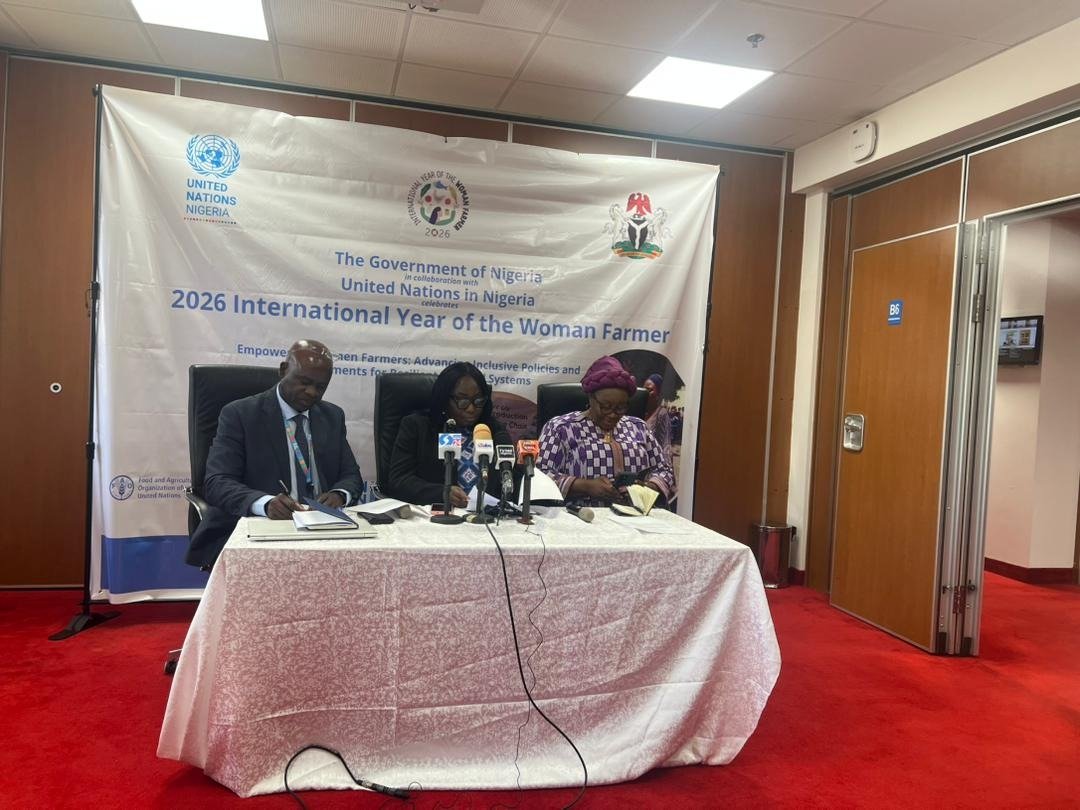
The call was made on Monday in Abuja at a press conference ahead of Nigeria’s activities to commemorate the International Year of the Woman Farmer (IYWF) 2026, proclaimed by the United Nations General Assembly to recognise the critical contribution of women farmers to food security, nutrition, poverty reduction and sustainable agrifood systems.
Speaking at the event, the FAO Nigeria Country Representative, Dr Hussein Gadain, represented by Jimmy Owani, Programme Officer, said the observance was not merely ceremonial but a global call to action to dismantle the inequalities that continue to limit women’s productivity and economic potential in agriculture.
He noted that although women remain central to Nigeria’s agrifood systems as farmers, livestock keepers, fish farmers, processors and traders, they continue to face structural barriers, including limited access to land, finance, technology, agricultural inputs, extension services and decision-making opportunities. He described investment in women farmers as both a matter of equity and a strategic necessity, stressing that closing these gaps translates directly into higher agricultural productivity, improved household incomes, stronger nutrition outcomes and greater community resilience to climate and other shocks.
Gadain said FAO had been working with federal and state governments, women farmers’ associations, research institutions and development partners to advance women’s empowerment through climate-smart agriculture, livelihood diversification, value addition, market linkages, financial inclusion and skills development. However, he urged stakeholders to move from recognition to action, calling specifically for increased investment in women-led agrifood enterprises, improved access to land and technology, stronger extension services, and expanded participation of women in agricultural governance and decision-making.
In her remarks, the UN Women Country Representative to Nigeria and ECOWAS, Beatrice Eyong, said women account for a significant share of the labour involved in food crop production, processing and distribution in Nigeria, yet continue to operate within structural constraints that prevent them from reaching their full potential.
“Though women provide about 70 per cent of the labour in agriculture, they continue to face structural constraints and obstacles that prevent them from performing to their full potential,” Eyong said.
She identified access to land as one of the most significant challenges, stressing that the problem goes beyond ownership or control to basic access to productive farmland.
The situation, she added, is being compounded by climate change, which is increasingly pushing women away from fertile agricultural land, raising their workload while reducing productivity.
Eyong also identified limited access to agricultural knowledge and extension services as a major constraint, noting that gender and cultural barriers in rural communities could sometimes prevent women from benefiting fully from extension programmes.
She said restrictions also exist around women’s access to technology, finance and markets, while social norms can limit their ability to travel for economic activities without the permission of their husbands.
Underscoring what effective implementation can achieve, the IFAD Country Director, Dede Ekoue, cited results from UN-supported projects that reached more than 100,000 women in Nigeria, backed by about $47 million in investments incorporating targeted inclusion thresholds. She said the International Year offers an opportunity to shift the narrative around women from passive beneficiaries of agricultural interventions to producers, entrepreneurs, innovators, leaders and key economic actors.
Ekoue disclosed that more than 221 market, processing and storage facilities were constructed or rehabilitated in 2025, while over 4,500 units of smart technology and clean-energy equipment were distributed to improve productivity, processing and value addition. She added that more than 87,888 women now belong to supported rural producer organisations, and that 82 women State Apex Leaders across 16 states had received leadership training to strengthen their participation in cooperative and community decision-making.
She further stated that about 21,015 hectares of land had been rehabilitated and placed under climate-resilient practices, with roughly 6,500 hectares facilitated specifically for women and youth.
On financial inclusion, she said about ₦465 million had been mobilised in savings among 21,498 active savers, while clean-energy interventions had provided biodigesters and related equipment to more than 780 rural women households across six states.
Ekoue stressed that these interventions were not designed merely to increase women’s participation in agriculture on paper, but to change the actual conditions under which they participate, enabling them to own productive assets, access finance and technology, build profitable enterprises and exercise genuine leadership. She framed this as the kind of on-the-ground implementation that government policy must now be scaled to match.
Meanwhile, the UN disclosed that its investments target 48–50 per cent women beneficiaries, 30 per cent youth and five per cent persons with disabilities.