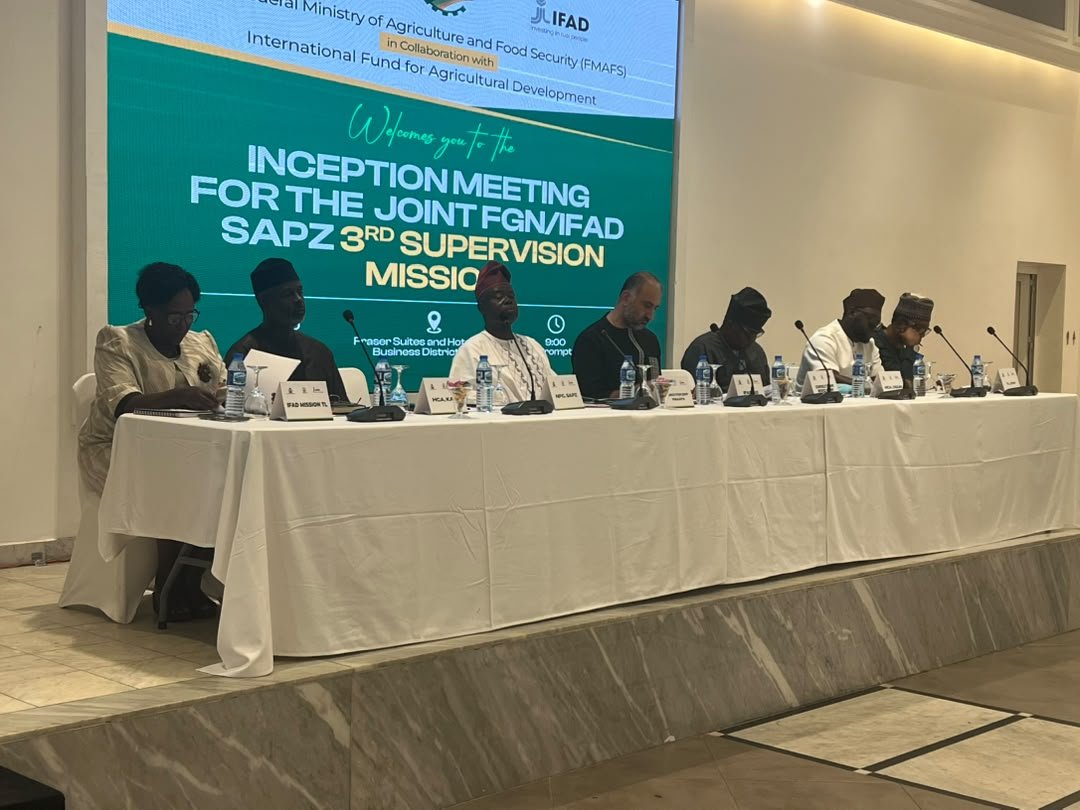

The Federal Government of Nigeria and the International Fund for Agricultural Development (IFAD) have commenced the third joint supervision mission of the Special Agro-Industrial Processing Zones (SAPZ) Programme, with a renewed push to accelerate implementation, address bottlenecks and deliver tangible benefits to beneficiaries.
The mission was formally launched at an inception workshop on 24 November in Abuja, as the programme prepares for its first Additional Financing and Mid-Term Review.
Speaking on behalf of the Federal Government, the Director of the Federal Department of Development Partners Projects at the Federal Ministry of Agriculture and Food Security, Dr. Emmanuel Oladipo Akogun, described the mission as a critical opportunity to review implementation progress, assess results and strengthen accountability.
He said the mission would provide a strategic window to examine activities, contracts, disbursements, outcomes and sustainability arrangements, while identifying areas requiring urgent attention to improve programme delivery.
Akogun noted that SAPZ is a collaborative initiative involving the Federal Government, IFAD, the African Development Bank (AfDB), the Islamic Development Bank (IsDB), state governments and private investors, aimed at developing integrated agro-industrial platforms to attract investments, create jobs, reduce rural poverty, promote import substitution and increase agriculture’s contribution to the national economy.
IFAD’s $50 million financing for the programme was approved by its Executive Board in December 2021 and signed on 8 July 2022. The intervention supports implementation in Ogun and Kano States, focusing on rice and cassava value chains, with a target of 100,000 direct and 500,000 indirect beneficiaries, particularly women and young people.
Akogun highlighted progress recorded in Kano State, where a pilot intervention in 2024 supported more than 1,000 smallholder farmers and farmer organisations through input provision, market linkages and capacity development. He said the programme is now scaling up implementation in the state, while activities in Ogun State are being strengthened through an accelerated implementation plan informed by lessons from the December 2024 Accelerated Implementation Support Mission.
The ongoing supervision mission is expected to assess progress against the programme’s logical framework, review the implementation of recommendations from the previous mission, identify best practices and lessons, and address operational bottlenecks. It will also update the Procurement Risk Matrix and Integrated Project Risk Matrix, culminating in a supervision report, Aide-Memoire and wrap-up debriefing.
Field visits are scheduled to take place from 25 November to 2 December as part of the mission’s assessment of implementation progress and beneficiary-level outcomes.
Akogun noted that the initial loan implementation period runs until 30 September 2029, with financial closure scheduled for 31 March 2030, stressing that decisions taken during the mission would be crucial to maximising the remaining implementation period.
The IFAD Country Director, Mohamed El-Ghazaly, acknowledged progress in establishing institutional structures, strengthening partnerships, supporting value-chain development and expanding beneficiary engagement.
He said although progress had been made in addressing recommendations from the previous supervision mission, the number of outstanding and partially implemented actions underscores the need for stronger implementation discipline, better coordination and timely decision-making.
El-Ghazaly urged stakeholders to shift their focus from implementation processes to measurable outcomes, stressing that programme investments must translate into functional infrastructure, stronger value chains, commercially viable enterprises, improved market access and tangible benefits for beneficiaries.
He emphasised that the programme’s success should not be measured merely by completed activities or expenditure, but by its ability to establish sustainable systems and economic opportunities that continue to benefit communities beyond the programme’s lifespan.
Describing the mission as more than a routine implementation review, the IFAD Country Director called on stakeholders to approach the exercise with openness, candour and a shared commitment to results, while urging the mission team to prioritise beneficiary experiences during field visits.
He also underscored the importance of effective coordination among the Federal Government, IFAD, AfDB and IsDB in resolving cross-institutional challenges and accelerating implementation.
The SAPZ National Project Coordinator, Dr. Kabir Yusuf, commended the commitment of the Federal Government and development partners to the programme, describing SAPZ as a strategic intervention to unlock agricultural productivity and strengthen linkages between farming, processing, market infrastructure and private-sector investment.
Yusuf said the programme’s ambition extends beyond increasing agricultural production to developing viable agro-industrial ecosystems capable of generating employment, improving livelihoods, reducing post-harvest losses and stimulating rural economies, while creating sustainable opportunities for smallholder farmers, women and youth.
He stressed that achieving these objectives would depend on the quality, pace and effectiveness of implementation, noting that the supervision mission provides an opportunity to assess performance, consolidate gains, address emerging constraints and identify actions required to strengthen delivery.
Yusuf expressed optimism that the mission’s recommendations would help translate the programme’s objectives into measurable outcomes for beneficiaries and participating states.